
Font size
 Worksheets
S3 2nd UT revision
Total questions: 47
Worksheet time: 54mins
Most metals in Earth's crust are found in rocks. Such rocks are called (a) .
The discovery and use of metals are related to their (a) and ease of extraction.
The discovery and use of metals are related to their availability and ease of (a) .
Gold exists as an (a) in Nature. It is easy to extract. It was the first metal used by humans. However, its abundance is very low on Earth, so it was not widely used.
For metals that exist as elements in Nature, we may extract them from their ores by (a) methods (物理方法).
Although aluminium is the most abundant metal on Earth, it is (a) to extract from its ores. Humans learnt how to use it at a later stage in history.
We need to use (a) methods (化學方法) to extract metals that exist as compound in Nature.
Some metals, such as copper and iron, need to be extracted from their oxides by heating with (a) .
An alloy is made by adding other elements to a (a) . The elements added can be one or more than one metals or non-metal.
Match the alloy and its uses in the table below.
Bronze
Making Statue
Brass
Making musical instrument
Stainless Steel
making cooking utensil
Carat gold
making jewellery
Titanium Alloy
Aircraft engine
Crude oil is a black, thick and smelly liquid. It is one of the main (a) sources in the world.
Crude oil is a mixture of many different (a) (炭烃化合物). These compounds contain hydrogen and carbon atoms only.
Hydrocarbon molecules made up of more hydrogen and carbon atoms have (a) sizes.
To use crude oil effectively, we need to separate the different hydrocarbons in it. Processing crude oil in this way is known as (a) (精炼).
Smaller hydrocarbons have (a) boiling points. Larger hydrocarbon have (b) boiling point
Hydrocarbons in crude oil can be separated into fraction (馏份) based on the differences in (a) .
Hydrocarbon are separated by a method called (a) based on the different of their boiling point
The table below compares the physical properties of fractions with different sizes of hydrocarbon molecules. Circle the correct answers.
The physical properties of hydrocarbons are related to their (a) .
In an oil refinery (炼油厂), fractional distillation of crude oil is carried out in a fractionating tower (分馏塔). The higher levels are (a) than the lower levels.
Smaller hydrocarbons condense at (a) , cooler levels.
Hydrocarbons of different sizes have different __________ ____. They are collected at different levels.
(a)
Larger hydrocarbons condense at lower, (a) levels.
Most plastics are made from chemicals derived from one of the crude oil fractions — (a) .
General process of making polyethene from naphtha: The process of joining many small molecules to form a macromolecule is called (a) .
The small molecules are called (a) while the macromolecules formed are called (b)
Match the plastics below with their uses by writing a to e in the spaces provided.
Polyethene (PE)
bags, food wraps and bottles
Polyvinyl chloride (PVC)
raincoats, water pipes
Expanded polystyrene (polystyrene foam)
disposable food containers
Perspex (acrylic )
aircraft windows, safety spectacle
Polypropene (PP)
ropes and reusable shopping bags
To reduce the environmental problems caused by the use of metals and plastics by practising the 4 Rs principle: __________ (减少使用), __________ (重复使用), __________ (在循环使用), and __________ (循环再造).
Objects that give out light of their own are called (a) , Objects that do not give out light are called (b) .
Classify the following objects into luminous objects and non-luminous objects: smartphone screen, red hot charcoal, LED scoreboard, firefly, diamond, sunflowers.
smartphone screen
red hot charcoal
LED scoreboard
firefly
diamond
sunflowers
Light travels in (a) lines.
We draw (a) (光线图) to show how light travels.
We use a set of light rays to represent a light beam. Identify the kind of light beam shown in each of the diagrams below.

Parallel
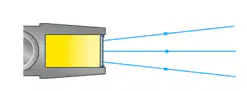
divergent
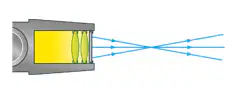
convergent
- Light rays from a point on a near object are (a) . - Light rays from a point on a distant object are (b) .
Label the diagram
Angle of reflection
Incident ray
normal
reflected ray
Angle of incidence
Nature of images formed by plane mirror The image formed by a plane mirror is: - __________ (the same size / of different size) as the object; - __________ (upright/inverted); - a __________ image (虚像); - located __________ (in front of / behind) the mirror with the image distance __________ (the same as / different from) the object distance.
Draw the ray diagram

Light __________ (does / does not) bend when it enters along the normal.
does
does not
Label the ray diagram
angle of refraction
angle of incidence
Incident Ray
normal
refracted ray
Light bends __________ (towards / away from) the normal when it enters the transparent medium from air.
towards
away from
Light bends __________ (towards / away from) the normal when it exits the transparent medium into air.
towards
away from
When light enters a medium from air at an angle, it bends __________ (more / less) if the medium has a higher refractive index.
more
less
Light bends ______ (away from / towards) the normal when it enters a medium of higher refractive index at an angle.
away from
towards
Light bends ______ (away from / towards) the normal when it enters a medium of lower refractive index at an angle.
away from
towards
For total internal reflectionto occur, both of the following conditions must be satisfied: - Light travels from a medium of (a) refractive index to a medium of (b) refractive index, e.g. from glass to air. - The angle of incidence is (c) than the (d) angle (臨界角).
(a) can act like mirrors. When the angle of incidence is greater than the critical angle, light is totally reflected at the inside faces.
When a person underwater looks up the water surface at an angle ______ (larger / smaller) than the critical angle, the water surface totally reflects light from underwater objects to his eyes.
larger
smaller

