wayground logo

Free Printable Worksheets

Font size

S
M
L
XL
Worksheets

Evidence of Evolution, Cladogram and Population Growth

Total questions: 40

Worksheet time: 1hrs 5mins
Name
Class
Date
1.
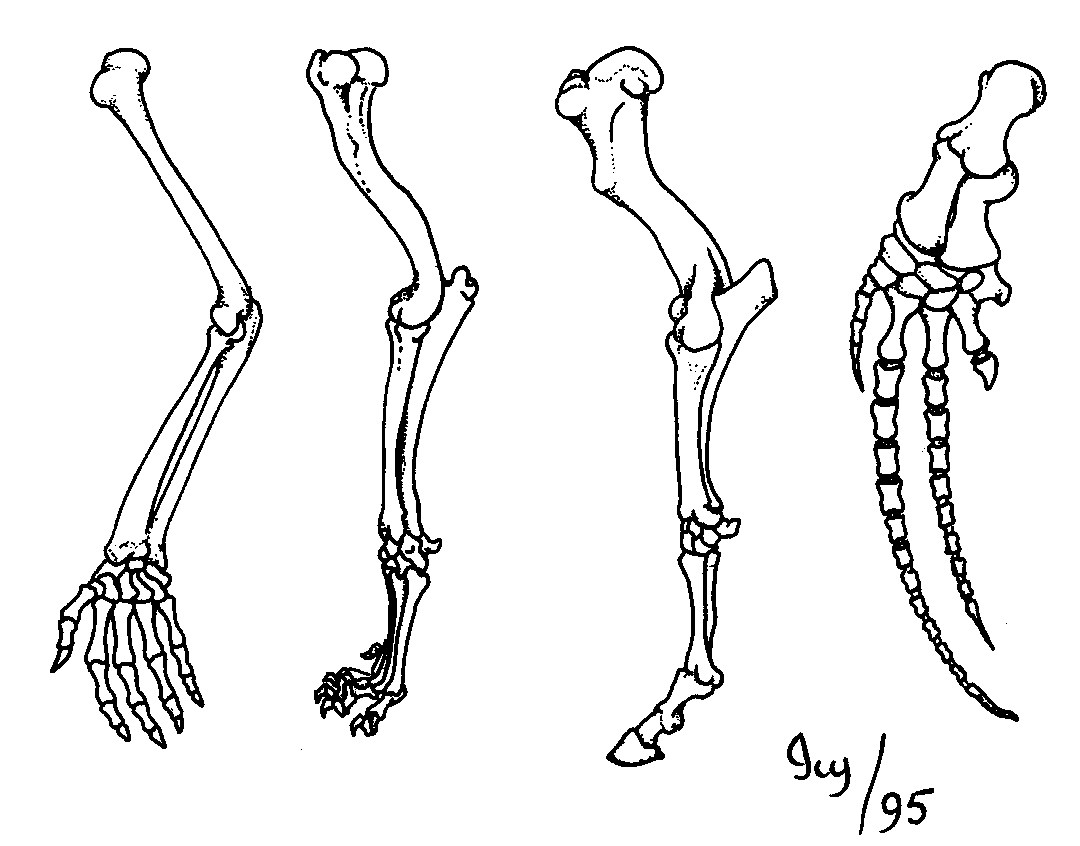
Structures with the same parts have different functions; suggests that organisms share a common ancestry
a)
vestigial structures
b)
homologous structures
c)
adaptive radiation
d)
fossil
2.
Study of embryos of various organisms to show a common ancestor because of similarities in development
a)
natural selection
b)
embryology
c)
speciation
d)
evolution
3.
Some organisms that share a common ancestor have features that have different functions, but similar structures.  These are known as
a)
vestigial structures
b)
analogous structures
c)
homologous structures
d)
fossil structures
4.
How do fossils provide evidence that evolution has happened on Earth?
a)
Fossils show how the sizes of certain animals has changed drastically over millions of years
b)
Fossils show that some species have gone extinct
c)
Fossils show how life forms present today are different than those from the past
d)
Different sedimentary rock layers provide evidence for how the environment has changed over time
5.
The diagram illustrates an embryonic stage of two organisms.

Which of the following can be determined by observing the embryos shown in the diagram
a)
The organisms share a common ancestry.
b)
The organisms belong to the same genus.
c)
The organisms are native to the same geographic areas.
d)
The organisms will grow into anatomically similar adults.
6.
Humans, birds, whales, and lizards all have similar arm bones. What is the reason for this?
a)
The function of these bones is the same in all animals
b)
They live in similar environments
c)
They have a common ancestor
d)
All organisms resemble humans
7.

Vestigial structures

a)

structures that perform a similar function but are not similar in origin

b)

remnants of once-important structures that have slowly lost all or most of their function

c)

features found in different organisms that share structural similarities but may have very different functions

d)

preserved remains of an organism

8.
Which layer is the youngest
a)
1
b)
2
c)
3
d)
4
9.
The changes of species over time
a)
Embryonic 
b)
Natural selection 
c)
Mimicry 
d)
Evolution 
10.

The picture shows a/an ___________

a)

homologous structure

b)

vestigial structure

11.

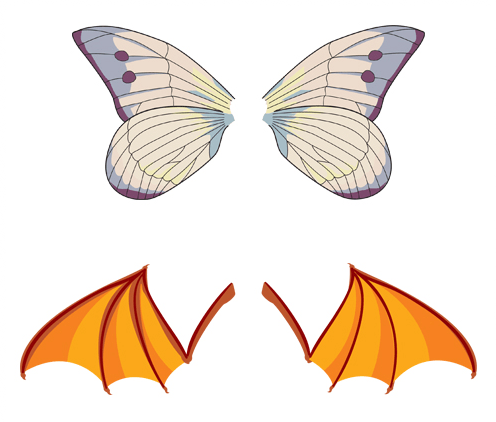
What is this an example of?

a)

Homologous structure

b)

Analogous structure

c)

Vestigial organs

d)

Functional adaption

12.
Study of embryos of various organisms to show a common ancestor because of similarities in development
a)
natural selection
b)
embryology
c)
speciation
d)
evolution
13.
How do fossils provide evidence that evolution has happened on Earth?
a)
Fossils show how the sizes of certain animals has changed drastically over millions of years
b)
Fossils show that some species have gone extinct
c)
Fossils show how life forms present today are different than those from the past
d)
Different sedimentary rock layers provide evidence for how the environment has changed over time
14.
The diagram illustrates an embryonic stage of two organisms.

Which of the following can be determined by observing the embryos shown in the diagram
a)
The organisms share a common ancestry.
b)
The organisms belong to the same genus.
c)
The organisms are native to the same geographic areas.
d)
The organisms will grow into anatomically similar adults.
15.

What best describes the hind leg bones seen in the whale?

a)

The bones are analogous structures to the fins of living fish.

b)

The bones are vestigial structures that had a function in an ancestor.

c)

The bones are homologous structures to the wings of butterflies.

d)

The bones are fossil structures from an extinct ancestor.
16.
Which layer is the youngest
a)
1
b)
2
c)
3
d)
4
17.
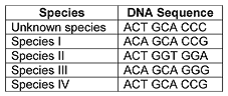
If two organisms have similar traits of DNA they are probably
a)
share a common ancestor
b)
share a common environment
c)
share a common population
d)
speciation
18.
According to this data, the unknown bacterial species is most closely related to: 
a)
Species I
b)
Species II
c)
Species III
d)
Species IV
19.

What type of evidence is shown with the diagram above?

a)

Molecular

b)

Anatomical

c)

Embryological

d)

Fossil

20.

Match the following

a)

Analogous Structure

1.

Same function different structure

b)

Homologous Structure

2.

Same structure different function

c)

Comparative Embryology

3.

Comparing embryological development of different species

d)

Biochemical Evidence

4.

Comparing DNA and amino acid sequences of different species

e)

Vestigial Structures

5.

Structures in the body of an organism that no longer work.

21.
Which is not evidence for evolution?
a)
many animals have homologous structures due to common ancestry
b)
Many animals have vestigial structures from an ancestor
c)
We can observe changes in life forms by observing the fossil record
d)
All of these are evidence for evolution
22.
If two organisms have similar traits of DNA they are probably
a)
share a common ancestor
b)
share a common environment
c)
share a common population
d)
speciation
23.
Which species’ DNA is most similar to the DNA of the toothed whale? 
a)
Hippopotamus 
b)
Baleen Whale
c)
Grazing Mammals
d)
Camels
24.

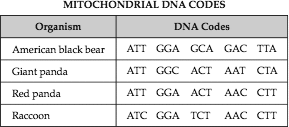
What conclusions can be made based on this table shown?

a)

the American black bear and the giant panda are most closely related

b)

the giant panda and the red panda are most closely related

c)

the red panda and the racoon are the most closely related

d)

the giant panda and the racoon are most closely related

25.
The picture shows the members of the Camelidae family. The physical features and the geographical origin of these animals provide evidence that - 
a)
they live in the same type of environment.
b)
have slowly evolved to become herbivores.
c)
have a common ancestor.
d)
exchanged DNA in the past.
26.

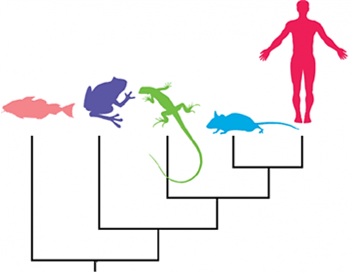
What is the human most closely related to?

a)

Fish

b)

mouse

c)

Salamander

d)

Human

27.

Where is the alligator and T. rex's common ancestor?

a)

Point A

b)

Point B

c)

Point C

d)

Point D

28.
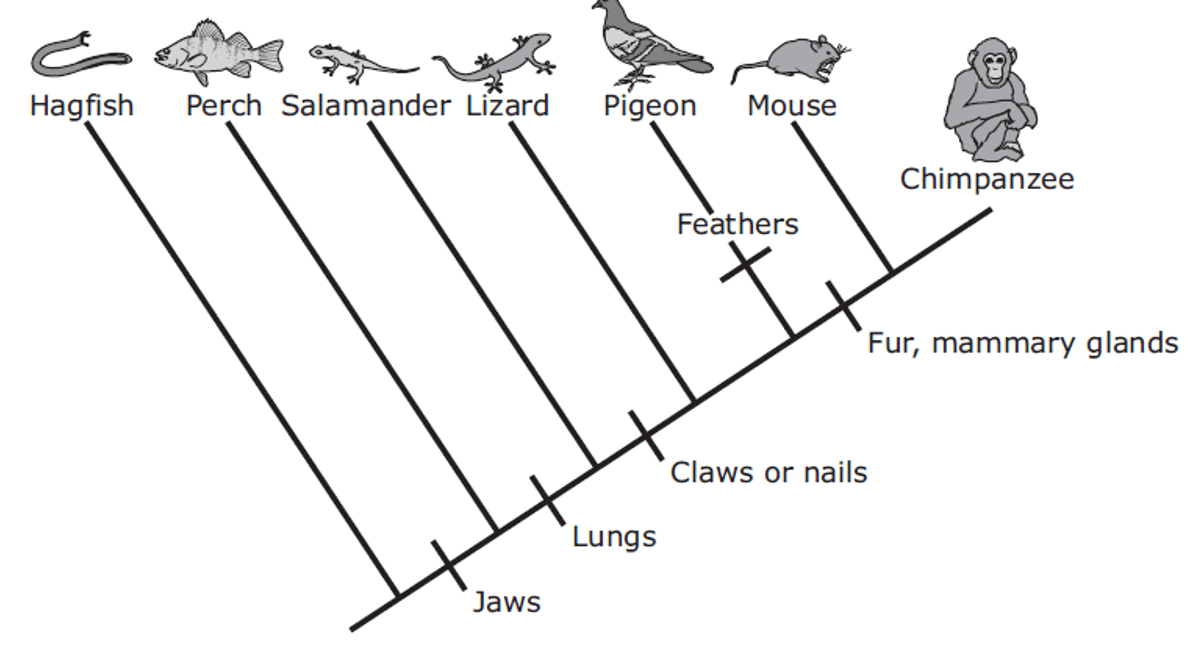
All the animals to the right of the hagfish would have the common characteristic of -
a)
Fur
b)
Claws or nails
c)
Lungs
d)
Jaws
29.

What do amphibians, birds, prosimians and humans all have in common? Check all that apply.

a)

Hair

b)

Endothermic

c)

Eukaryotic

d)

Tetrapod

e)

Vertebrate

30.

At what population was carrying capacity met?

a)

250

b)

1000

c)

400

d)

720

31.

Exponential population growth can be described as

a)

growth when resources are limited

b)

a j-shaped curve

c)

a s-shaped curve

d)

growth that reaches carrying capacity

32.

What limits Population Growth?

a)

birth rates increasing

b)

resources being used up

c)

natural selection taking place

d)

none of the above

33.

Which country will have the most rapid population growth?

a)

Sweeden

b)

United States

c)

Mexico

d)

None

34.

Density-independent limiting factors to population growth includes

a)

stress from overcrowding

b)

parasitism

c)

competition

d)

natural disasters

35.

Exponential Growth occurs when-

a)

populations have plenty of food/space

b)

home to keystone species

c)

have few evasive species in a habitat

d)

have little to no competition or predators

36.
The largest number of individuals in a species that an environment can support long term
a)
carrying capacity
b)
emigration
c)
immigration
d)
population density
37.
The graph of logistic growth can be described as...
a)
S-shaped
b)
J-shaped
c)
U-shaped
38.

Factors that affect population size:

INCREASE: Number of ___________ & ____________


(Choose 2 answers)

a)

Birth

b)

Death

c)

Immigration

d)

Emigration

39.

Factors that affect population size:

DECREASE: Number of ___________ & ____________


Choose all that applies.

a)

Birth

b)

Death

c)

Immigration

d)

Emigration

40.

A small island nation is tracking its total population.  It started with exactly 100 people. During the year, 10 people immigrated, while 20 emigrated.  The birth rate was 15, and the death rate was 5.  What is the new population of the country?

a)

115

b)

110

c)

90

d)

No change; the population is still 100.