
Font size
 Worksheets
7AE_Chemistry End-term test
Total questions: 28
Worksheet time: 39mins
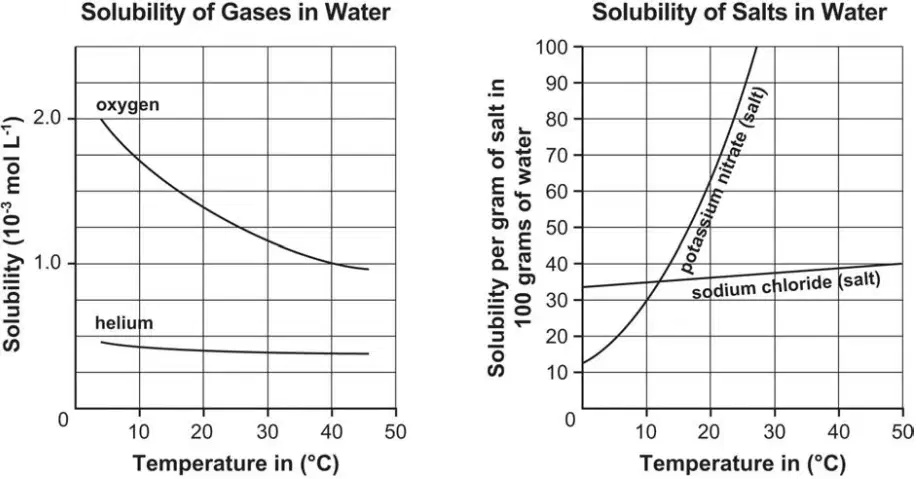
A student added four substances to water placed in separate glass containers. She recorded the solubility of the substances as the temperature of the water was heated and graphed the results.
What do the graphs she created help demonstrate?
The solubility of solids and gases in water increases as the temperature increases.
The solubility of solids and gases in water decreases as the temperature increases.
The solubility of solids in water increases, but the solubility of gases decreases as the temperature increases.
The solubility of solids in water decreases, but the solubility of gases increases as the temperature increases.
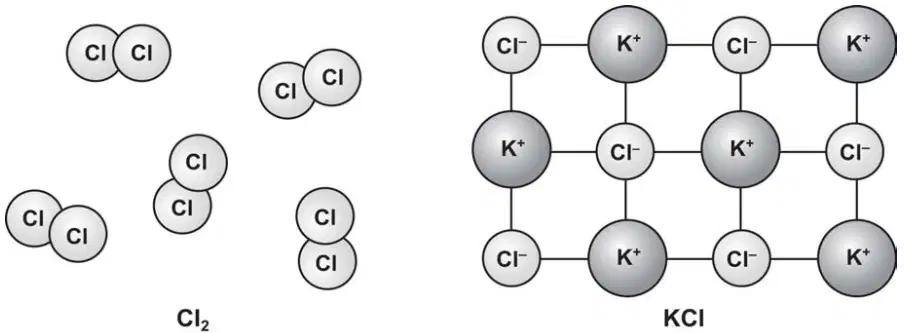
The diagram models bonding in chlorine gas, Cl2, and sodium chloride, KCl. Which statement accurately compares ionic and covalent bonding?
The attractive forces between molecules are weaker than those between ions because valence electrons are shared.
The attractive forces between molecules are stronger than those between ions because valence electrons are shared.
The attractive forces between molecules are weaker than those between ions because valence electrons are transferred.
The attractive forces between molecules are stronger than those between ions because valence electrons are transferred.
Which property is dependent only on the atomic structure of the compound?
mass
volume
melting point
total thermal energy
Which statement is correct about changes in solubility of gases and solids in liquids?
The solubility of gases and solids changes with pressure.
The solubility of gases but not solids changes with pressure.
The solubility of solids but not gases changes with pressure.
The solubility of gases and solids does not change with pressure.
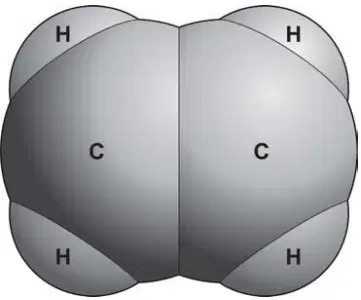
Ethylene is a compound used in the production of polyethylene, a widely used plastic. The chemical formula for ethylene is C2H4. There is a double bond between the two carbon atoms.
How does the three-dimensional arrangement of ethylene affect its polarity?
The C–H dipoles cancel to make ethylene a polar molecule.
The C–H dipoles combine to make ethylene a polar molecule.
The C–H dipoles cancel to make ethylene a nonpolar molecule.
The C–H dipoles combine to make ethylene a nonpolar molecule.
A company needs a plastic that is lightweight and flexible but doesn’t need to withstand impacts or other tests of strength. Which polymer structure would best suit the company’s needs?
linear
branched
networked
cross-linked
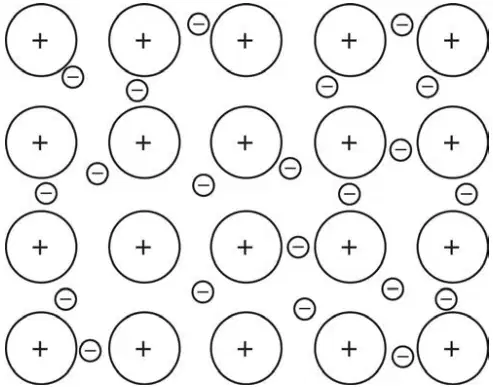
The diagram models metallic bonding. What about the electrons in metal elements contributes to metallic bonding?
All electrons move within pairs of atoms.
All electrons are attracted to several nuclei.
Outer electrons are able to move freely within the sample.
Outer electrons are tightly held by the nucleus in each atom.
What would be the general formula unit of a compound made with a Group 1 element, A, and a Group 16 element, Z, from the periodic table? Refer to the periodic table.
AZ
AZ2
AZ16
A2Z
A block of steel rests on a table. Which action will increase the internal kinetic energy of the block?
Drop it on the floor.
Raise it off the table.
Slide it across the table.
Heat it to a greater temperature.
Raymundo uses the following recipe to make fresh lemonade.
9 lemons + 2 cups sugar + 12 cups water → 1 pitcher of lemonade
He has 72 lemons, 18 cups of sugar, and plenty of water. Raymundo will make pitchers of lemonade until he runs out of one of the ingredients. How many pitchers will Raymundo make?
8 pitchers because he will run out of sugar first
8 pitchers because he will run out of lemons first
9 pitchers because he will run out of sugar first
9 pitchers because he will run out of lemons first
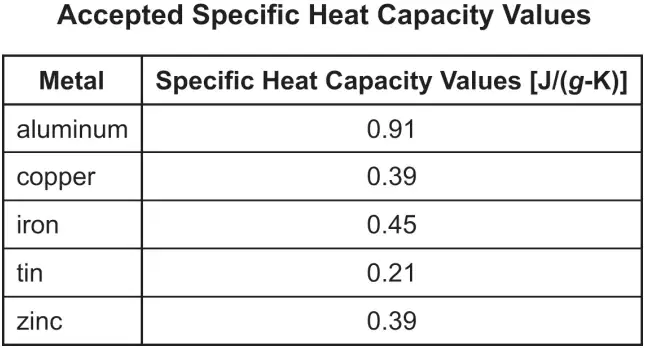
The data show that aluminum has the greatest specific heat capacity of the metals in the list. Which statement, based on the data, accurately compares aluminum with the other metal samples if they have the same mass?
It gains less energy at a specific temperature.
It gains more energy at a specific temperature.
Less energy is required to increase its temperature by one degree.
More energy is required to increase its temperature by one degree.
The balanced equation describes the decomposition of sodium azide, NaN3.
2NaN3 → 2Na + 3N2
What mass of N2 is produced from the decomposition of 100 g of NaN3?
21.5 g
35.4 g
43.1 g
64.7 g
Heating sodium bicarbonate (NaHCO3) produces sodium carbonate (Na2CO3), carbon dioxide (CO2), and water (H2O). The balanced equation describes the reaction.
2NaHCO3 → Na2CO3 + CO2 + H2O
What is the mass of sodium carbonate produced if 115 g of sodium bicarbonate were used? Refer to the periodic table.
72.56 g
145.12 g
57.5 g
30.12 g
The complete combustion of methane can be seen in the equation:
CH4 + 2O2 → CO2 + 2H2O
If 50 g of methane are reacted completely, which statement describes the reaction?
The total mass of reactants is 50 g.
The total mass of reactants is greater than 50 g.
The total mass of products is 50 g.
The total mass of products is less than 50 g.
Which event must happen in order for chemical reactions to occur?
The final energy of the reaction must be lower than the initial energy.
The net change in heat of products must be greater than that of reactants.
Reactant particles must collide so that the kinetic energy needed to break bonds is available.
Product molecules must interact with each other so that potential chemical energy can be stored.
Endothermic and exothermic reactions can be modeled through energy diagrams and chemical reactions. In energy diagrams modeling endothermic reactions, the final energy is greater than the initial energy. Which chemical reaction models an endothermic reaction?
PCl3(g) + Cl2(g) → PCl5(g)
C(s) + O2(g) → CO2(g) + 393.5 kJ
NH3(g) + HCl(g) + 176 kJ → NH4Cl(s) + 176 kJ
4NO(s) + 6H2O(l) + 1170 kJ → 4NH3(g) + 5O2(g)
A metal ball and beaker of water are at room temperature. The ball is heated and immediately placed in the water. Which statement describes the energy transfers as the ball and the beaker of water approach thermal equilibrium?
The energy gained by the water will equal the energy lost by the surroundings.
The energy lost by the water and the metal ball will equal the energy lost by the surroundings.
The energy lost by the metal ball will equal the energy gained by the water and the surroundings.
The energy gained by the metal ball will equal the energy gained by the water and the surroundings.
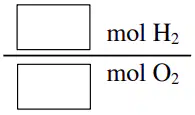
The balanced equation describes the synthesis of water.
2H2 + O2 → 2H2O
What conversion factor compares moles of hydrogen gas with moles of oxygen gas? Write the missing numbers in the boxes to complete the formula.
A researcher is carrying out an experiment where she is using an electric heater to boil off a volume of liquid in a small beaker. The experiment is performed within a rigid, sealed container. The researcher calculates that 130 kilojoules of energy is needed to completely boil off the liquid. When the last of the liquid has boiled off, the researcher notes that 150 kilojoules of energy was released by the heater.
Circle the letters of ALL of the correct statements regarding this experiment.
Less than 20 kilojoules of energy is transferred to the beaker.
The beaker is an isolated system because only vapor leaves the boundaries.
The beaker is a closed system because only energy flows across the boundaries.
Some of the energy released by the burner is transferred to the liquid and the rest is released to the surrounding air.
The container is an isolated system during the experiment because both matter and energy remain inside the container.
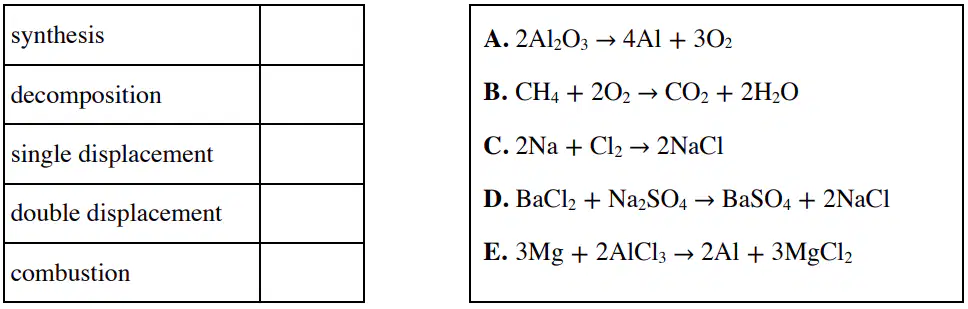
Write the letter of the equation that matches each reaction type in the box next to the reaction type.
Benzene (C6H6) is a hydrocarbon pollutant produced during petroleum refining. Balance the chemical equation for the combustion of benzene (C6H6) in oxygen. Write the coefficients on the lines.
__________ C6H6 + 15O2 → __________ CO2 + __________ H2O
The combustion reaction of propane, C3H8, is shown.
C3H8 + 5O2 → 3CO2 + 4H2O
If 5 moles of propane at STP is burned with excess oxygen, enter the amount of CO2 in grams that is produced when the reaction is complete. Write the answer on the line.
__________ g CO2
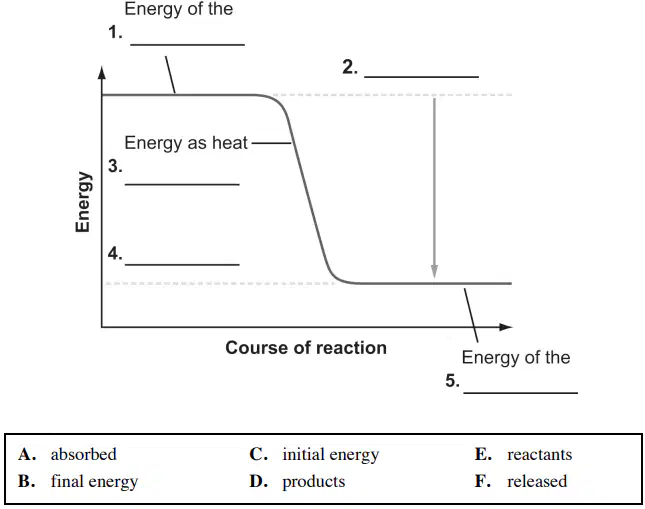
The graph describes an exothermic reaction. Write the letter or letters in each blank to show how energy moves during the reaction. Some letters will not be used.
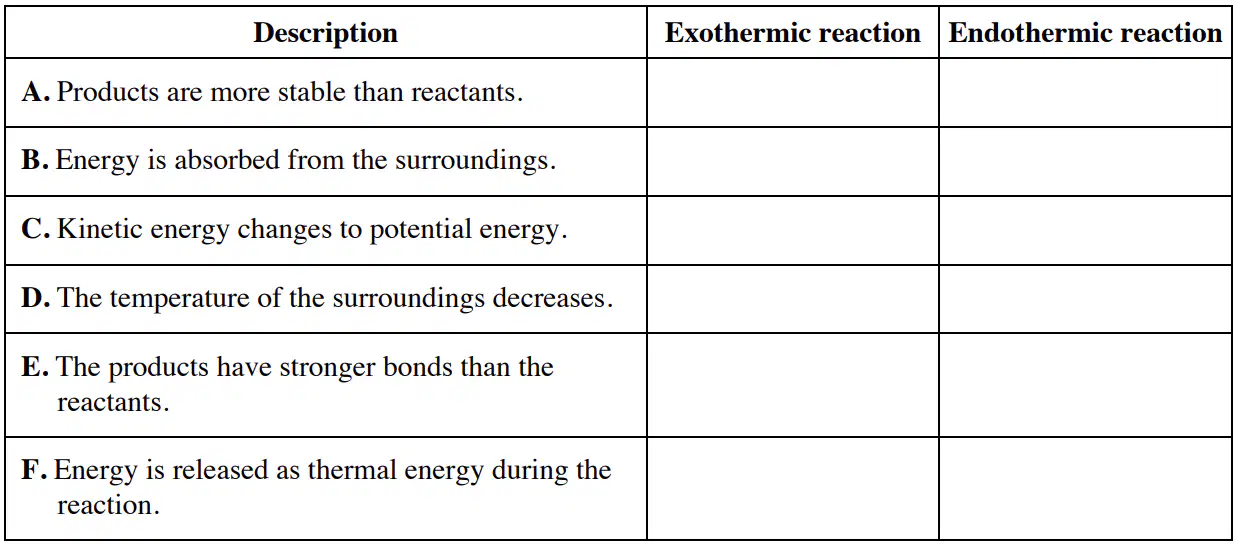
Exothermic and endothermic reactions differ in terms of the energy changes that take place during the reaction. Write one X in the correct box to show whether each statement describes an exothermic or an endothermic reaction.
A 10.0 g sample of CaCO3 is combined with HCl. The following equation describes the reaction.
CaCO3 + 2HCl → CaCl2 + H2O + CO2
Calculate the amount of H2O produced during the reaction.
Aluminum reacts with oxygen to form aluminum oxide. Refer to the periodic table. Write a balanced equation for this reaction.
When solutions of magnesium chloride (MgCl2) and silver nitrate (AgNO3) react, one of the products is insoluble silver chloride (AgCl). A student is asked to determine the mass of magnesium chloride that is dissolved in 1 L of solution based on the mass of precipitate that is formed.
a) Predict the products and write the balanced equation for the reaction.
b) When 100 mL of MgCl2(aq) reacts with excess AgNO3, 1.032 grams of silver chloride forms. Calculate the mass of MgCl2 in 1 L of solution.

