
 Worksheets
U5 Genetics Review #1 (Lessons 5.1, 5.2, 5.3)
Total questions: 57
Worksheet time: 46mins
What is the scientific study of heredity known as?
Genetics
Botany
Zoology
Ecology
What term describes the passing on of characteristics from parents to offspring?
Genetics
Heredity
Evolution
Metabolism
Which plant did Gregor Mendel use for his experiments on heredity?
Tomato
Garden peas
Corn
Wheat
What are the male and female sex cells in plants called?
Spores
Gametes
Pollen
Seeds
What is the result of the fertilization process in plants?
Pollen
Seed
Zygote
Fruit
What type of breeding did Mendel use to ensure that offspring were identical to themselves?
Cross-pollination
Hybridization
Self-pollination
Selective breeding
What is an offspring called when it has parents that have different forms of a trait?
Polyhybrid
Monohybrid
Purebred
Crossbred
How many traits of pea plants did Mendel study at a time?
One
Two
Six
Seven
What is the offspring of the P1 generation called?
P2 generation
F1 generation
F2 generation
S1 generation
What generation follows the F1 generation?
P1 generation
S1 generation
F2 generation
G1 generation
What did Mendel conclude about biological inheritance?
It is determined by environmental factors alone.
It is determined by factors that are passed from one generation to the next.
It is random and cannot be predicted.
It is solely determined by the mother's genes.
What are alleles?
A type of gene that only appears in certain organisms.
The physical appearance of an organism.
Different forms of genes.
The process by which genes are inherited.
What is the Law of Segregation?
Every organism inherits a single allele from each parent.
Every organism has two alleles of each gene and when gametes are produced the alleles separate.
Genes for different traits are inherited together.
Alleles for a gene always stay together and are never separated.
What is a phenotype?
The genetic makeup of an organism.
The way an organism looks and behaves.
The combination of alleles for a trait.
The process by which traits are inherited.
What does it mean if an organism is homozygous for a trait?
It has two different alleles for the trait.
It has no alleles for the trait.
It has two identical alleles for the trait.
It has one allele for the trait.
What is the Law of Independent Assortment?
Alleles for different traits are inherited depending on the environment.
Genes for different traits are inherited independently of each other.
Only one allele is inherited for each trait.
Traits are not inherited; they are acquired.
Who developed Punnett Squares to predict the proportions of possible genotypes in offspring?
Gregor Mendel
Charles Darwin
Reginald Punnett
James Watson
What is the expected genotype ratio for offspring when crossing two pea plants that are heterozygous for tall gene (Tt)?
1:2:1
3:1
2:1:1
1:3
What is the result of a cross between a homozygous tall pea plant (TT) and a homozygous recessive short plant (tt)?
All offspring are heterozygous tall (Tt)
All offspring are homozygous tall (TT)
All offspring are homozygous short (tt)
Offspring are a mix of homozygous tall (TT) and heterozygous tall (Tt)
How many boxes would a Punnett square for dihybrid crosses have?
2 boxes wide and 2 boxes tall
4 boxes wide and 4 boxes tall
3 boxes wide and 3 boxes tall
4 boxes wide and 2 boxes tall
Who was the Austrian monk that experimented on pea plants and is called the "father of genetics"? (a)
Gregor Mendel
Charles Darwin
Francis Crick
James Watson
If a person has 2 different alleles for a gene, they are (a) , but if they have 2 of the same alleles, they are (b) .
heterozygous
homozygous
In cats, the gene for black fur (D) is dominant to the gene for grey fur (d). If two heterozygous cats have kittens, (a) are expected to be black and (b) are expected to be grey.
75%
25%
50%
0%
100%
Among the alleles, the (a) always blocks the (b) .
dominant
recessive
chromosome
DNA
When a dominant gene B for brown eye and a recessive gene b for blue eyes meet in an offspring. The baby will have a ................................... eyes.
Blue
Brown
Mixture of both brown & blue

R - Red dominant Flower
r - purple recessive flower
How many purple flowers are there in this Punnett square?
4
3
2
1

B - Brown eye dominant
b - blue eye recessive
how many blue-eyed off spring are in this Punnett square?
4
2
0
5
Yy is:
Homozygous Dominant
Heterozygous
Homozygous Recessive
We use letters to describe genes: Blue Eyes = (bb)
These letters are called:
Heredity
Alleles
Dominant Genes
When your genes are expressed physically (how you look) we call that your:
Phenotype
Recessive Trait
Genetics
Genotype
True or false: You inherit 75% of your genes from mom, 25% from dad
True
False
A flower garden has 300 flowers, and 250 of them are purple flowers, and the other 50 are white flowers. Which of the following is true?
He doesn't have enough pollen spreaders
The purple flowers are dominant
The white flowers will eventually overpower the purple
He is using a soil that helps boost his plant growth rate
A recessive trait is
A trait that always hides from the dominant trait
A trait that always beats the dominant trait
A trait that only happens in mom's side of the family
None of these
the different versions of a gene
trait
gene
Punnett Square
allele
trait
the different forms of a gene
a characteristic that an organism can pass onto its offspring through its genes
set of information that controls a trait
when characteristics are passed from parent to offspring
Hybrid
the offspring of many generations that have the same traits
a change in a gene or chromosome
a pair of chromosomes that determine gender
an organism that has 2 different alleles for a trait; an organism that is heterozygous for a trait
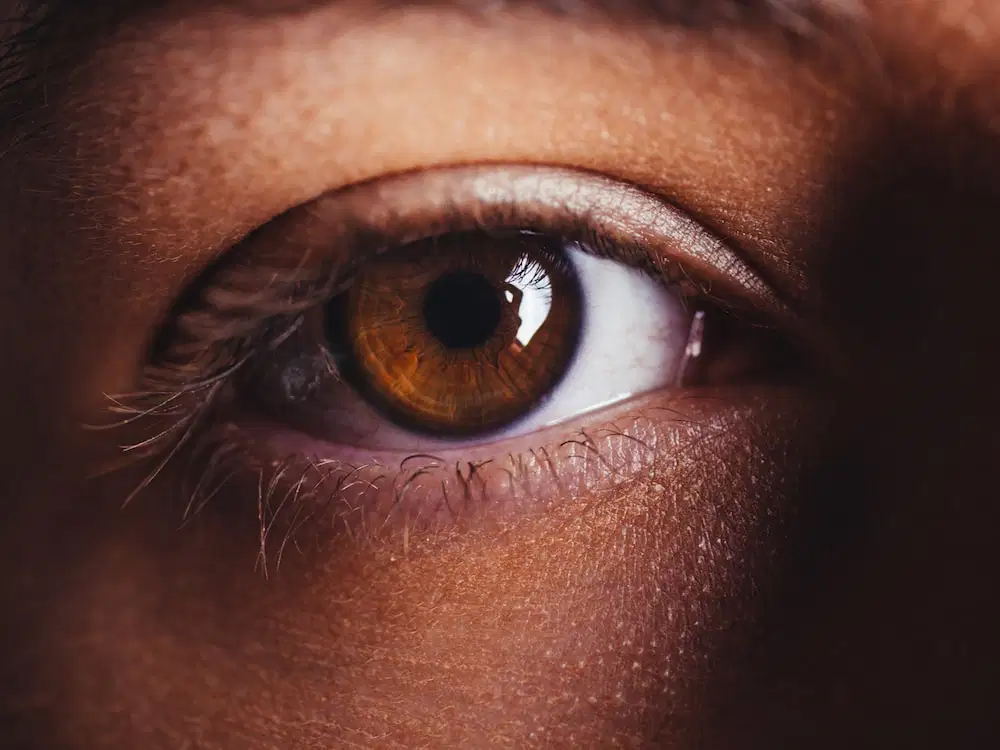
Brown Eyes: Trait or Gene?
Trait
Gene
This is a specific form of a gene, like green peas versus yellow peas.
allele
recessive
dominant
This is an allele whose trait will always appear if the allele is present.
dominant
hybrid
recessive
purebred
What is an organism called if its alleles are represented by two of the same letter?
purebred
hybrid
dominant
recessive
What is an organism called if its alleles are represented by two different letters?
hybrid
purebred
dominant
recessive
What does a Punnett Square show?
The actual results of a genetic cross
The physical traits of the parents
The potential genotypes of the offspring from a genetic cross
The dominant genes in a population
What type of genotype does each flower have?
Purple (P) is dominant to white (p).
Move label to bottom of square.
homozygous recessive
homozygous dominant
heterozygous dominant
Organize the genotypes into the correct category.
GG
gg
Gg
Hh
HH
hh
tt
Tt
TT
(a) is the PASSING of (b) from parents to offspring. (c) is WHAT is passed down through generations. (d) is the study of (e) .
Heredity
Genetics
heredity
Inheritance
traits
(a) is the physical expression or visible traits for a gene.
Phenotype
Genotype
Gregor Mendel came up with the idea of
---------
incomplete dominance
codominance
inheritance
gene pools
Match the following genotypes and allelles.
RR
Homozygous Dominant
Bb
Heterozygous
dd
Homozygous Recessive
G
Dominant Allele
g
Recessive Allele
What organism did Mendel study?
pea plants
onions
mice
cats
What is the term for an organism that has two identical alleles for a trait?
Homozygous
Genotype
Heterozygous
Hybrid
Which of the following would produce a recessive phenotype?
hh
Rr
Ww
BB
Aa, DD, Ba, and yy are all examples of ---
genotypes
phenotypes
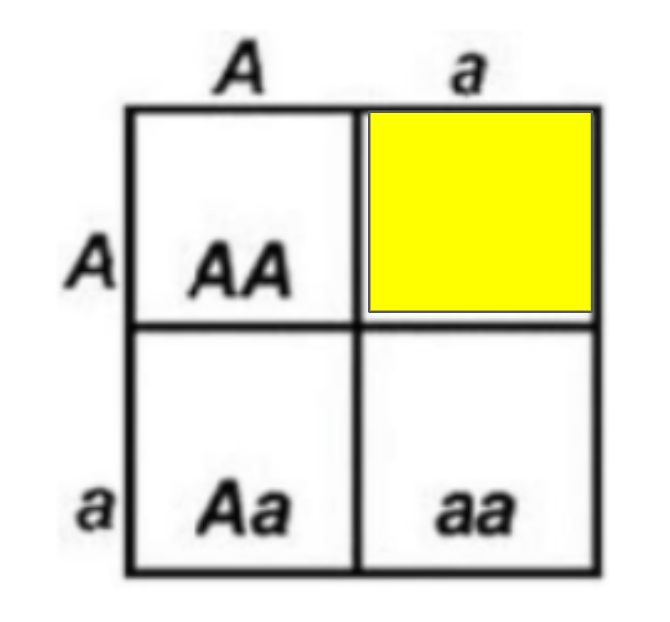
Fill in the Yellow Box
AA
Aa
aa
Why do scientist use Punnett Squares?
A tool scientist use to to see alleles
A tool scientist use to see which alleles are dominant
A tool scientist use to determine possible genotypes for offspring
Feature that a living thing can pass to its offspring
Trait
Phenotype
Genetics
Heredity
Two of the same recessive genes for one trait
Homozygous recessive
Heterozygous
Homozygous dominant
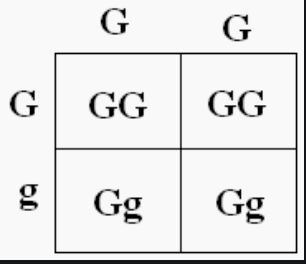
What is the probability that an offspring born from this cross will have a homozygous dominant genotype?
25%
50%
75%
100%

