wayground logo

Free Printable Worksheets

NEW

Font size

S
M
L
XL
Worksheets

Pre Cal Functions

Total questions: 75

Worksheet time: 4hrs 42mins

Name
Class
Date
1.
Which equation represents the following graph?
a)
y = 3x + 2
b)
y = -2x + 3
c)
y = 2x + 3
d)
y = -3x + 2
2.
Find the slope
a)
-5/3
b)
-3/5
c)
5/3
d)
3/5
3.

What is the y-intercept in the equation?

y = 5x - 4

a)

(0,5)

b)

(0,-4)

c)

(-4,0)

d)

(5,0)

4.
Find the slope between the two given points: (-2,1) and (5,7)
a)
7/6
b)
2
c)
6/7
d)
-2
5.
Determine the slope and y-intercept from the following equation:   y = 3/2x + 3
a)
slope: 5   y-intercept:  (0,3) 
b)
slope: 3/2   y-intercept:  (0,3) 
c)
slope:  4  y-intercept:  (0,3/2)
d)
slope: 1/5   y-intercept:  (0,5) 
6.
Which of these represents slope-intercept form?
a)
y - y1 = m(x-x1)
b)
Ax + By = C
c)
y = mx + b
7.
Write the equation of the line that passes through the points (-5, -2) and (0, -1)
a)
y=1/5x-2
b)
y=1/5x+1
c)
y=1/5x+3
d)
y=1/5x-1
8.
Which of these represents point-slope form of a linear equation?
a)
y - y1 = m(x - x1)
b)
Ax + By = C
c)
y = mx + b
9.
Find the x and y intercepts
4x - 5y = 40
a)
x intercept is 10 
y intercept is 8
b)
x intercept is 10
y intercept is 20
c)
x intercept is 8
y intercept is 10
d)
x intercept is 10
y intercept is -8
10.
Change the following to slope-intercept form:
5x - 5y = 25
a)
y = x - 5
b)
y = 5x - 1
c)
y = -x + 5
d)
y = 5x + 1
11.
Find the slope and y-intercept:
-6x + -2y = 18
a)
slope = -6, y-intercept = -2
b)
slope = -3, y-intercept = 9
c)
slope = 3, y -intercept = -9
d)
slope = 6, y-intercept = 3
12.
Which parent function matches the graph?
a)
y = |x|
b)
y = ∛(x)
c)
y = x2
d)
y = a⋅bx
13.
What type of function is shown?
a)
absolute value
b)
quadratic
c)
linear
d)
exponential
14.
What type of function is shown?
a)
linear
b)
quadratic
c)
square root
d)
absolute value
15.
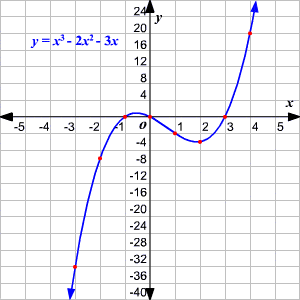
Name the parent function. 
a)
constant
b)
quadratic
c)
linear
d)
exponential
16.
Name the parent function. 
a)
constant
b)
square root
c)
linear
d)
absolute value
17.
g(x)=f(x)-4
Describe the transformation to f(x) that results in g(x).
a)
f(x) has been translated down 4.
b)
f(x) has been translated up 4.
18.
g(x)=f(x-4)
Describe the transformation to f(x) that results in g(x).
a)
f(x) has been translated to the right 4.
b)
f(x) has been translated to the left 4.
19.
Match the equation to its description.
a)
Right 2 and up 2
b)
Left 2 and up 2
c)
Right 2 and down 2
d)
Left 2 and down 2
20.
Name the parent function.
a)
quadratic
b)
cubic
c)
square root
d)
logarithmic
21.
Domain is: 
a)
All x values, from left to right.
b)
All y values, from bottom to top.
c)
All x values from bottom to top. 
d)
All y values from left to right.
22.
Range is:
a)
All x values, from left to right.
b)
All y values, from left to right. 
c)
All y values, from bottom to top.
d)
All x values, from bottom to top.
23.

Which of the following parent functions does not have a Domain of all Real numbers?

a)
b)
c)
d)
24.
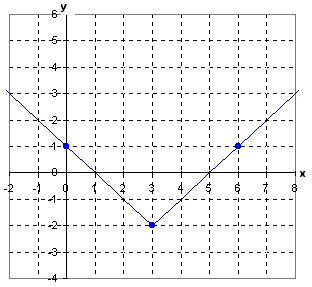
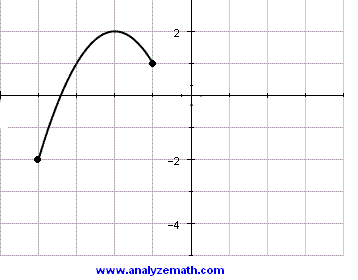
What is the range of the graph?
a)
(-∞,∞)
b)
[-2,∞)
c)
[0,∞)
d)
[3,∞)
25.
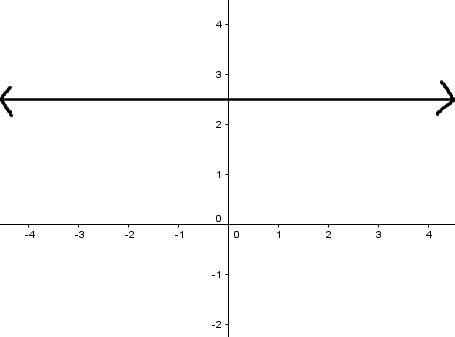
What is the domain of the following graph?
a)
(-∞,∞)
b)
{1.5}
c)
[-5,5]
d)
(-5,5)
26.
What is the range of the graph?
a)
(-∞,∞)
b)
[-1,0]
c)
[-1,3]
d)
[3,∞)
27.
What is the range of the graph?
a)
(-∞,∞)
b)
[0,∞)
c)
(0,5)
d)
[-1,∞)
28.
What is the range of the graph?
a)
[-2,2]
b)
[-2,1]
c)
[-4,-1]
d)
(-∞,∞)
29.
What is the domain of the graph?
a)
[-2,2]
b)
[-2,1]
c)
[-4,-1]
d)
(-∞,∞)
30.
What is the domain of the function?
a)
(3, ∞)
b)
[-3, ∞)
c)
(-∞, 4]
d)
(-∞, 4)
31.
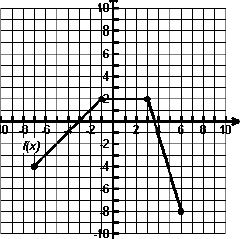
What is the range?
a)
[-7,6]
b)
(-7,6)
c)
(-8, 2)
d)
[-8,2]
32.
What is the domain?
a)
(-3 , 3)
b)
[-4, 5]
c)
(-4, 5)
d)
(-3, 3]
33.
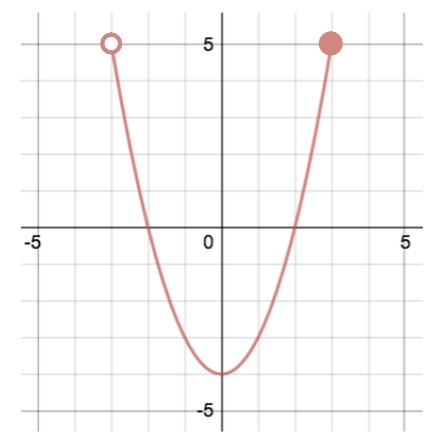
What is the range of the graph?
a)
[-7, 5)
b)
[-3 , 1]
c)
[-3 , 1)
d)
[-7 , 5)
34.
If the blue graph is f(x) (the original function) and the red graph is the transformation, what is the equation of the red graph?
a)
-f(x)
b)
f(-x)
c)
f-1(x)
d)
f(2x)
35.
Identify the transformations. 
a)
horizontal shift to the left 2 and vertical stretch by a factor of 3
b)
horizontal shift to the right 2 and vertical stretch by a factor of 3
c)
horizontal shift to the right 2 and vertical shrink by a factor of 3
d)
horizontal shift to the left 2 and vertical shrink by a factor of 3
36.

g(x)=f(x)g\left(x\right)=-f\left(x\right)
Describe the transformation to f(x) that results in g(x).

a)
f(x) has been reflected over the x-axis.
b)
f(x) has been reflected over the y-axis.
37.
Which equation is an absolute value graph shifted right 5 units?
a)
y = |x - 5|
b)
y = |x + 5|
c)
y = |x| + 5
d)
y = -5|x|
38.
Given f(x) = 2x and
g(x) = x2+3 , find f(g(x)).
a)
x2+2x+3
b)
4x2+3
c)
2x2+3
d)
2x2+6
39.
Given f(x) = 3x + 10
and g(x) = x - 2
Find f(g(5))
a)
19
b)
23
c)
-10
d)
None of these.
40.

Which option below is the same as (f∘g)(x) (How can you rewrite this)

a)

f(x)*g(x)

b)

f(g(x))

c)

g(f(x))

d)

(f*g)(x)

41.

Given f(x)=5x+7f\left(x\right)=5x+7  and  g(x)=3+4xg\left(x\right)=3+4x , find  (fg)(x)\left(f\circ g\right)\left(x\right)  in simplest form.

a)

15+16x15+16x  

b)

31+20x31+20x  

c)

22+20x22+20x  

d)

42+25x42+25x  

42.

Given f(x)=3x6f\left(x\right)=3x-6  and  g(x)=x2+4g\left(x\right)=x^2+4 , find  (gf)(1)\left(g\circ f\right)\left(-1\right)  

a)

13

b)

85

c)

9

d)

65

43.

Given f(x)= x+ 25 and g(x)= x - 5, find     (f+g)(x). 

a)
x+ x - 20
b)
x+ x + 20
c)
-x+ x - 20
d)
x- x - 20
44.
f(x) = 3x2 + 7x and g(x) = 2x2 - x - 1, find (f - g)(x).
a)
x2 + 8x + 1
b)
x2 + 6x - 1
c)
5x2 + 8x - 1
d)
x2 + 8x -1
45.
f(x) = x + 5 and g(x) = x2 - 2x + 3
Find f(x) * g(x)
a)
x3 + 3x2 - 7x + 15
b)
x3 - 2x2 + 15
c)
x3 + 3x2 - 10x + 15
d)
x3 - 3x + 15
46.

Which of the following is the domain of
84x\sqrt[]{8-4x}

a)
A) [0,∞)
b)
B) [2,∞)
c)
C) (-∞, 2]
d)
D)  (-∞, ∞)
47.

What is the domain of 
g(x)=5x5x21g\left(x\right)=\frac{5x-5}{x^2-1}

a)
A) (-∞, ∞)
b)
B) All Reals except -1
c)
C)  (-∞,-1)U(-1,1)U(1,∞)
d)
D) All Reals except 1
48.

State the domain

a)

(-oo, -1) U (-1, oo)

b)

[-1, oo)

c)

(-oo, -1]

d)

(-1, oo)

49.

State the domain:

a)

(-oo, 7) U (7, oo)

b)

(-oo, -7) U (7, oo)

c)

(7, oo)

d)

[7, oo)

50.

Determine the domain of f(x)=6x+2f\left(x\right)=\frac{6}{\sqrt{x+2}}  

a)

(,2]\left(-\infty,-2\right]  

b)

[2,)\left[-2,\infty\right)  

c)

(,2)\left(-\infty,-2\right)  

d)

(2,)\left(-2,\infty\right)  

51.

What is the domain f(x)=3x2+6x+5f\left(x\right)=\frac{3}{x^2+6x+5} ?

a)

x5,1x\ne-5,-1  

b)

x1,5x\ne1,5  

c)

x>5, x<1x>5,\ x<1  

d)

x<5, x>1x<-5,\ x>-1  

52.
Find the inverse of f(x) = -4x - 12
a)
f-1(x) = 4x - 3
b)
f-1(x) = -1/4x - 3
c)
f-1(x) = 1/4x + 3
d)
f-1(x) = -4x - 3
53.
Find the inverse of the function
f(x) = 3x − 5
a)
f-1(x)=3x +5
b)
f-1(x)=(x+5)/3
c)
f-1(x)=3y-5
d)
f-1(x)=3y+5
54.
What does it mean to find the inverse of a function?
a)
the x's and y's are switched
b)
the x's and y's are divided by 2
c)
the x's and y's are made negative
d)
the x's and y's are the same
55.
a)

Inverse Functions

b)

Not Inverse Functions

56.
a)

Inverse Functions

b)

Not Inverse Functions

57.
Are these functions inverses?
a)
Yes
b)
No
58.
Are these inverse functions?
a)
no
b)
yes
c)
no way to tell
59.
The inverse of the function f(x) is written as ...
a)
f -1(x)
b)
f 2(x)
c)
f '(x)
d)
f +(x)
60.
The inverse has been reflected over which line?
a)
y = x
b)
y =1
c)
y = 0
d)
y = x + 1
61.
If the equation of f(x) goes through (1, 4) and (4, 6), what points does f-1(x) go through?
a)
(1, 4) and (4, 6)
b)
(-4, -1) and (-6, -4)
c)
(-1, -4) and (-4, -6)
d)
(4, 1) and (6, 4)
62.
When finding the inverse of a relation, 
1st you replace f(x) with y
2nd switch the x's and y's
What do you do next?
a)
solve for y
b)
replace y with f-1(x)
c)
solve for x
d)
find the greatest common factor
63.
a)
TRUE
b)
FALSE
64.

Use the horizontal line test to determine if the function has an inverse function.

a)

yes

b)

no

65.

Use the horizontal line test to determine if the function has an inverse function.

a)

yes

b)

no

66.

Use the horizontal line test to determine if the function has an inverse function.

a)

yes

b)

no

67.

Use the horizontal line test to determine if the function has an inverse function.

a)

yes

b)

no

68.

Use the horizontal line test to determine if the function has an inverse function.

a)

Yes

b)

No

69.

Use the horizontal line test to determine if the function has an inverse function.

a)

Yes

b)

No

70.

What is the slope parallel to the following equation
 4x+3y=124x+3y=12  

a)

 34\frac{3}{4}  

b)

 43\frac{4}{3}  

c)

 43-\frac{4}{3}  

d)

 34-\frac{3}{4}  

71.
What is the slope of all horizontal lines?
a)
0
b)
undefined
c)
1
d)
-1
72.
A line is perpendicular to    y = 2x - 7.
What is the slope of this line? 
a)
-2
b)
1/2
c)
-1/2
d)
2
73.

What is the formula for finding slope?

a)

y=mx+by=mx+b

b)

Ax+By=CAx+By=C

c)

y2y1x2x1\frac{y_2-y_1}{x_2-x_1}

74.
What direction is an undefined slope?
a)
horizontal
b)
vertical
75.
Find the slope of the line.
a)
Undefined
b)
0
c)
1/1
d)
-1/1