
Font size
 Worksheets
Unit 1-5 Practice Questions
Total questions: 20
Worksheet time: 30mins


Examine the atom of sodium (Na). Sodium has an atomic mass of 23. Select the correct model that represents the nucleus of an atom of sodium.


The model represents a neutral silicon atom. Select the response that describes what would happen to the silicon atom if one electron was removed.
The overall charge of the atom will become positive.
The overall charge of the atom will become negative.
The overall charge of the atom will not be affected.
The atom will become a chlorine atom.
An atom of gallium (Ga) has 31 protons and 39 neutrons. How many electrons does a neutrally charged atom of gallium have?
70
39
31
8
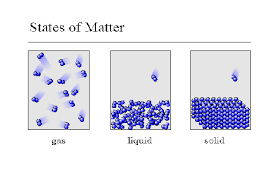
Study the image and complete the statement below with its correct response.
At higher temperatures ______.
the energy of the particles remains the same
the particles will move at a constant rate at any temperature

Noble gases are inert because ____. Select two answers!
They are highly reactive
They are unreactive
They are noble
They have 8 electrons in their outer most energy level

Classify this matter shown.
pure substance
mixture of elements
mixture of compounds
mixture of elements and compounds

Which two parts of the chemical reaction shown contains pure substances? Select two.
Reactant 1
Reactant 2
Product
Which is a molecule, but NOT a compound?
hydrogen peroxide
H2O2
iodine
I2
caffeine
C8H10N4O2
methane
CH4
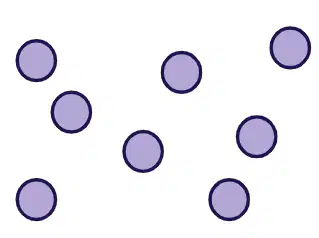
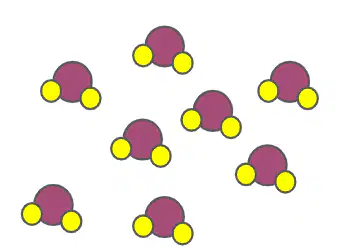
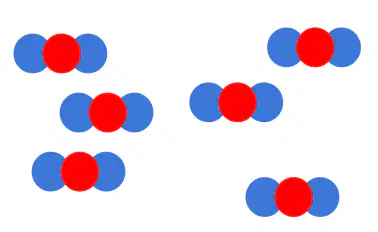
Which of the samples shown represents an element?


Choose the chemical formula that best represents the model below.
CH4+2O2 → CO2+2H2O
CH7+4O2 → 2O2+7H4
2CH4+2O2 → 2CO2+H2O
2CH5+O2 → 8CO2+2H2O

Analyze the model. Which process and in which structure would this most likely occur?
Mitochondria-photosynthesis
Mitochondria- cellular respiration
Chloroplast- photosynthesis
Chloroplast- cellular respiration

The model shows the flow of matter between photosynthesis and cellular respiration. Which compounds should X and Y represent?
X = C6H12O6 ; Y = CO2
X = CO2; Y = C6H12O6

Select THREE statements that correctly describes how carbon cycles from biotic and abiotic factors.
Plants take in carbon from the atmosphere through photosynthesis.
Decomposers take carbon from decaying materials and returns the nutrients to the soil.
Deforestation and forest fires remove carbon from the atmosphere.
Cows take in carbon from the atmosphere and converts it to food during photosynthesis.
Cows release carbon into the atmosphere during the process of cellular respiration.

Analyze the model. Which process and in which structure would this most likely occur?
Mitochondria-photosynthesis
Mitochondria- cellular respiration
Chloroplast- photosynthesis
Chloroplast- cellular respiration
respiration breaking down sugars without oxygen
anaerobic
abiotic
biotic
buel
Trace gases are small amounts of gases in the atmosphere such as water vapor, carbon dioxide, methane, nitrous oxide, and CFCs. When combined, the trace gases only make up 0.1% of Earth's atmosphere.
Which of the following actions would most likely increase the amount of trace gases in the atmosphere?
A shoe manufacturer utilizing fossil fuels to power the factory.
A group of friend traveling in the same car to their destination.
A recycling company cleaning the plastic washed up in the shorelines.
A family planting several oak trees in the backyard.

Using the model, reorder the following gases in Earth's atmosphere from least to greatest.
carbon dioxide
oxygen
nitrogen
Select three human activities that would decrease the amount of carbon dioxide emitted into the atmosphere.
Traveling by bus, subway, or public transportation
Buying more manufactured goods
Sharing a ride with friends to go to a restaurant
Installing solar panels
Deforestation

