
NEW
Font size
 Worksheets
EOC Review Part 2
Total questions: 20
Worksheet time: 12mins

The political is from the late 1800s:
This political cartoon is a criticism of which practice in the 19th century?
horizontal integration
monopolization
industrialism
laissez-faire capitalism
Which of the following BEST describes a laissez-faire economic policy?
The government should leave businesses alone
The government should heavily regulate businesses.
The government should protect small businesses from failing.
The government should prevent big businesses from expanding.
According to the quote below, which issue(s) did the American worker face in the late 19th century?
“It is vain to hope for material relief upon the prevailing system of capitalism. All the reforms that are proposed by the three capitalist parties, even if carried out in good faith, would still leave the working class in industrial slavery.
The working class will never be emancipated by the grace of the capitalists class, but only by overthrowing that class.”
-Eugene Debs’s “The Monstrous System of Capitalism” Speech
A lack of proper living conditions
A lack of a living wage
A proper living wage
More opportunities to advance in the company

What was the Progressive result of the actions displayed by the political cartoon to the right?
Child Labor Laws were created.
Children’s health improved due to working conditions.
Capitalists and corporations improved working conditions for all employees.
Slavery was reintroduced to help solve worker shortages.

Examine the map. What do the islands labeled on the map have in common?
They were all battle sites during the Spanish-American War.
They all gained their independence after the Spanish-American War.
They all became Spanish spheres of influence after the Spanish-American War.
They were all territories ceded to the United States after the Spanish-American War.
Read the excerpt below from a major Congressional address President Theodore Roosevelt made in 1904.
“… and in exceptional cases to take action which in a more advanced stage of international relations would come under the head of the exercise of the international police. A great free people owes it to itself and to all mankind not to sink into helplessness before the powers of evil”
This statement became known as the __________.
Roosevelt Corollary
Panama Canal
Open Door Policy
Monroe Doctrine
Which statement describes the role played by the U.S. journalists during the Spanish-American war?
Journalists provided frequent reports of the fighting, allowing the public to follow a foreign war closely for the first time
Journalists focused on bad news rather than good news in order to criticize the decisions made by the president and military leaders.
Journalists ignored the signs of impending war until it was too late to inform the public of the government’s intentions to declare war on Spain.
Journalists exaggerated events to build support for the war, giving the president and Congress little chance to resolve the conflict diplomatically.
Read the quotation below from President Woodrow Wilson's message to Congress in 1914. What was the president asking the nation to do?
“The United States must, . . . during these days that are to try men's souls, . . . be impartial in thought, as well as action, must put a curb upon our sentiments, as well as upon every transaction that might be construed as a preference of one party to the struggle before another.”
adopt a policy of neutrality
make the world safe for democracy
offer loans and sell supplies to their allies
compete for trade and territory with their enemies
In 1917, President Woodrow Wilson created the Committee on Public Information to…
promote pro-war propaganda to "sell" the war to the American public.
encourage American men to join the army and defend their country.
provide the American public with accurate updates on the war.
persuade other nations to become allies with the United States.
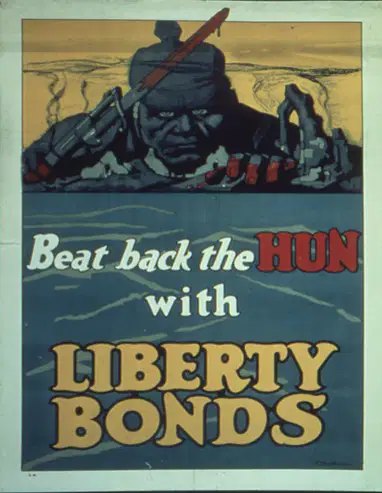
The image is a poster from World War I.
What was the main purpose of this poster?
to create public distrust of Germans
to encourage young men to enlist in the army
to demonstrate the reason for entering the war
to generate financial support for the war effort
What was the purpose of the Palmer Raids?
to find and deport illegal immigrants
to break the power of the Ku Klux Klan
to identify and punish suspected communists
to undermine the Civil Rights movement
How did Congress contribute to the cause of the Great Depression?
They made policies that favored global trade over local trade.
They passed the Hawley Smoot Tariff that raised the taxes of imported goods.
They implemented an extremely high discount rate.
They kept interest rates low to make borrowing money easier.

The diagram shows some of the sources of controversy during the 1920s:
The controversies surrounding these issues were all signs of what aspect of American life?
the need for government intervention during economic crises
the benefits of new technologies introduced by popular inventors
the tension between traditional and modern values and beliefs
the importance of fighting against communism at home and abroad
How did investors respond to Black Tuesday in 1929, and what was the effect of this response?
Investors quickly sold their stocks, which caused stock prices to lower.
Investors bought as many stocks as possible, which raised stock prices.
Investors put all of their money into stocks, which caused banks to fail.
Investors began buying stocks overseas, which led to a bull market.
The following quote is from President Roosevelt in the early 1900s: "This Second New Deal Act gives "contributors a legal, moral, and political right to collect their pensions and unemployment benefits." Based on this quote, to which Second New Deal Act is Roosevelt referring?
Social Security Act
Volstead Act
Wealth Tax Act
Agricultural Adjustment Act
Passage of which of these represented a shift from the foreign policy that dominated American politics between the two world wars?
the Wagner Act
the Espionage Act
the Lend-Lease Act
the Taft-Hartley Act
The quote below comes from the Supreme Court ruling in Korematsu v. United States, handed down in 1944: "The properly constituted military authorities feared an invasion of our West Coast and felt constrained to take proper security measures.... Congress, reposing its confidence in this time of war in our military leaders—as inevitably it must—determined that they should have the power to do just this."
What security measures are being referred to in this case, also known as Executive Order 9066?
internment of Japanese Americans
dropping of atomic bombs on Japan
deportation of all recent immigrants from Japan
exclusion of Japanese Americans from the draft
How did the formation of the United Nations resemble the formation of the League of Nations?
It was created to prevent the spread of communism.
It was set up to promote international efforts to stop war
It was intended to prevent another global Great Depression
It was boycotted by both the United States and the Soviet Union.
The main justification of the internment of Japanese Americans after the bombing of Pearl Harbor in 1941 was to.....
to protect them from anti-Japanese riots and demonstrations
preserve the security of the United States
adhere to the Open Door policy
prevent leaks about the development of the atomic bomb
permitted the trade of non-military goods to nations involved in the war if they paid cash and transported them themselves
Neutrality Acts
Lend-Lease act
Cash and carry
Selective Service and Training Act

