
 Worksheets
SCI 530 Final Core Assessment Review
Total questions: 24
Worksheet time: 12mins
Name
Class
Date
1.

Choose the correct answer for the ALPHA DECAY....
a)
.
b)
,
c)
'
d)
;
2.
There is evidence from the scientific community that suggests the heat from the Earth's core comes from radioactive isotopes. Why do you think this is true?
a)
As they break down into other elements and atoms, they give off energy and particles.
b)
They have an electric charge and will produce energy as they interact with the magnetism of Earth.
c)
They release energy when reacting with non-radioactive material
d)
They absorb the sunlight from the surface and radiate that energy downward into the ground beneath them.
3.
When lead-206 undergoes an alpha decay what is produces?
a)
Mercury-202
b)
Platinum-204
c)
Polonium-210
d)
Radium-208
4.
What causes a radioactive particle to stop going through nuclear decay?
a)
It has become stable
b)
Half of the original mass has changed
c)
The element gets a negative charge
d)
It becomes happy
5.
Which of these are an example of nuclear fission?
a)
Polonium-213 and a neutron produces Tin-115, Niobium-94, and four neutrons
b)
Hydrogen-2 and Helium-4 produce Lithium-6
c)
Titanium-48 and an Alpha particle produce Chromium-52
d)
All are Fusion
6.

Which particle will complete the following reaction?
a)
Beta
b)
Proton
c)
Neutron
d)
Alpha
7.
In a nuclear reaction, what happens to the mass and why?
a)
It stays the same due to the law of conservation of mass
b)
It becomes more due to the law of conservation of mass
c)
It becomes less due to the law of conservation of mass
d)
It stays the same due to the law of conservation of energy
8.
Which of these statements apply to a fusion reaction?
a)
The combining of atoms
b)
High temperature
c)
The splitting of atoms
d)
Multiple atoms produced
9.

In the below image, an atom of carbon-14 undergoes a beta decay, resulting in the products shown. Which isotope is represented by X in the diagram?
a)
Nitrogen-14
b)
Carbon-15
c)
Boron-14
d)
Beryllium-10
10.
Which type of nuclear reaction gives off the least amount of energy?
a)
Fission
b)
Fusion
c)
Their energy is the same
11.
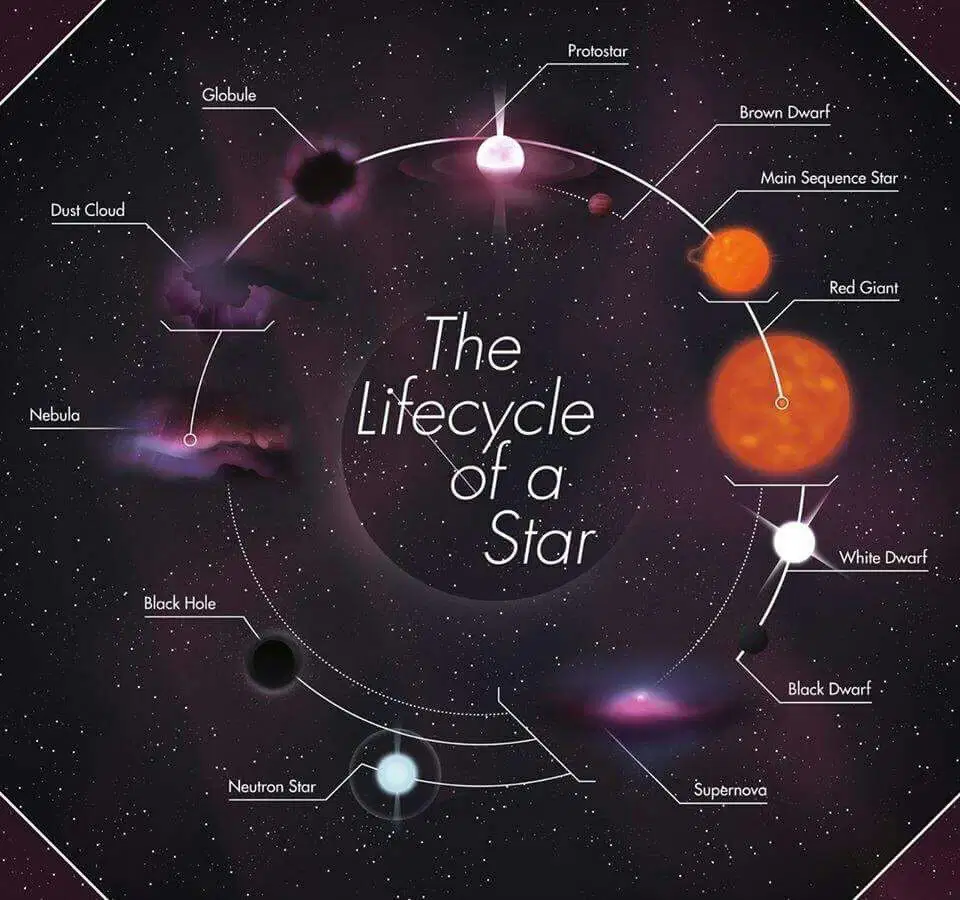
Which statement best describes why a sun-like star and red giant give off light?
a)
Fusion
b)
Fission
c)
Atoms splitting
d)
a star is on fire
12.
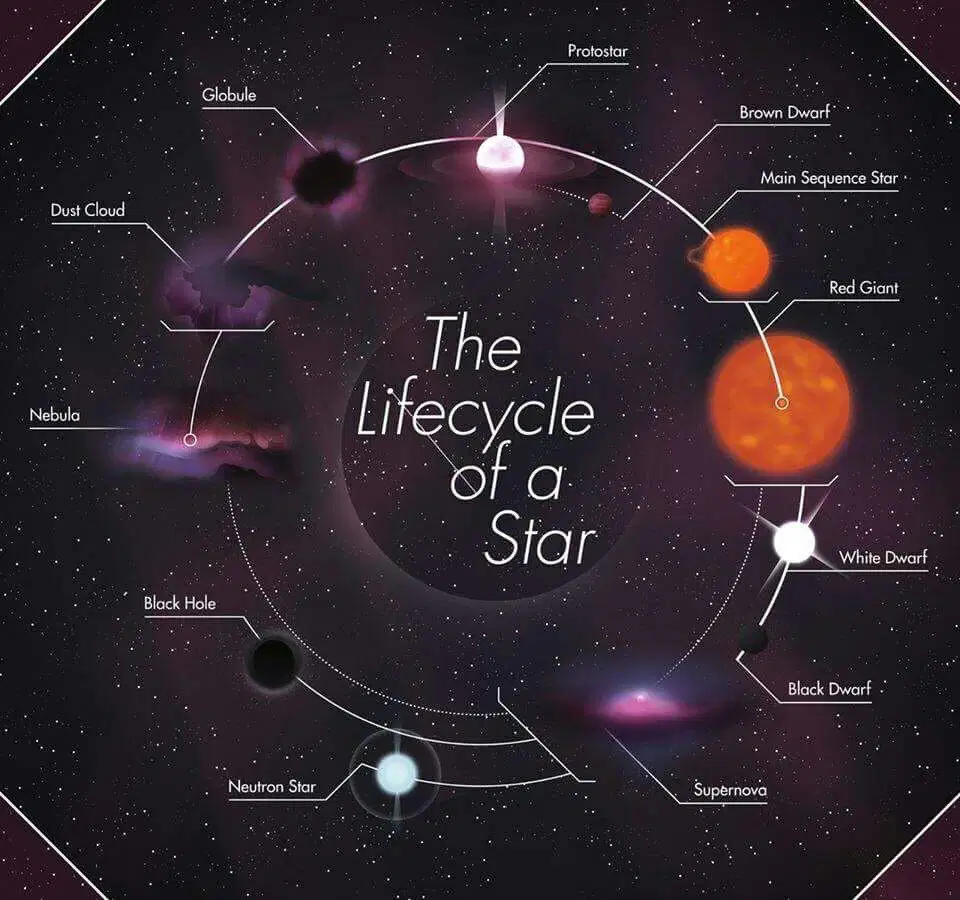
In the life cycle of a star, there are multiple stages of life. Proton-proton fusion produces helium-4 and energy during stage 3 of the star life cycle (Our Sun). Triple alpha fusion, however, produces carbon-12 and energy during stage 4 (Red Giant).
At the end of the current phase, what will happen to our sun? Make a prediction.
a)
The chemicals composing the core of the sun will become iron-like.
b)
The sun will have more energy than before to make more fusion reactions
c)
The sun will go dark
d)
The sun will transform into a neutron star.
13.
Which of these are NOT necessary when building a life cycle model for a flavor assessment?
a)
Color
b)
Distance
c)
Time
d)
Composition
14.

Which elements were produced by exploding massive stars?
a)
Co
b)
Kr
c)
Sn
d)
H
15.
True or False: All elements are the same no matter where they are found in the universe
a)
True
b)
False
16.
One major piece of evidence that supports the Big Bang Theory is _____, which is when the wavelength of light becomes longer as the galaxies move away from each other.
a)
Red Shift
b)
Yellow Shift
c)
Purple Shift
d)
Radio Shift
17.

The diagram below shows a hydrogen emission spectrum in a lab on earth and one from a star in a far away galaxy, which statement best describes what is happening
a)
the galaxy is moving away
b)
the galaxy is moving closer
c)
the galaxy is staying the same distance away
d)
the galaxy has a different element
18.
Which of these are observable evidence that proves the Big Bang Theory?
a)
Red Shift
b)
Uniform Background Radiation
c)
Life cycle of a Star
d)
Gravity
19.
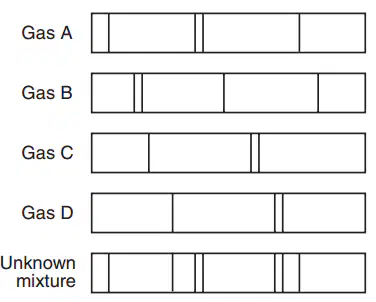
Which gases are in this unknown based on the emission spectrum of each gas?
a)
Gas A
b)
Gas B
c)
Gas C
d)
Gas D
20.
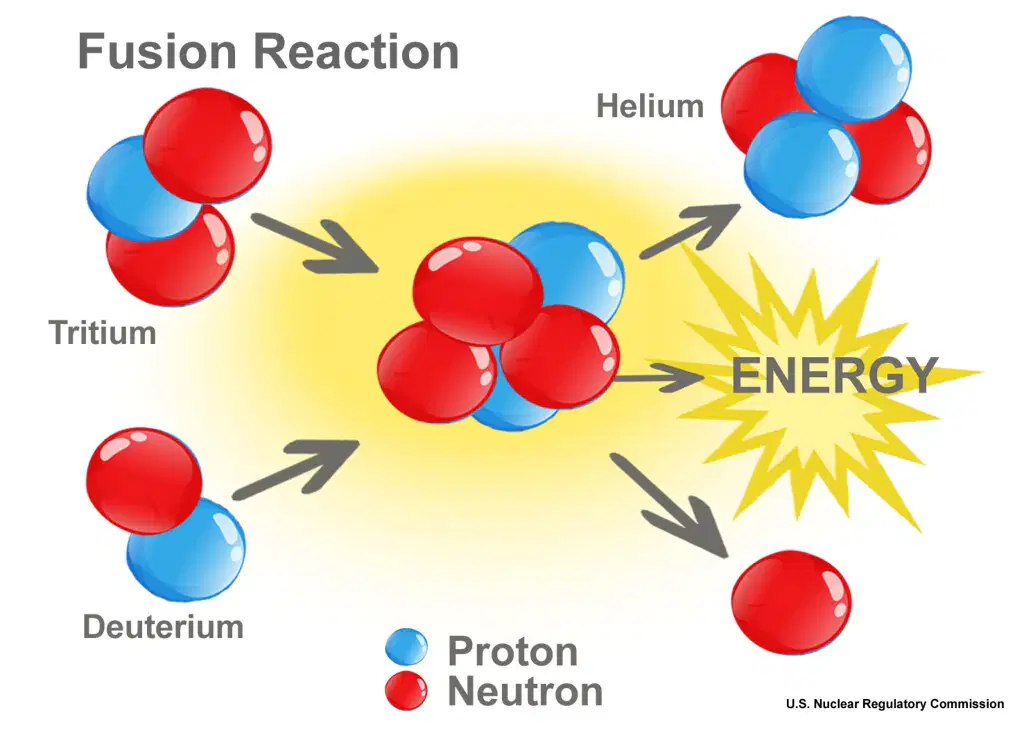
When the core of a star has the elements of deuterium and tritium reacting with one another, which of the following answers best explains why the star gives off a large amount of energy in the attached formula?
a)
The mass of the reacting elements can be converted into energy in this process
b)
All of the isotopes of hydrogen in the star will undergo radioactive decay
c)
The temperature of the results of the reaction is lower than that of the elements that started the reaction
d)
The hydrogen will convert the light into pure energy.
21.
As an electron releases energy, what is produced?
a)
Light
b)
Gamma Rays
c)
Gravity
d)
Sound
22.
Which of the following terms happens as a star evolves?
a)
Nucleosynthesis
b)
Electrolysis
c)
The creation of helium
d)
The formation of a surface layer
23.

Which element is in the layer that is blank?
a)
Neon (Ne)
b)
Cobalt (Co)
c)
Nitrogen (N)
d)
Calcium (Ca)
24.
Stars are in what phase of matter?
a)
Plasma
b)
Solid
c)
Liquid
d)
Gas
100 %

