
Font size
 Worksheets
Unit 5 Review Quiz
Total questions: 34
Worksheet time: 17mins
The spinning of an object on its axis is called ________.
orbit
rotation
revolution
tide
The Earth's Rotation....
Causes Day & Night
Causes the seasons
Causes the tides
How long does it take the Earth to make one revolution around the Sun?
12 hours
24 hours
365 days
29.5 days
As the Earth travels around the sun, this tilt causes different areas of the Earth’s surface to get different amounts of daylight at different times of the year. The angle of the Sun’s rays to the surface also causes areas to have more or less of the Sun’s energy. This causes the ________.
tides
eclipses
seasons
phases of the moon
A ______ occurs when the moon passes between Earth and the Sun, blocking the sunlight from reaching Earth.
solar eclipse
lunar eclipse
vernal equinox
autumnal equinox
Sunlight hits Earth's surface most directly at the ________.
north pole
south pole
equator
prime meridian
A ________ tide occurs when the sun, moon, and the Earth are aligned causing a ________ difference in high and low tide for the day.
neap, smaller
spring, greater
neap, greater
spring, smaller
What cyclic pattern is described by the changes in the relative positions of the Earth, sun, and moon?
months
day and night
seasons
years
A ______ eclipse occurs when the Moon passes directly behind the Earth into its umbra (shadow). This can occur only when the Sun, Earth, and Moon are aligned exactly, or very closely so, with the Earth in the middle.
spring
neap
solar
lunar
What is the natural force that tends to cause physical things to move toward each other?
motion
force
orbit
gravity
What is the central, darker part of an eclipse shadow where light is blocked called?
penumbra
umbra
postumbra
solar flare
Why do neap tides occur?
Low tide because of the tidal bulges.
Spring tide because the sun and moon are working together pulling on Earth.
Spring tide because of where the Earth is in its orbit.
Neap tide because the sun and moon provide opposite forces on the Earth.
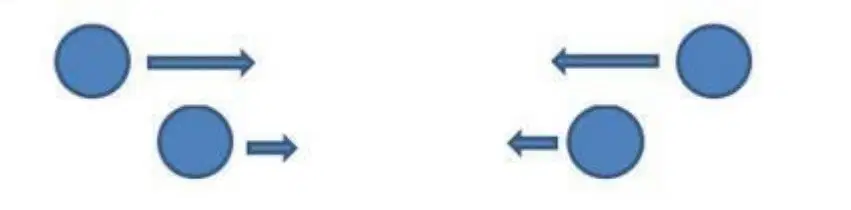
Which pair of objects has the greatest force of gravity between them?
The top pair because they are farther apart.
The bottom pair because they are closer together.
The top pair because they are moving fast.
The bottom pair because they are moving slow.
Why do we have tides here on Earth?
We have tides because of how the moon's gravity pulls on different parts of the Earth.
We have tides because the Earth's oceans move.
We have tides only because of the sun's gravity pulling on Earth.
We have tides because of how the Earth revolves around the sun.
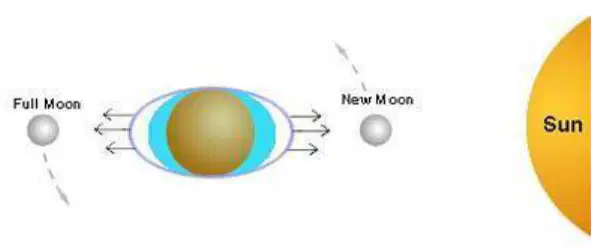
Which type of tide is represented in the picture?
Neap tide because the sun and moon are working opposite each other.
Neap tide because of the tidal bulges.
Spring tide because the sun and moon are lined up and working together.
Spring tide because of the position of the Earth.
The Sun has more mass than Earth. Why doesn't the Moon orbit the Sun instead of Earth?
The moon is closer to Earth than the sun, so its gravitational pull is more.
The Earth has a greater mass than the sun.
Earth's magnetic field is so strong it pulls the moon close.
The other planets counterbalance the gravity of the Sun.
When the South pole is tilted towards the Sun, it is _______.
Summer in both hemispheres.
Winter in both hemispheres.
Summer in the Northern Hemisphere and Winter in the Southern Hemisphere.
Winter in the Northern Hemisphere and Summer in the Southern Hemisphere.
What type of tide occurs when the sun, moon, and the Earth are not aligned?
Neap
Spring
Summer
Big
What causes a difference between the high and low tide of the day?
The gravity of the sun and the moon working together
The gravity of the sun and the moon working against each other
The rotation of the Earth on its axis
The size of the moon
What is the name of the larger, lighter part of the Moon's shadow?
Umbra
Penumbra
Ellipse
Orbit
The part of the Sun that can only be seen during a total eclipse is called the __________.
Core
Chromosphere
Photosphere
Corona
What factor limits the number of eclipses per year?
Distance between the moon and the earth.
Tilt of the moon's orbit around the earth.
Distance between the earth and the sun.
Tilt of the earth's axis of rotation.
The Earth's ______ is an imaginary line that goes from the North Pole to the South Pole.
vernal equinox
axis
solar eclipse
solar flare
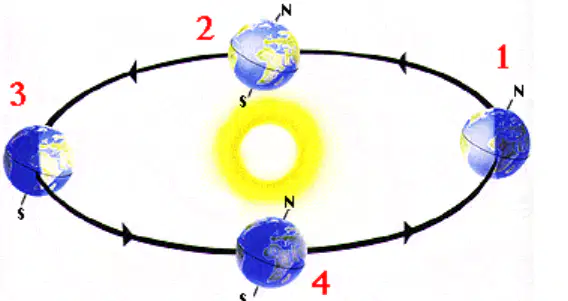
Which season is taking place in the Northern Hemisphere in Position 3?
Winter
Spring
Summer
Fall
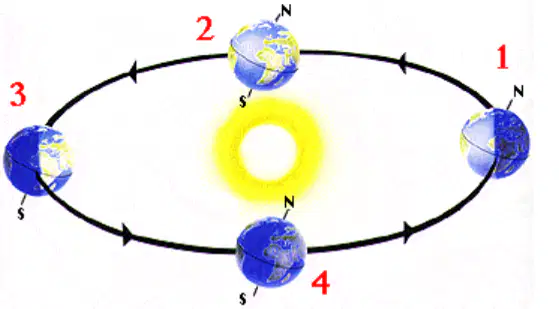
Which season is taking place in the Southern Hemisphere in Position 1?
Winter
Spring
Summer
Fall
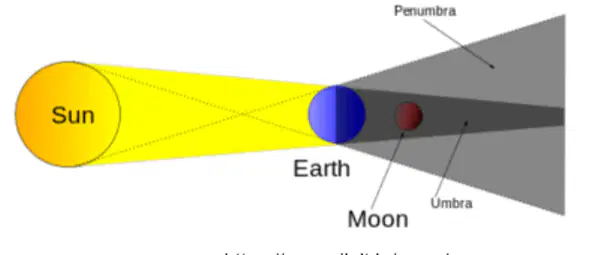
What type of eclipse is shown in the diagram?
Lunar eclipse
Solar eclipse
Full eclipse
New eclipse
Which space machine is known as the first rocket to carry astronauts to the moon?
Hubble Space Telescope
International Space Station
James Webb Telescope
Apollo 11
What holds the planets in their orbits around the sun?
The moon's gravity
Earth's magnetic field
The sun's gravity
The atmosphere
What is the primary force that holds the solar system together?
Magnetism
Velocity
Electric fields
Gravity
Which two planets are out of order in this list of our solar system? Mercury-Venus-Earth-Jupiter-Mars-Saturn-Uranus-Neptune.
Mercury and Earth
Earth and Venus
Mars and Jupiter
Neptune and Uranus
Which of the following is NOT a reason why Earth is considered to be in the "Goldilocks Zone"?
Earth is the perfect distance away from the Sun and the moon.
Earth has an atmosphere that keeps us warm, protects us from the Sun, and sustains water.
Earth is lacking a magnetic field.
Earth has chemicals to support life.
Which of the following is NOT an essential chemical that supports life on Earth?
Hydrogen
Mercury
Oxygen
Sulfur
The ______ the distance between two objects, the more ______ the objects will have.
greater, gravity
smaller, gravity
greater, essential chemicals
smaller, eclipses
The tides are caused by
Earth's rotation on it's axis
The Moon's Gravitational Pull
Earth's revolution around the sun

