
 Worksheets
Federalism
Total questions: 20
Worksheet time: 10mins
India comes under which form of federation?
Coming together federalism
Holding together Federalism
Both
None
Which of the following is not included in State List
Law and Order
National Defence
Education
Agriculture
The concept of Decentralisation signifies
The three tier government at urban level
The two tier government at only rural level
Power taken away from both State and Centre and given to local governance at both urban and rural levels
Autonomy given to State government
In what way changes can be made in the federal constitution
Changes can be Unilateral
Changes require consent of both the levels of government
Changes can be through Judiciary
Changes require only consent of the people
Who is the Political Head of Municipality and Gram Panchayat?
Mayor and Sarpanch
Deputy Collector and Mayor
Sarpanch and Deputy Collector
Mayor and Chief Minister
According to Census 2011, How many languages were included in 'Scheduled Languages'?
25
23
21
22
In case of a clash between the laws made by the centre and a state on a subject in the concurrent list:
the state law prevails.
the central law prevails.
both the laws prevail within their respective jurisdictions
the Supreme Court has to intervene to decide.
What is federalism?
Two or more than two levels of government
Rulers elected by the people
A system where monarch is the head
One man rule
An ideal federal system must have
Mutual trust between different levels of government
Agreement to live together
Both of these
None of these
Who has the power to declare war?
Federal
State
Shared
Which government makes treaties and deals with foreign countries
Federal
State
Shared

Who can create an army and navy?
Federal
State
Shared
union territories do not have the power of a state
true
false
Example of coming together
USA ,Australia ,Switzerland
Australia,Spain and Switzerland
USA,India ,Spain
Example of Holding Together is
India,US ,Canada
Spain ,Belgium ,Australia
India,Spain,Belgium

System of governance where states are weak and centre is strong is .....
Bicameral
Unitary
Federal
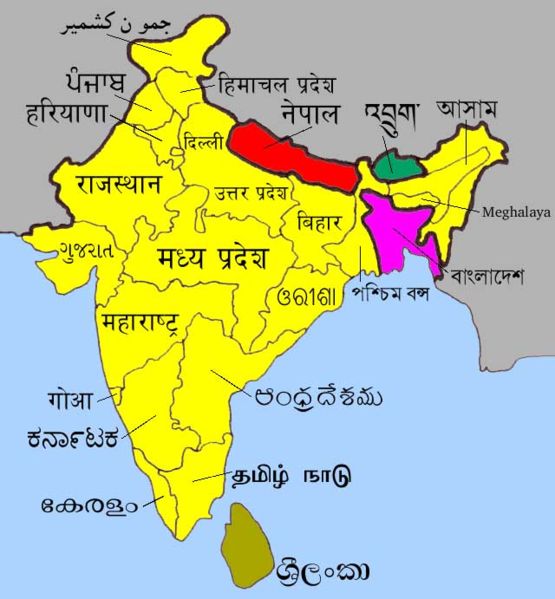
This map of India denotes accommodation based on
Linguistic Diversity
Economic and Social Diversity
System of government
5. The Constitution of India
divided powers between centre and states in three lists.
divided powers between centre and states in two lists.
listed the powers of the states and left the undefined powers to the state.
Specified the pow ers of the states and left the residuary powers with the centre.
Consider the following statements on the practice of federalism in India. Identify those (more than one option) which hold true for decentralisation after 1992.
Local governments did not have any power or resources of their own.
It became constitutionally mandatory to hold regular elections to local government bodies.
The state governments are required to share some powers and revenue with local government bodies.
No seats are reserved in the elected bodies for scheduled castes, scheduled tribes and other backward
Which third tier was added later on in the system of Indian government?
Lok Sabha
Panchayats and Municipalities
Centre
States

