
 Worksheets
Software Design Models: Waterfall and Iterative
Total questions: 44
Worksheet time: 24mins
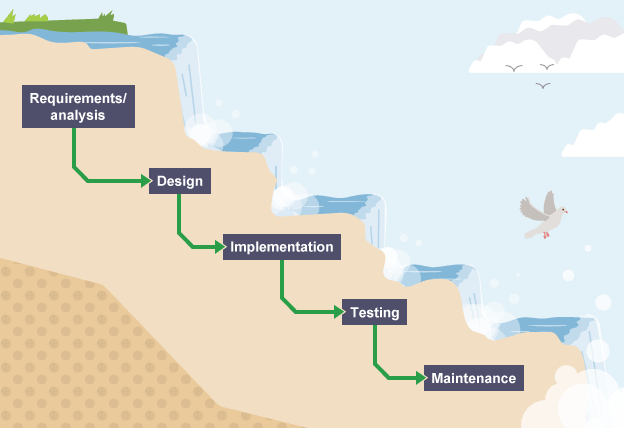
waterfall model happens to clarify the process into ________ flow with a specified sequence
linear
dynamic
Water fall is useful where program are __________________
small
bigger
The Waterfall Model was the first Process Model to be introduced.
True
False
The Waterfall Model is also referred to as what?
Linear-sequential life cycle model
Non linear-sequential life cycle model
Circular-sequential life cycle model
Non Sequential life cycle model
In a waterfall model, each phase must be completed before what?
It does not matter
The next phase can begin
All of the above
What software development approach was the earliest that was used in software development?
Agile Model
Waterfall model
Scrum Model
What is the first activity under the waterfall model?
Software Testing
Design
User (business) requirements definition
Support and maintenance
What is the last activity under the waterfall model?
Software Testing
Design
User (business) requirements definition
Support and maintenance
The process to gather the software requirements from client, analyze and document them is known as
Feasibility Study
Requirement Gathering
Requirement Engineering
System Requirements Specification
It is the process in which developers discuss with the client and end users and know their expectations from the software.
Requirements gathering
Organizing Requirements
Negotiation & discussion
Documentation
A waterfall model is most suitable model for smaller projects.
True
False
Amongst which of the following is/are the characteristics of Waterfall Model
Simplest model
Good to small / medium-sized projects where requirements are specified and do not frequently changed
Development phases executes sequentially
All of the mentioned above
A waterfall model is a model of ____
System Development Life Cycle
System Enhancement
System Prototype
Amongst which of the following model is the oldest model of system development life cycle?
Spiral model
Prototype model
Waterfall model
The Waterfall model approach for the system development divides the whole process of system development into separate phases.
True
False
Which of these is NOT a phase in the Waterfall methodology?
Requirements
Design
Continuous Integration
Implementation
Which of the following is the first phase of the Iterative Model in the Software Development Life Cycle (SDLC)?
Testing
Planning
Design
Implementation
What is a key advantage of the Iterative Model?
It requires complete requirements at the start.
It allows for early detection of risks.
It is less flexible than the Waterfall Model.
It is suitable for small projects only.
Which of the following is a disadvantage of the Iterative Model?
It is inflexible to changes.
It can be more costly than other models.
It does not allow for feedback.
It requires less user involvement.
How does the Iterative Model differ from the Waterfall Model?
The Iterative Model is linear, while the Waterfall Model is cyclical.
The Iterative Model allows for changes after each iteration, while the Waterfall Model does not.
The Waterfall Model is more flexible than the Iterative Model.
The Iterative Model requires complete requirements upfront.
In which real-world application is the Iterative Model commonly used?
Small-scale projects with fixed requirements
Large-scale projects with evolving requirements
Projects with no user feedback
Projects with a short timeline
What is the primary focus during the feedback and iteration process in the Iterative Model?
Minimising costs
Enhancing user interface
Improving product quality and functionality
Reducing development time
Which phase follows the Design phase in the Iterative Model?
Testing
Implementation
Planning
Evaluation
What is a significant benefit of using the Iterative Model in software development?
It eliminates the need for testing.
It allows for early user feedback.
It reduces the need for documentation.
It requires less time for development.
Which of the following is a challenge when using the Iterative Model?
Lack of user involvement
Difficulty in managing changes
High initial costs
Complexity in project management
How does the Iterative Model handle changes in requirements?
Changes are not allowed once development starts.
Changes are incorporated in subsequent iterations.
Changes are only allowed during the testing phase.
Changes are ignored to maintain the timeline.
Which of the following best describes the feedback process in the Iterative Model?
Feedback is collected only at the end of the project.
Feedback is ignored to speed up development.
Feedback is collected and used to improve each iteration.
Feedback is collected but not implemented.
What is a common use case for the Iterative Model?
Projects with well-defined requirements
Projects with a high degree of uncertainty
Projects with no need for user feedback
Projects with a fixed budget
Which phase of the Iterative Model involves evaluating the current iteration and planning for the next?
Design
Testing
Evaluation
Implementation
What is a key difference between the Iterative and Waterfall Models in terms of project delivery?
The Iterative Model delivers the final product at the end.
The Waterfall Model delivers increments of the product.
The Iterative Model delivers increments of the product.
Both models deliver the final product at the end.
Which of the following is an advantage of the Iterative Model over the Waterfall Model?
It requires less documentation.
It is more suitable for projects with fixed requirements.
It allows for continuous improvement.
It has a shorter development cycle.
In the Iterative Model, what is the purpose of the Testing phase?
To finalise the product
To identify and fix defects in the current iteration
To gather user requirements
To design the system architecture
What is a potential drawback of the Iterative Model?
It is less flexible than the Waterfall Model.
It can lead to scope creep.
It requires complete requirements upfront.
It is not suitable for large projects.
Which of the following best describes the Design phase in the Iterative Model?
Creating a detailed plan for the entire project
Developing the final product
Designing a prototype or a part of the system
Testing the system for defects
How does the Iterative Model ensure product quality?
By minimising user involvement
By incorporating feedback and making improvements in each iteration
By reducing the number of iterations
By focusing solely on cost reduction
Which of the following is a characteristic of the Iterative Model?
It follows a strict linear sequence.
It allows for parallel development of components.
It requires a complete design before implementation.
It involves repeated cycles of development.
Well-defined, structured sequence of stages in software engineering to develop the intended software product.
SDLC
SDLC
SLDC
SLCD
SDLC process consist of the following except
PLANNING
DECODING
DESIGNING
DEBUGGING
TESTING
Software development paradigm assumes that everything is carried out and taken place perfectly as planned in the previous stage and there is no need to think about the past issues that may arise in the next phase.
Waterfall Model
Iterative Model
Spiral Model
V- Model
Big Bang Model
Software development paradigm leads the software development process in iterations. It projects the process of development in cyclic manner repeating every step after every cycle of SDLC process.
Waterfall Model
Iterative Model
Spiral Model
V- Model
Big Bang Model
Which SDLC model is best suited for projects with well-defined requirements that are unlikely to change?
Agile
Waterfall
Spiral
Incremental

