
 Worksheets
El Gran Repaso
Total questions: 124
Worksheet time: 4hrs 33mins
Which of the following is an appropriate greeting in Spanish for 1:00 p.m.?
Buenas noches
Buenos días
Buenas tardes
Hola
Based on the time of day, which of the following is an appropriate greeting in Spanish for 9:00 p.m.?
Buenos días
Buenas tardes
Buenas noches
Hola
Which of the following is an appropriate greeting in Spanish for 8:00 a.m.?
Buenas noches
Buenas tardes
Buenos días
Hola
Choose whether you would use tú or usted to address the following people: Your brother.
tú
usted
Choose whether you would use tú or usted to address the following people: Your teacher.
tú
usted
Choose whether you would use tú or usted to address the following people: Your classmate.
tú
usted
Parte 3 – Escribe el número en español. Write the number 25 in Spanish.
(a)
Parte 3 – Escribe el número en español. Write the number 18 in Spanish.
(a)
Parte 3 – Escribe el número en español. Write the number 74 in Spanish.
setenta y cuatro
sesenta y cuatro
ochenta y cuatro
setenta y cinco
Parte 3 – Escribe el número en español. Write the number 93 in Spanish.
noventa y dos
ochenta y tres
ochenta y dos
Parte 3 – Escribe el número en español. Write the number 52 in Spanish.
cincuenta
noventa y dos
cuarenta y dos
Parte 3 – Escribe el número en español. Write the number 100 in Spanish.
cincuenta
noventa
miel
Parte 3 – Escribe el número en español. Write the number 36 in Spanish.
trienta y cinco
trinta y cuatro
trienta y siete
Parte 3 – Escribe el número en español. Write the number 41 in Spanish.
cuarenta y dos
cuarenta y tres
cuarenta
Parte 4 – Escribe la hora en español. Write the time "It's 2:00" in Spanish.
son las dos.
es la dos
son las tres
son las cuatro
Parte 4 – Escribe la hora en español. Write the time "It's 3:30" in Spanish.
Son las tres y media
Son las tres y treinta
Son las cuatro
Es medio día
Parte 4 – Escribe la hora en español. Write the time "It's 3:20" in Spanish.
Son las tres y veinte
Son las cinco menos cuarto
Son las cuatro y cuarto
Son las cinco y veinte
Parte 4 – Escribe la hora en español. Write the time "It's 9:45" in Spanish.
Son las diez menos cuarto
Son las nueve y cuarenta y cinco
Son las nueve menos cuarto
Son las diez y cuarenta y cinco
Parte 4 – Escribe la hora en español. Write the time "It's 8:50" in Spanish.
Son las nueve menos diez
Son las ocho y cincuenta
Son las ocho menos diez
Son las nueve y cincuenta
Fill in the missing month of the year or day of the week in Spanish for the following sequence: lunes, martes, (a) .
Fill in the missing month of the year or day of the week in Spanish for the following sequence: diciembre, enero, (a) .
Fill in the missing month of the year or day of the week in Spanish for the following sequence: sábado, (a) , lunes.
Fill in the missing month of the year or day of the week in Spanish for the following sequence: (a) , febrero, marzo.
Fill in the missing month of the year or day of the week in Spanish for the following sequence: miércoles, (a) , viernes.
Fill in the missing month of the year or day of the week in Spanish for the following sequence: agosto, (a) , octubre.
Write the date in Spanish: It’s January 2nd.
Es el 2 de Enero
Es el 3 de Enero
Es el 1 de Enero
Es el 2 de Febrero
Write the date in Spanish: It’s September 16th.
Es el 16 de septiembre.
Es el 17 de septiembre.
Es el 15 de septiembre.
Es el 14 de septiembre.
Write the date in Spanish: It’s February 20th.
Es el 20 de Febrero.
Son las 20 de Febrero.
Es 20 Febrero.
Está el 20 de Febrero.
Write the date in Spanish: It’s November 25th.
25 de Noviembre
Noviembre 25
25 Noviembre
Noviembre 25th
Write the date in Spanish: It’s July 4th.
Es el 4 de Julio
Es el 4 de Junio
Es el 4 de Agosto
Es el 4 de Septiembre
Write the date in Spanish: It’s March 1st.
Es el 1 de Marzo
Es el 2 de Marzo
Es el 1 de Abril
Es el 1 de Mayo
Write the date in Spanish: It’s December 21st.
Es el 21 de diciembre.
Es el 12 de enero.
Es el 21 de noviembre.
Es el 15 de diciembre.
Answer the following question in a complete sentence in Spanish: ¿Cómo te llamas?
Answer the following question in a complete sentence in Spanish: ¿Qué te gusta hacer?
Answer the following question in a complete sentence in Spanish: ¿Qué no te gusta hacer?
Parte 8 – Escribe los artículos en español. The =
el, la, los, las
un, una, unos, unas
el, los, un, unos
la, las, una, unas
Parte 8 – Escribe los artículos en español. A, An =
los las
el la
ellos ellas
Parte 8 – Escribe los artículos en español. Some =
ellos ellas
los
les
Parte 9 – Conjugate the verb ser in the present tense. Yo
es
eres
ellos
Parte 9 – Conjugate the verb ser in the present tense. Tú
soy
es
somos
Parte 9 – Conjugate the verb ser in the present tense. Él, ella, usted
soy
eres
son
Parte 9 – Conjugate the verb ser in the present tense. Nosotros
son
eres
soy
Parte 9 – Conjugate the verb ser in the present tense. Ellos, ellas, ustedes
soy
es
somos
Parte 10 – Complete the chart with the indirect object pronouns and forms of gustar. A mí
te gusta
le gusta
nos gusta
Parte 10 – Complete the chart with the indirect object pronouns and forms of gustar. A ti
me gusta
le gusta
nos gusta
Parte 10 – Complete the chart with the indirect object pronouns and forms of gustar. A él, ella, usted
nos gusta
les gusta
me gusta
Parte 10 – Complete the chart with the indirect object pronouns and forms of gustar. A nosotros
nos gusta
les gusta
le gusta
nos gusta
Parte 10 – Complete the chart with the indirect object pronouns and forms of gustar. A ellos, ellas, ustedes
nos gusta
le gusta
me gusta
What is the Spanish translation for "I am from Colombia"?
Yo soy de Colombia
Yo tengo de Colombia
Yo vengo de Colombia
Estoy de Colombia
Translate the following sentence to Spanish, using the informal "you": "You are from Peru."
Tú eres de Perú.
Usted es de Perú.
Ellos son de Perú.
Nosotros somos de Perú.
What is the Spanish translation for: "We are from El Salvador."?
Nosotros somos de El Salvador.
Ellos son de El Salvador.
Nosotros venimos de El Salvador.
Yo soy de El Salvador.
Translate the following sentence to Spanish, using the formal "you all": "You all are from Spain."
Vosotros sois de España.
Ustedes son de España.
Ellos son de España.
Nosotros somos de España.
What is the Spanish translation for: "He is from Costa Rica."?
Él es de Costa Rica.
Ella es de Costa Rica.
Ellos son de Costa Rica.
Yo soy de Costa Rica.
What is the Spanish translation for: "Marta is from Honduras."?
Marta es de Honduras.
Marta es de España.
Marta es de México.
Marta es de Argentina.
Which of the following sentences correctly translates to Spanish: "Pablo and Marco are from Cuba."?
Pablo y Marco son de Cuba.
Pablo y Marco es de Cuba.
Pablo y Marco están de Cuba.
Pablo y Marco tienen de Cuba.
What is the Spanish translation for: "I like to draw."?
Me gusta dibujar.
Me gusta correr.
Me gusta leer.
Me gusta nadar.
Translate the following sentence to Spanish, using the formal "you all": "You all like to study."
Les gusta estudiar.
Te gusta estudiar.
Os gusta estudiar.
Les gustan estudiar.
What is the Spanish translation for: "He likes to sing."?
Le gusta cantar.
Ella canta bien.
Quiero cantar.
Nos gusta bailar.
Translate the following sentence to Spanish, using the formal "you": "You like to dance."
Te gusta bailar.
Le gusta bailar.
Nos gusta bailar.
Les gusta bailar.
Which of the following sentences translates to "Mr. Sanchez likes to teach." in Spanish?
El Sr. Sanchez gusta de enseñar.
El Sr. Sanchez tiene un libro.
El Sr. Sanchez come manzanas.
El Sr. Sanchez camina al parque.
Which of the following sentences translates to "They (boys) like to run." in Spanish?
A ellos gusta correr.
Les gusta correr.
A ellos les gusta correr.
Ellos gustan de correr.
Translate the following sentence to Spanish, using the informal "you": "You like to listen to music."
Te gusta escuchar música.
Te gusta leer libros.
Te gusta jugar al fútbol.
Te gusta comer pizza.
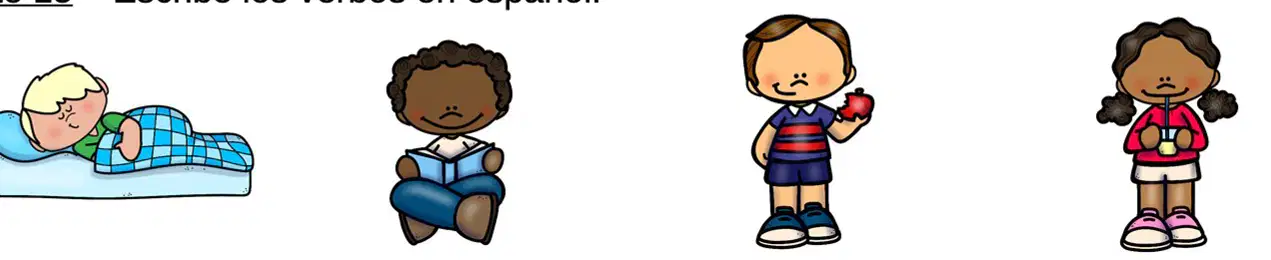
Parte 15 – Escribe los verbos en español. Write the Spanish verbs with the corresponding images. (There are four)
Sleep, read, eat, drink
Yo (arte) ________.
pinto
escribo
canto
bailo
Tú (español) ________.
hablas
hablo
hablan
habla
Ustedes (inglés) ________.
are
is
am
be
Conjugate the verb "tener" in the present tense for "Nosotros".
tenemos
tienes
tienen
tengo
Write the present tense -AR ending for "Yo".
-o
-as
-a
-amos
Write the present tense -AR ending for "Nosotros".
-amos
-emos
-imos
-omos
Write the present tense -AR ending for "Tú".
-o
-as
-a
-amos
What is the present tense -AR ending for "Él, ella, usted"?
-amos
-áis
-an
-a
What is the present tense -AR ending for "Ellos, ellas, ustedes"?
-amos
-áis
-an
-en
What do "Nosotros" have to do, using "tener + que"? The verb provided is "estudiar".
Nosotros tenemos que estudiar
Nosotros tenemos estudiar
Nosotros tener que estudiar
Nosotros estudio
What does "Miguel" have to do?
Miguel tiene que hablar español
Miguel tiene que comer
Miguel tiene que correr
Miguel tiene que dormir
What does "Usted" have to do, using "tener + que" with the verb "escribir"?
Usted tiene que escribir
Usted tiene que leer
Usted tiene que correr
Usted tiene que hablar
Conjugate the verb "cantar" in the present tense for "Yo".
canto
cantas
canta
cantamos
Conjugate the verb "nadar" in the present tense for "Nosotros".
nadan
nadas
nadamos
nado
Conjugate the verb "pescar" in the present tense for "Leo".
pescáis
pescamos
pescas
pesco
pesca
Conjugate the verb "acampar" in the present tense for "Tú".
acampas
acampo
acampamos
acampan
Conjugate the verb "escuchar" in the present tense for "Ava y yo".
escuchamos
escuchan
escuchas
escucho
Parte 24 – Conjugate the verb IR in the present tense. Complete the conjugation for "Nosotros" in the present tense of the verb IR.
vamos
vas
van
voy
Complete the sentence for "Lincoln (to the cafeteria)" with the correct form of the verb IR and the place in Spanish.
Lincoln va al gimnasio
Lincoln va a la cafetería
Lincoln va a la biblioteca
Lincoln va al baño
Write the –ER verb endings in the present tense for the pronoun "Yo".
E
Es
emos
Write the –ER verb endings in the present tense for the pronoun "Tú".
E
EN
EMOS
Write the –ER verb endings in the present tense for the pronoun "Él, ella, usted".
EN
ES
EMOS
Write the –ER verb endings in the present tense for the pronoun "Nosotros".
EN
ES
E
Write the –ER verb endings in the present tense for the pronoun "Ellos, ellas, ustedes".
ES
EMOS
E
Translate the sentence to Spanish: "I run in the gym."
Corro en el gimnasio.
Yo corro en la casa.
Ellos corren en el parque.
Nosotros corremos en la escuela.
Translate the sentence to Spanish: "We do the homework."
Translate the sentence to Spanish: "You (informal) live in a green house."
Translate the sentence to Spanish: "The teacher (female) opens the door."
Translate the sentence to Spanish: "They (boys) read a book."
Make the following noun plural and be sure to include the correct definite article: "El libro".
el libros
los libro
el libro
Make the following noun plural and be sure to include the correct definite article: "La mujer".
la mujer
las mujer
la mujeres
Make the following noun plural and be sure to include the correct definite article: "El papel".
el papel
los papeles
el papeles
Make the following noun plural and be sure to include the correct definite article: "El hombre".
el hombre
los hombre
el hombres
we
nosotros
vosotros
ellos
ustedes
Which would you use to replace "Miguel"?
tú
ella
él
yo
Alejandro y yo (we)
nosotros
vosotros
ellos
ustedes
Lola y Carlos (they)
nosotros
vosotros
ellos
ustedes
we (only girls)
ellos
nosotros
nosotras
ellas
él
she
they
he
we (males)
nosotros
we (male and mix)
we (female)
you (plural)
they (males)
The verb tener means...
to be
to have
to go
to want
ella
I
he
she
they (female)
usted
I
you (formal)
you (informal)
you (plural)
¿Cuál es el número 57 en español?
Cincuenta y siete
Sesenta y siete
Cuarenta y siete
Setenta y cinco
Doce
12
2
11
20
cuarenta
14
30
40
10
diecinueve
8
9
19
28
How do you say "month" in Spanish?
día
año
mes
semana
¿Cómo se dice...You (informal) go?
Tú va
Tú estás
Tú vas
¿Cómo se dice city en español?
surbubio
ciudad
campo
parque
How do you say "Antonio and I are going to buy a backpack"
Antionio y yo va a comprar una mochila.
Antonio y yo vamos a comprar una mochila.
Anontio y yo vamos a compramos una mochila.
Anontio y yo va a compra una mochila.
Si quieres pedir una hamburguesa en un restaurante, ¿cuál es la frase correcta?
Quiero una hamburguesa, por favor.
Tengo una hamburguesa.
Me gusta una hamburguesa.
Soy una hamburguesa.
I have
Yo tengo
Yo tiene
Tú tengo
ella tiene
I am hungry
(a)
pasar tiempo juntos
to spend time together
to spend time apart
to watch the weather
to pray together
una
the
some
a
those

