
 Worksheets
7A2 Review for 2nd end-term test
Total questions: 127
Worksheet time: 2hrs 54mins
What is at the center of every atom?
An electron
A compound
A molecule
A nucleus
Which two particles make up the nucleus of an atom?
Protons and Electrons
Protons and Neutrons
Molecules and Compounds
Neutrons and Electrons
In an atom, what is the number of protons equal to?
The number of electrons.
The number of neutrons.
The number of molecules.
The number of nuclei.

The particles with no charge in an atom are the _______.
electrons
neutrons
protons
protons and neutrons

The positively charged particles of an atom are the ________.
electrons
protons
neutrons
protons & neutrons

The negatively charged particles of an atom are the ______.
electrons
protons
neutrons
protons & neutrons
An electron has this charge
positive
negative
neutral
A neutron has this charge
negative
positive
neutral
A proton has this charge
negative
positive
neutral
A particle that moves around the nucleus is a(n)...
Proton
Neutron
Electron
Quark
The center of an atom that holds protons and neutrons?
model
electron
nucleus
neutron

What does the nucleus of an atom contain?
Electrons and neutrons
Protons and neutrons
Neutrinos and positrons
DNA and RN

What number indicates an electron?
1
2
3
4

What number indicates the nucleus?
1
2
3
4
Which element has 31 protons ?
Gallium
Germanium
Gadolinium
Polonium
What is the mass number?
the number of protons
the sum of the number of protons and the number of neutrons in the nucleus of an atom
the number of electrons
the number of neutrons
What is the atomic number?
number of protons
number of neutrons
Which element has 31 protons ?
Gallium
Germanium
Gadolinium
Polonium

Oxygen’s atomic number is 8. This means that an oxygen atom must have
8 electrons
8 protons
8 neutrons
a mass number of 8

What is the mass number of this element?
5
27
32
59
Which one describes purity or pure element?
it has two or more different types of atom
it has one and the same type of atoms all throughout
it is made up of sub-atomic particles
it is a matter and has the different subatomic particles
Gold is divided into 24 parts, with each single unit called a karat. The higher the karat, the purer the gold. How much is the concentration of gold in a 10 K neclace?
99.5 %
75 %
50 %
41.7 %
Gold is divided into 24 parts, with each single unit called a karat. The higher the karat, the purer the gold. How much is the concentration of gold in a 14 K neclace?
99.5 %
75 %
58.3 %
41.7 %
If a diamond has 1000 parts, it is said to be pure diamond. If the diamond is mixed with parts of other atoms, what is the concentration of a diamond if it has at least 800 parts?
50 %
60 %
70 %
80 %
When there is more than one product they are mixed up together, this means that the product produced is ______.
pured
compound
impured
atom
Some reactions would lead to impurity because it has two or more products during the reaction. Why do you think it is hard to produce pure product?
Select two correct responses.
because some different types of atoms of compounds are mixed up
because reactants are made up of two different compounds reacting together
atoms do not react each chemically
atoms are attracted to each other
The weather is_________.
The typical state of the atmosphere in a long period of time.
The state of the atmosphere at a particular time.
The atmospheric condition usually for 30 years
The atmospheric condition that is affected by temperature and precipitation
The climate is______.
The typical state of the atmosphere over a long period of time.
The state of the atmosphere at a particular time.
The atmospheric condition that is affected by temperature, cloudiness, humidity and precipitation
The atmospheric condition that usually changes any time of the day
Which among the choices best fits describe WEATHER?
Select all that applies
The typical state of the atmosphere over a long period of time.
The state of the atmosphere at a particular time.
The atmospheric condition that is affected by temperature, cloudiness, humidity and precipitation
The atmospheric condition that usually changes any time of the day
Which among the choices that best fits describe CLIMATE?
Select all that applies
The typical state of the atmosphere in a long period of time.
The state of the atmosphere at a particular time.
The atmospheric condition usually for 30 years
The atmospheric condition that is affected by temperature and precipitation
Which factors that contribute to the CLIMATE of a region?
Select all that applies
temperature
cloudiness
humidity
precipitation
Which factors that contribute to the WEATHER of a region?
Select all that applies
temperature
cloudiness
humidity
precipitation
evaporation
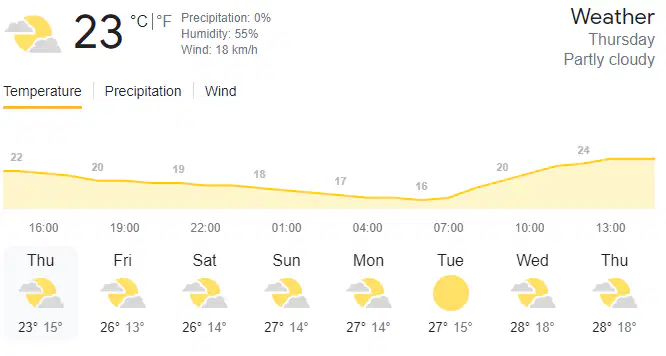
Take a closer look of the image on the left.
What is the forecast telling you?
it tells you the weather specifically the temperature on Thursday and also shows the predicted weather for a week
it tells you the predicted climate of a certain place for a week
it tells you the weather of a certain place for a month
it tells you the weather on Thursday showing the precipitation level for a week

Take a closer look of the image on the left.
What is the forecast telling you?
it is very hot
it is cool
it is extremely cold
very low chance of rain
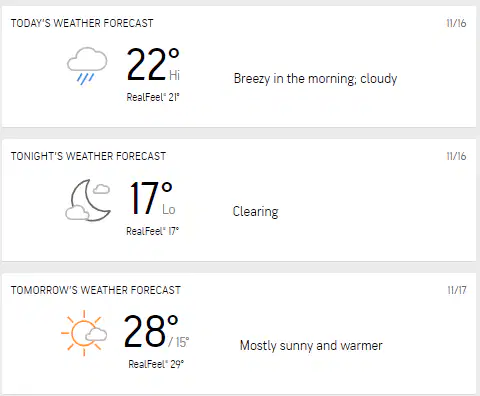
The image on the left is a weather forecast on November 16, 2023.
Compare the weather at 3:15 of November 16 (220) to the weather in the evening.
What conclusion can you make about this forecast?
Select all that applies
it will get a bit cold in the evening
it is cloudy during the day
it is extremely cold
it gets warmer the next day
the sky is clear and a bit cool at night
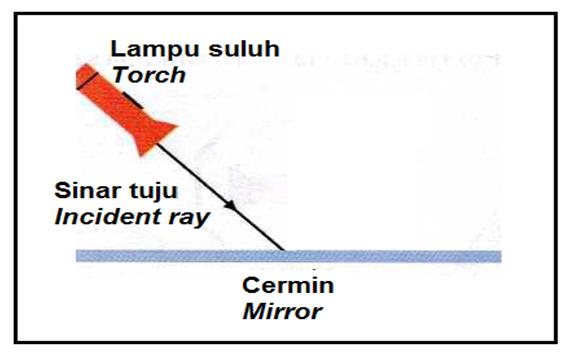
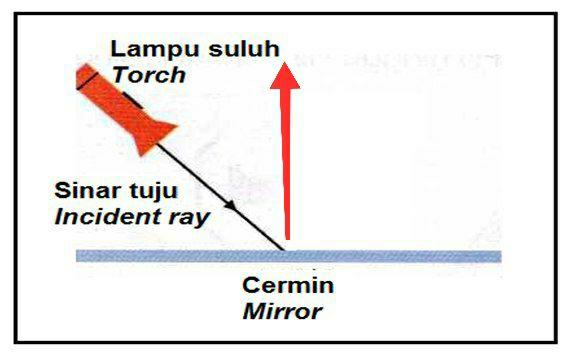
The following diagram shows the ray diagram when a torch light is torched towards a mirror. Which of the following is the correct reflected ray?
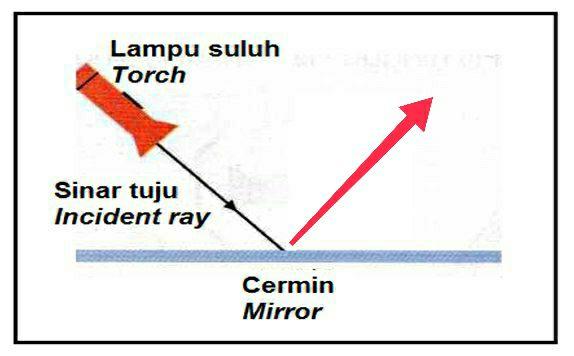
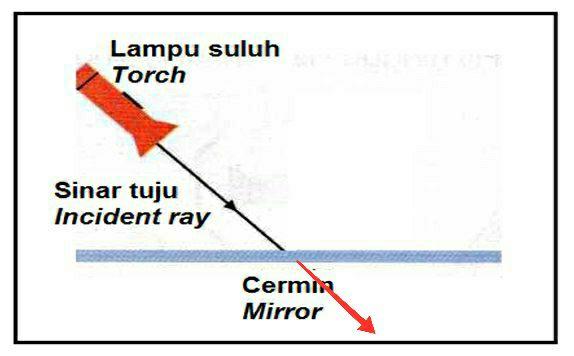
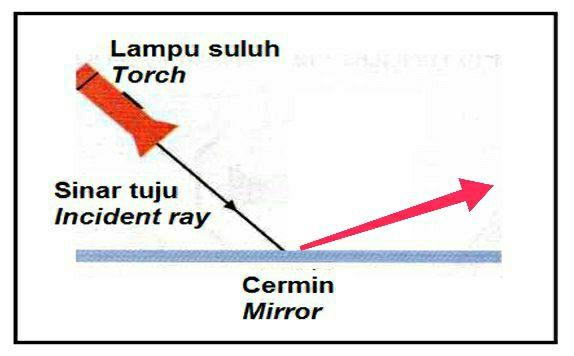

The following diagram shows a driver who could see the image of a vehicle behind him without turning his back.
Why?
Light travels in a straight line
Light is refracted
Light is reflected
Light travels in two different mediums

Which is the reflected ray?
A
B
C
D
which image represents reflection of light?


When light hits a shiny surface and bounces back, it is an example of:
Absorption
Refraction
Reflection
Scattering

In the diagram, which letter represents the angle of incidence?
A
B
C
D

The ray of light that strikes a reflecting surface is called _____________.
incident ray
reflected ray
normal ray
none of the above
According to the laws of reflection, if i = angle of incidence and r = angle of reflection
i > r
r > i
i=r
i is not equal to r
Light travels through air, water, glass and many other materials. What path does it travel to get from one place to another?
sideways
back and forth
straight
up and down
........... – the angle between the normal and the incident ray.
Angle of incidence
Angle of reflection
Angle of coincidence
Angle of direction
Objects that reflect well are
Matte surfaces
Smooth, shiny surfaces
Dark coloured surfaces
Medium coloured surfaces
The law of reflection states that
Angle of incidence = Angle of reflection
Angle of incidence = Angle of incidence
Angle of reflection = Angle of translucence
Angle of reflection = Angle of reflection
Lateral inversion is
When a light ray hits an object as a curved wave
The term used to describe light rays reflecting off dark, matte surfaces
The same as 'angle of incidence'
When something is reflected in a plane mirror where left becomes right and right becomes left
A concave mirror
Curves inwards
Curves outwards
Curves sideways
Curves in multiple directions
A convex mirror
Curves inwards
Curves outwards
Curves sideways
Curves in multiple directions

The angle of reflection is
90 degrees
55 degrees
45 degrees
135 degrees
Refraction is
The bending of light as it passes through the one substance at an angle
A light beam shone in one end of an optical fibre and totally internally reflected at the other end
The bending of light as it passes from one substance to another at an angle
A type of convex object used in everyday life

The above image is an example of a ____________. They happen because cool and hot air have a different ___________________________.
Mirage; angle of incidence
Optical fibre; refractive index
Lateral inversion; angle of reflection
Mirage; refractive index
Refraction happens because light travels _____________ in glass or water compared to air
Faster
The same
At the speed of sound
Slower
Total internal reflection is
When lateral inversion occurs
When the angle of reflection increases up to a critical point where all the light is reflected
When the angle of incidence increases up to a critical point where all the light is reflected
Used in surgery where a light is connected to an optical fibre
A convex lens produces a _______ image whereas a concave lens produces a _______ image
Virtual, real
Virtual; diffused
Real; refracted
Real; virtual
An example of total internal reflection is
Diamond
Looking down at someone in a swimming pool
A camera inserted in a person's body during surgery
The 'pool' of water seen when looking into the distance on a hot day
The refractive index of a substance
Is the degrees between the reflected ray and the normal
Is a number that tells you how much the light bends when going from air into that substance
Is a number that tells you how fast the light bends when going from air into that substance
Is the degrees between an incident ray and the normal

The angle of incidence is
56 degrees
124 degrees
90 degrees
34 degrees
The incident ray is the light ray leaving the light source. The angle of ______________ correlates with the incident ray.
Incidence
Reflection
Refraction
Normal
who discovered that white light could be split into different colors
Edison
Einstein
newton
what do we call the range of colours that can be seen in white light
(a)
Orders of colors
(a)
When light split into different colours
(a)
why light is shown as multiple colors after the prism?
(a)
when drops of water in the air cause dispersion of light
(a)

A
B
C
D

The t-shirt reflects red light, the shorts reflect green light, other colours are absorbed.
The t-shirt reflects blue light, the shorts reflect red light, other colours are absorbed.
The t-shirt reflects red light, the shorts absorb yellow light, all other colours are reflected
The t-shirt reflects red light, the shorts reflect blue light, other colours are absorbed.


Red + Blue = Magenta
Red + Green = Yellow
Blue + Green = Cyan
Red + Green = orange

A
B

A
B
A
B

Which colour combinations produce yellow?
Red and Cyan
Cyan and Magenta
Red and Blue
Red and Green

In the additive colour mixing, select the secondary colours.
Yellow
White
Magenta
Cyan
what colour will form when a blue light and green light shie on the same spot on a white paper?
yellow
blue
black
cyan

Why does this flower appear magenta to our eyes?
Only red and blue light are absorbed into our eye
Because all colours of the visible spectrum are absorbed
Because that's what colour the flower is
Only red and blue light are reflected into our eye

How will this object appear when looking at it through a blue filter?
Blue
Green
Black
Orange

Which color will transmit through the filter?
Red only
Blue and Violet
Green
All colors

A leaf is green. What does this tell you about the light that is being absorbed?
The light is a UV ray.
The light is not a part of the light spectrum.
All colors are reflected except green.
All colors are absorbed except green
What type of galaxy is the Milky Way?
Spiral
Elliptical
Irregular
Transition
One of the more common types of galaxies which have stars still forming within them are...
Elliptical
Spiral
Irregular
Transition
This type of galaxy is generally considered to be older and is no longer forming stars.
Spiral
Irregular
Elliptical
Transition Galaxies

A flat, disk-shaped galaxy with a central bulge and winding "arms" that extend outward.
irregular galaxy
spiral galaxy
elliptical galaxy
random galaxy


Which element makes up the most composition of the Sun?
Helium
Oxygen
Hydrogen
Carbon

I am located between Mars and Jupiter.
Comet belt
Asteroid belt
Meteor belt
Stars
If you took all the asteroids in the main belt and lumped them together, how large would it be?
Smaller than our moon
Slightly larger than Earth
Close to the size of Jupiter
About the size of a blue whale
Ceres is the largest asteroid, and it is spherical.
True, it retains is shape because of it's massive size.
False, it is only a midsize asteroid.
False, it is lumpy like deimos
False, it is actually a moon.
Do all asteroids live in the main belt?
No, there are some that have orbits that cross Mars and Earth
Yes, once an asteroid leaves the main belt it becomes a comet.
Yes, asteroids are pulled into the main belt through gravity and cannot escape it.
No, asteroids sometimes leave and come back to the main belt after visiting neighboring planets.
How many stars are in a galaxy.
billions
thousands
hundreds
Ten
Vitamin C


If you suffer from anaemia you should eat foods rich in _____.

_____________can be used as a store of energy in animals.

