
 Worksheets
Probability Practice - 7th Grade Math
Total questions: 52
Worksheet time: 2hrs 44mins

Which of the following numbers are you most likely to spin?
1
2
3
6

Which number are you most likely to spin?
1
2
3
4
Equal chance for all numbers

If the spinner is spun one time, how many possible outcomes are there?
1
2
8
64

If spinning an EVEN number is a favorable outcome, how many favorable outcomes are there using this spinner?
1
2
4
8
A basketball team wins the game about 2/3 of the time. What is the likelihood it will its next game?
No chance
Unlikely
50/50
Likely
The TV weather person said there was a 0% chance of snow tomorrow. What best describes the likelihood it will snow?
No chance
Likely
50/50
Certain
What is meant by a probability of 1?
Impossible
Likely
50/50
Certain

If the spinner is spun one time, what is the likelihood it will be at least 5?
No chance
Unlikely
50/50
Likely

Based on the results of the favorite color survey, what is the experimental probability of choosing BLUE?
4012
2012
12
40

Based on the results of the favorite color survey, what is the experimental probability of choosing BLUE or GREEN?
12/40
14/40
20/40
40/40

Based on the results of the favorite color survey, what is the experimental probability of choosing ORANGE?
0
20/40
12/40
1

Based on the results of one spin, what is the probability of spinning an even number?
0%
40%
50%
60%

Based on the results of one spin, what is the probability of spinning a number greater than 8?
0%
20%
30%
50%

What is P(5)?
0
1/6
5/6
1

What is P(even number)?
0
2/6
3/6
4/6

What is P(less than 7)?
0
1/6
3/6
1

How many possible outcomes are there when rolling two dice?
6
12
36
72

How many possible options are there for fitness trackers?
9
18
20
24

How many possible outfit combinations are there based on the picture?
16
36
40
128

Answer the question based on rolling two dice.
What is P(12)?
1/36
2/36
1/6
2/6

The probability of rolling a five and flipping a heads is ____.
1/12
2/12
5/12
6/12
A collection of outcomes
Trial
Sample
Fair
Event
The set of all possible outcomes
Sample Space
Event
Trial
Probability
Probability that is based on repeated trials of an experiment
probability
experimental probability
theoretical probability
fundamental counting principle
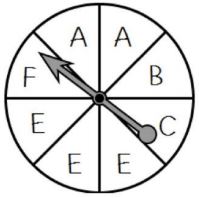

What is the probability you spin something larger than 10
5
3/10
10/15
3/8

Find the probability of drawing a 10 from a standard deck of 52 cards.
1 out of 52
13 out of 52
26 out of 52
1 out of 13
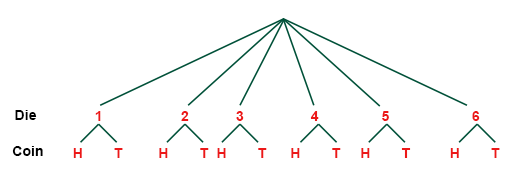
How many total outcomes are there?
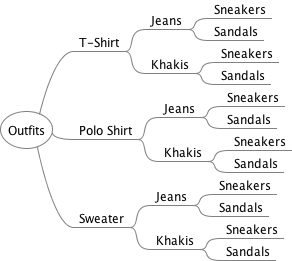
You have a 3 tops, 2 pants and 2 shoes. How many total outfit options are represented?
12 outfits
22 outfits
3 outfits
7 outfits

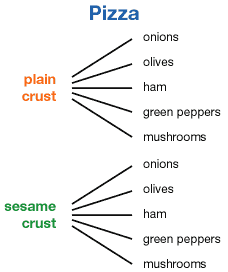
What is the probability that you will get plain crust with ham on your pizza?
1/8
1/2
1/10
2/10

What is the probability that you will get mushrooms on your pizza?
2/10
2
2/5
Which tree diagram has the most possible outcomes?
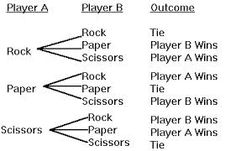
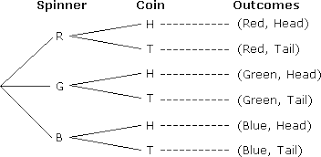
There are 4 jacks in a standard deck of 52 playing cards. If Peyton selects a card at random, what is the probability that it will be a jack?
1/13
1/52
1/2
12/13
Complementary Events
A game where there is not a chance of each player being equally likely to win
The events of one outcome happening and that outcome not happening. The sum of the probabilities of an event and its complement is 1 or 100%.
An event consisting of two or more simple events
The ratio of the number of ways an event can occur to the number of possible outcomes. It based on what should happen when conducting a probability experiment
Fair Game
An experiment hat is designed to model the action in a given situation
A game where each player has an equally likely chance of winning
The chance that some event will happen. It is the ratio of the number of favorable outcomes to the number if possible outcomes
An arrangement, or listing, of objects in which order is important
Fundamental Counting principle
Two or more events in which the outcome of one event affects the outcome of other events
An estimated probability based on the relative frequency of positive outcomes during an experiment. It is based on what actually occurred during such an experiment
Uses multiplication of the number of ways each events in an experiment can occur to find the number of possible outcomes in a sample space
The events of one outcome happening and that outcome not happening. The sum of the probabilities of an event and its complement is 1 or 100%.
Sample Space
Uses multiplication of the number of ways each events in an experiment can occur to find the number of possible outcomes in a sample space
The set of all possible outcomes of a probability experiment
An arrangement, or listing, of objects in which order is important
Any one of the possible results of an action. For example, 4 is an outcome when a number cube is rolled
Theoretical Probability
Two or more events in which the outcome of one event affects the outcome of other events
Uses multiplication of the number of ways each events in an experiment can occur to find the number of possible outcomes in a sample space
The ratio of the number of ways an event can occur to the number of possible outcomes. It based on what should happen when conducting a probability experiment
An arrangement, or listing, of objects in which order is important
You flip two coins. What is the probability of getting two tails?
I L O V E M A T H
You pull a letter at random. What is the probability the letter is an I or A?

