wayground logo

Free Printable Worksheets

Font size

S
M
L
XL
Worksheets

JMS law of cons of mass plus acid/base and pH

Total questions: 41

Worksheet time: 57mins

Name
Class
Date
1.

The Law of Conservation of Mass states Matter is NEITHER created nor destroyed.

a)

True

b)

False

2.
The number in front of a compound or element is a 
a)
Subscript
b)
Coefficient
c)
Superscript
d)
Charge
3.

The Coefficient (3) in the Chemical Formula, 3H2O, tells you how many _____________ there are.

a)

Atoms of Hydrogen

b)

Atoms of Oxygen

c)

Atoms of Water

d)

Molecules of Water

4.
The number to the lower side of an element is a 
a)
Subscript
b)
Superscript
c)
Coefficient
d)
Charge
5.

How many oxygen atoms are in this chemical formula?

a)

6 oxygen atoms

b)

2 oxygen atoms

c)

3 oxygen atoms

d)

4 oxygen atoms

6.
A chemical reaction is balanced when
a)
both sides have the same elements
b)
Both sides have the same  number of atoms
c)
Same subscripts
d)
Same coefficients
7.
If a reaction starts with a total 75g of reactants it should produce 
a)
a total of 40g of products
b)
a total of 75g of products
c)
a total of 180 g of products
d)
None of the above
8.
24 g of magnesium reacts with 38 g of fluorine to produce _____ g magnesium fluoride
a)
62 
b)
38
c)
24
d)
14
9.
What is the arrow in a chemical equation...
H2 + O --> H2O
a)
Reactants
b)
Products 
c)
Yields 
d)
Chemical Equation 
10.

Is this equation balanced or unbalanced?

CH4 + 2O2--> CO2+ 2H2O

a)

balanced

b)

unbalanced

11.
12g of Carbon react with 16g of Oxygen, how much carbon monoxide (CO) is formed? 
a)
28 g
b)
4g
c)
30g
d)
12g
12.
Question Image

Match the following

a)

Reactant

Element

1.

2C2

b)

Reactant

Compound

2.

CH4

c)

Product

Compound

3.

CO2

13.
Exothermic reactions
a)
have higher energy in their products than their reactants
b)
release energy
c)
get cold
d)
are synthesis reactions
14.
Students react baking soda & vinegar.
Which of the following would provide the evidence that the number of atoms present before a chemical reaction is equal to the number of atoms present after the chemical reaction?
a)
The mass of the plastic bag, baking soda, and vinegar before the reaction was equal to the mass after the reaction.
b)
Bubbles were produced during the reaction, which meant that a gas was being produced.
c)
The plastic bag did not change in any way, indicating that it was not involved in the reaction.
d)
The mass of the baking soda was exactly equal to the mass of the vinegar used to create the chemical reaction.
15.
Balance this equation.
_CF+ _Br-- _CBr+ _F2
a)
2,1,2,1
b)
1,2,2,1
c)
1,2,1,2
d)
2,2,2,2
16.

Does the equation H2+O2 →H2O follow the Law of Conservation of Mass?

a)

Yes, because the atoms are equal.

b)

No, because more info is needed.

c)

No, because there are more atoms in the product.

d)

No, because there are more atoms in the reactant.

17.

The ​ (a)   are on the right side of the arrow and the ​ (b)   are on the left side of the arrow.

Choose from the below words
products
reactants
dipoles
samples
ionic compounds
covalent compounds
18.

What is the pH of a neutral solution at 25°C?

a)

0

b)

7

c)

14

d)

It varies

19.

Which of the following is a sign of a chemical reaction?

a)

Change in state of matter

b)

Change in temperature

c)

Dissolving of a substance

d)

Change in volume

20.
How many Hydrogen atoms are on the reactant side of this chemical equation?            
2C2H2 + 5O2  -->  4CO2 + 2H2O
a)
2
b)
4
c)
6
d)
8
21.
Is this equation balanced?
a)
yes
b)
no
c)
Not enough information
d)
Left side is balanced
22.
What are the smaller numbers that you CANNOT change in a chemical equation? 
a)
Coefficient
b)
Products
c)
Reactants
d)
Subscript
23.
What coefficients are needed to correctly balance the equation?
_Bi   +   _O2   →  _Bi2O3
a)
3,2,3
b)
2,3,2
c)
4,3,2
d)
none of these
24.

Which of the following would increase the rate of a chemical reaction?

a)

Removing a catalyst

b)

Diluting the chemicals

c)

Decreasing the temperature

d)

Adding a catalyst

25.

Which colour on the graph would represent the solution with the higher temperature?

a)

Red

b)

Blue

c)

None

d)

Both

26.
Increasing the surface area of the reactants will increase the rate of the reaction.
a)
True
b)
False
27.

The rate of a reaction increases as temperature__________________

a)

decreases

b)

increases

c)

stays the same

28.

Products will form faster if____________

a)

the particle size of the reactants are larger.

b)

temperature is decreased.

c)

concentration of the reactants are increased.

d)

the reaction is not stirred.

HIDE ANSWER

29.

Smaller particle size allows for a _________ surface area to be exposed for the reaction.

a)

larger

b)

smaller

c)

very small

d)

extremely small

30.

You observe bubbles after adding metal to a solution. Has a chemical reaction taken place?

a)

Yes

b)

Yea

c)

Yeap

d)

No

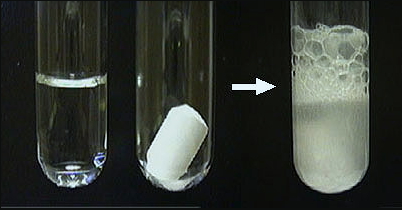
31.

How could we make this reaction happen more quickly?

a)

Decrease the concentration of the acid

b)

crush the chalk to increase the surface area

c)

Put the test tube in an ice bath

32.
To slow down a chemical reaction you will do one of the following:
a)
Place the reactants in hot water
b)
Place the products in ice bath
c)
Place the reactants in a ice bath
d)
Keep stirring the reactants with a stirring rod
33.
More collisions correspond to a: 
a)
Faster reaction rate  
b)
Slower reaction rate
c)
Constant reaction rate 
d)
None of the above
34.
Which of the following is a base?
a)
orange juice
b)
water
c)
vinegar
d)
dishwashing detergent
35.
 Which of the following is an acid?
a)
shampoo
b)
baking soda
c)
orange juice
d)
water
36.
Many cleaning solutions are bases. Which of the following is a property of most bases?
a)
feels slippery
b)
white color
c)
can only be liquid
d)
tastes sour
37.
Which food is the most acidic?
a)
bananas
b)
lemon juice
c)
orange juice
38.
Bleach is a strong base, what is the pH level of bleach?
a)
13
b)
14
c)
1
d)
2
39.
tastes sour
a)
acid
b)
base
40.
tastes bitter
a)
base
b)
acid
41.

In a chemical equation, a ​ (a)   is a number that shows how many atoms of an element are in a particle of a compound, while a ​ (b)   is a number that tells you how many particles of that compound you have.

Choose from the below words
subscript
coefficient
multiple
molar mass