
NEW
Font size
 Worksheets
Target Audience and Research Quiz
Total questions: 28
Worksheet time: 14mins
What does the term "demographic" refer to in the context of audience analysis?
The statistical data of a population, especially those showing average age, income, education, etc.
The geographical location of a population.
The preferred media products of a population.
The political affiliations of a population.
What is meant by "segmentation" in marketing?
Dividing a market into distinct groups of buyers who have different needs, characteristics, or behaviors.
The process of increasing the sales of a product through aggressive advertising.
The method of combining different demographics to form a large target audience.
The practice of changing the price of a product to match with competitor prices.
How can segmentation help in targeting an audience for a media product?
By focusing on a broad range of demographics to increase general appeal.
By identifying specific needs and interests to tailor the product more effectively.
By reducing the cost of marketing to a larger audience.
By ignoring niche markets to streamline production.
What can the 'Location' category in audience segmentation include?
City only
Country only
Continent, country, region, or city
Specific businesses
What does the acronym STICAMS stand for in the context of audience segmentation?
Specific, Tailored, Identifiable, Content, Achievable, Meeting needs, Success
Segmentation, Targeting, Identification, Communication, Achievement, Management, Strategy
Specific, Tailored, Identifiable, Content, Achievable, Measurable, Success
Segmentation, Targeting, Identification, Communication, Achievement, Measurable, Strategy
Why is having a specific target audience beneficial for a media product?
It allows for broader and more general marketing strategies.
It helps focus the message on the right group of people who are most likely to respond.
It requires more time and costs to reach the audience.
It makes the product less identifiable to the audience.
How does audience segmentation contribute to measurable success of a media product?
By making it difficult to gather specific feedback from the target audience.
By ensuring the product is vague and general to appeal to a broad audience.
By making it easier to measure success through specific feedback from the target audience.
By increasing the time and costs involved in reaching the target audience.
What is the primary purpose of conducting research in media product design, according to the text?
To extend the production time
To influence the design and meet the needs of the target audience
To reduce the costs of production
To entertain the research team
What happens if the media industry ignores audience research?
It increases the film's popularity
It has no noticeable effect
It decreases the chances of the product's success
It shortens the production process
What is the primary purpose of using primary research methods in audience or competitor research?
To gather second-hand information
To verify external data sources
To collect first-hand accounts, data, or opinions directly related to the product or idea
To analyze previously published data
Which of the following best describes the concept of 'validity' in the context of research?
The consistency and accuracy of the data
The extent to which the method measures what it is intended to measure
The frequency of data collection
The use of multiple sources to gather data
What does 'reliability' refer to in research?
The method's ability to produce similar results under consistent conditions
The method's ability to gather large amounts of data
The method's cost-effectiveness
The method's compliance with ethical standards
What is the primary purpose of using focus groups in primary research methods?
To collect data through online surveys
To discuss an idea or product and gather analyzed responses before and after its creation
To conduct in-depth interviews
To distribute questionnaires for detailed analysis
Which primary research method is described as being useful for obtaining specific contributions that are needed?
Online surveys
Focus groups
Interviews
Questionnaires
What is a characteristic of online surveys as a primary research method?
They require face-to-face meetings
They are often completed with paper and pencil
They use tools like SurveyMonkey to provide quick and easy analysis of data
They are mainly used for collecting emotional responses
Why might questionnaires be considered difficult to analyze?
They only allow yes/no answers
They provide minute-by-minute data
They contain more detailed responses in the person’s own words
They are used exclusively online
Which of the following is an example of a secondary research source?
An original experiment conducted in a laboratory.
A textbook summarizing various studies.
A personal diary.
A live broadcast of an event.
What type of information might you find in academic journals that qualifies them as secondary research sources?
Personal narratives and memoirs.
Summaries and analyses of primary research.
Advertisements and product catalogs.
Original letters and historical documents.
How can internet sites and research be utilized as secondary research sources?
By providing real-time data and live updates.
By offering original, unedited video footage.
By browsing for background information and competitor products.
By publishing legal documents and statutes.
What is a common use of magazines and newspapers in secondary research?
They are primarily used for entertainment purposes.
They offer detailed technical and scientific data.
They help in finding specific articles or trends.
They serve as primary sources for historical research.

Which of the following is considered an advantage of using primary methods and data according to the diagram?
Data is only available to you
Participants may not tell the truth
Might not be representative of the population
Detailed and specific individual responses

What is a disadvantage of secondary sources and data as shown in the diagram?
Convenient and easy to access
Could be out of date
Affordable
Can be completed online
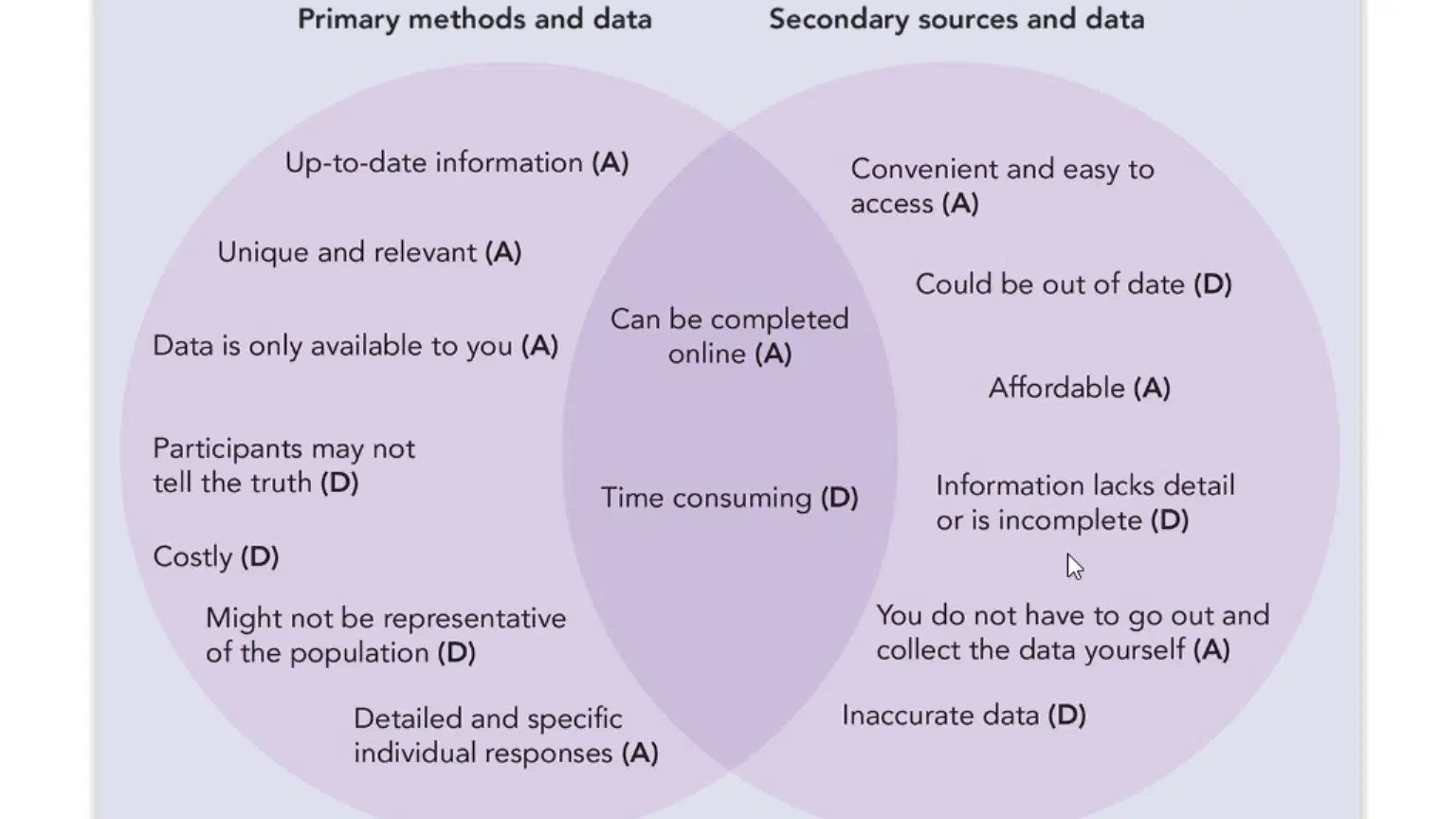
According to the diagram, which of the following is an advantage of both primary and secondary data sources?
Up-to-date information
Unique and relevant
Affordable
Can be completed online

Which of the following is listed as a disadvantage of primary methods and data in the diagram?
Costly
Information lacks detail
Inaccurate data
You do not have to go out and collect the data yourself
What is qualitative data primarily based on?
Numbers
In-depth and detailed information
Statistical analysis
Survey responses
Which of the following is an advantage of qualitative data?
It is quick to analyze
It can produce relevant details and quotes
It gives a wider picture from more people
It is based on numerical data
What is a disadvantage of qualitative data?
It provides too many details
It is time-consuming to analyze
It is easy to compare responses
It lacks depth and detail
What does quantitative data focus on?
Quality of responses
Limited responses
Many responses and building a picture through analysis
Individual detailed information

