
 Worksheets
College Chemistry Unit 8 Practice Test
Total questions: 20
Worksheet time: 44mins
The temperature of the cooling water as it leaves the hot engine of an automobile is 220 °F. After it passes through the radiator it has a temperature of 145 °F. Calculate the amount of heat transferred from the engine to the surroundings by 2 gallons of water with a specific heat of 4.184 J/g °C (1 gal = 3.785 L)
757 kJ
1627 kJ
1318 kJ
2375 kJ
A piece of copper metal is initially at 100.0°C. It is dropped into a coffee cup calorimeter containing 25.0 g of water at a temperature of 10.0°C. After stirring, the final temperature of both copper and water is 25.0°C. Assuming no heat losses, what is the mass of the piece of copper?
The specific heat capacity of water is 4.18 J/g·°C, the specific heat capacity of copper is 0.385 J/g·°C.
54.3 g
36.2 g
12.3 g
15.0 g
When a 0.650-g sample of trinitrotoluene (TNT), C7H5N2O6, is burned in a bomb calorimeter, the temperature increases from 22.1 °C to 24.7 °C. The heat capacity of the calorimeter is 354 J/°C, and it contains 475 mL of water. To three significant figures, how much heat (kJ) was produced by the combustion of the TNT sample?

The pictured sequence of reactions occurs in the commercial production of aqueous nitric acid:
Determine the total energy change for the production of one mole of aqueous nitric acid by this process.
Round your answer to 3 Sig Figs.
Calculate ΔH°298 for the process
Co3O4 (s) ⟶ 3Co(s) + 2O2 (g)
from the following information:
Co(s) + O2 (g) ⟶ CoO(s) ΔH°298 = −327.9kJ
3CoO(s) + O2 (g) ⟶ Co3O4 (s) ΔH°298 = −189.5kJ
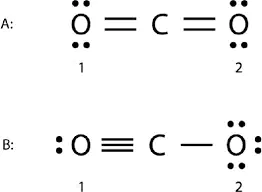
When a molecule can form two different structures, the structure with the stronger bonds is usually the more stable form. Use bond energies (in the instructions above) to predict the correct structure of the carbon dioxide molecule:
C-O is 350 kJ/mol
C=O is 741 kJ/mol
C=O is 1080 kJ/mol
A is more stable with a total bond energy of 1482 kJ/mol
B is more stable with a total bond energy of 1430 kJ/mol
B is more stable with a total bond energy of 1482 kJ/mol
A is more stable with a total bond energy of 1430 kJ/mol
Rank these compounds in order from greatest to least energy required to convert one mole of the solid into separate ions.
BeO
MgF
CaBr
NaF
RbBr
The melting point of H2S should be (a) than H2O due to the lack of hydrogen bonding.
On large covalent molecules like C4H9OH and CH2(OH)CH2OH what causes a change in boiling points other than molar mass?
more polar locations raises boiling points
increased hydrogen bonding raises boiling points
increased hydrogen bonding lowers boiling points
more polar locations lowers boiling points
Categorize the following compounds by the intermolecular forces that most strongly affect them.
NH3
HF
CH3COOH
CO
NO
SO2
Br2
CH4
C₃H₆
Which of the following explains why temperature does not change during a phase change?
Energy is being used to break intermolecular bonds.
The phases are completely new substances.
The energy is adding kinetic energy to the molecules in order to overcome intermolecular attractions.
All the molecules must undergo a change from one phase to another before the temperature begins to change.
What is the total amount of heat released when 75.0 g water at 70.0 °C cools to form ice at −20.0 °C? Express your answer in kJ.
ΔHfrz = -6.01 kJ/mol; c(H20(l)) = 4.184 J/g °C; c(H2O(s)) = 2.060 J/g °C
ROUND YOUR ANSWER TO THE NEAREST TENTH. BE CAREFUL WITH YOUR SIGN. IT SHOULD BE NEGATIVE SINCE HEAT IS RELEASED.
Rank these compounds in order of INCREASING molar enthalpy of vaporization (Hvap), even though the type of Intermolecular Forces (dispersion) is the same.
CH4
C2H6
C3H8
Rank these compounds in order of INCREASING molar enthalpy of vaporization (Hvap), ignore their molar mass since they are all quite similar.
CH4
NH3
H2O
Categorize the characteristics of simple cubic, body-centered and face-centered cubes. Coordination number, number of atoms total, and atomic radius (r) in relation to edge length (a).
1 atom
Coordination number of 6
r = a/2
2 atoms
Coordination number of 8
r = a√3/4
4 atoms
Coordination number of 12
r = a√8
Gold (atomic radius = 1.35 Å) crystallizes in a cubic closely packed structure. Calculate the edge length of the face-centered cubic unit cell in Angstroms (Å).
Ethylene glycol is used as a engine coolant in automobiles, it has a specific heat of 2.42 g⋅KJ . Calculate the q when 3650 g of ethylene glycol is cooled from 405 K to 358 K.
q = mCpΔT
−4.4 ×10⁵ J
4.4 ×10⁵ J
−4.4 ×10⁻⁵ J
4.4 ×10⁻⁵ J
A 15.75-g piece of iron absorbs 1086.75 joules of heat energy, and its temperature changes from 25°C to 175°C. Calculate the specific heat capacity of iron.
0.46 J/g x oC
1.654 J/g x oC
2,567,446.875 J/g x oC
3.26 J/g x oC
A 215 g sample of copper metal at some temperature is added to 26.6 g of water. The initial water temperature is 22.22oC, and the final temperature si 24.44 oC. If the specific heat of copper is 0.385 J/goC, what was the initial temperature of the copper? Use 4.187 J/goC as the Cp of water.
27.4 oC
22.2 oC
24.4 oC
21.5 oC

