wayground logo

Free Printable Worksheets

Font size

S
M
L
XL
Worksheets

🤩STAAR READY Mashup 4.23.24

Total questions: 106

Worksheet time: 1hrs 29mins

Name
Class
Date
1.

Slope-Intercept form

a)
b)

y = kx

c)

Ax+By=C

d)

x = my + b

2.

A relation contains the points (1, 2), (2, -1), (3, 0), (4, 1), and (5, -1). Which statement accurately describes this relation?

a)

The relation does not represent y as a function of x, because each value of x is associated with a single value of y.

b)

The relation represents y as a function of x, because one value of y is associated with two values of x.

c)

The relation does not represent y as a function of x, because each value of y is associated with two values of x.

d)

The relation represents y as a function of x, because each value of x is associated with a single value of y.

3.

Trapezoid PQRS is rotated 180° about the origin to form trapezoid P'Q'R'S'. Which statement is true?

a)

The sum of the angle measures of trapezoid PQRS is 180° less than the sum of the angle measures of trapezoid P'Q'R'S'.

b)

Trapezoid PQRS is not congruent to trapezoid P'Q'R'S'.

c)

The area of trapezoid PQRS is less than the area of trapezoid P'Q'R'S'.

d)

The angle measures of trapezoid PQRS are equal to the corresponding angle measures of trapezoid P'Q'R'S'.

4.

Which Venn diagram correctly represents the relationship between rational numbers and irrational numbers?

a)

Venn diagram showing rational numbers and irrational numbers as two non-overlapping circles within a rectangle labeled 'Real numbers,' because rational numbers and irrational numbers have no numbers in common.

b)

Venn diagram showing rational numbers and irrational numbers as two overlapping circles within a rectangle labeled 'Real numbers,' because some irrational numbers are also rational numbers.

c)

Venn diagram showing a circle labeled 'Irrational numbers' within a larger circle labeled 'Rational numbers,' both within a rectangle labeled 'Real numbers,' because all rational numbers are also irrational numbers.

d)

Venn diagram showing a circle labeled 'Rational numbers' within a larger circle labeled 'Irrational numbers,' both within a rectangle labeled 'Real numbers,' because all irrational numbers are also rational numbers.

5.

Pentagon WXYZ is shown on the coordinate grid. A student reflected pentagon WXYZ across the x-axis to create pentagon W'X'Y'Z'. Which rule describes this transformation?

a)

(x, y) → (x, -y)

b)

(x, y) → (x, y + 8)

c)

(x, y) → (-y, x)

d)

(x, y) → (-x, y)

6.

A square with a perimeter of 20 units is graphed on a coordinate grid. The square is dilated by a scale factor of 0.4 with the origin as the center of dilation. If (x, y) represents the location of any point on the original square, which ordered pair represents the coordinates of the corresponding point on the resulting square?

a)

(20x, 20y)

b)

(0.4x, 0.4y)

c)

(x + 20, y + 20)

d)

(x + 0.4, y + 0.4)

7.

Which situation could NOT represent a proportional relationship?

a)

The number of gallons of water in x barrels with 42 gallons of water in each barrel

b)

The amount an employee who makes $8.50 per hour earns in h hours

c)

The weight in x weeks of a puppy that gains 2 pounds per week if its starting weight is 8 pounds

d)

The cost of purchasing p pounds of bananas for $0.55 per pound

8.

Triangle RST is translated 6 units to the left and 4 units up to create triangle R'S'T'. Which rule best describes this transformation?

a)

(x, y) → (6x, -4y)

b)

(x, y) → (−6x, 4y)

c)

(x, y) → (x + 6, y − 4)

d)

(x, y) → (x − 6, y + 4)

9.
a)
A
b)
B
c)
C
d)
D
10.
a)
A
b)
B
c)
C
d)
D
11.
a)
F
b)
G
c)
H
d)
J
12.
a)
F
b)
G
c)
H
d)
J
13.
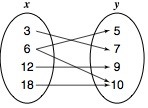
Is this mapping a function or not a function? 
a)
Function
b)
Not a Function
14.

Which rule best describes the dilation applied to Circle I to create Circle II?

a)
b)
c)
d)
15.

Which representation does NOT show y as a function of x?

a)
b)
c)
d)
16.
0.0000713 converted to scientific notation is ______.
a)
7.13 x 10⁻⁵
b)
7.13 x 10⁵
c)
7.13 x 10⁻⁴
d)
7.13 x 10⁴
17.
A graph needs to go through _____ to be proportional.
a)
The origin
b)
The y-intercept
c)
The y-axis
d)
The x-axis
18.
For an equation to be proportional, there has to be _____ after x.
a)
Nothing
b)
A positive number
c)
A negative number
d)
Something
19.
A proportional equation looks like...
a)
y=kx
b)
y=mx+b
c)
y=kx+b
d)
y=ax2+bx+c
20.
In the equation y=mx+b, m is the ____.
a)
Slope
b)
Y-intercept
c)
X-intercept
d)
Origin
21.
In the equation y=mx+b, b is the ____.
a)
Slope
b)
Y-intercept
c)
X-intercept
d)
Origin
22.
The vertical axis is the _____.
a)
X-axis
b)
Y-axis
c)
Origin
d)
Slope
23.
The horizontal axis is the _____.
a)
X-axis
b)
Y-axis
c)
Origin
d)
Slope
24.
For a table to be considered a function, ______ cannot repeat.
a)
X-values
b)
Y-values
c)
Positive Numbers
d)
Negative Numbers
25.
For a set of ordered pairs to be considered a function, ______ cannot repeat.
a)
X-values
b)
Y-values
c)
Positive Numbers
d)
Negative Numbers
26.
For a graph to be considered a function, it must pass ________.
a)
The vertical line test
b)
The origin
c)
The function-ratio test
d)
The y-axis
27.
For a mapping to be considered a function, there must be _______.
a)
No more than 1 arrow from each x-value
b)
No more than 1 arrow to each y-value
c)
At least 1 arrow from each x-value
d)
At least 1 arrow from each y-value
28.
X-values can repeat in a function.
a)
True
b)
False
29.
X-values cannot repeat in a function.
a)
True
b)
False
30.
Y=mx+b is called the _________ form of an equation.
a)
Slope-intercept
b)
Standard
c)
Point-slope
d)
Quadratic
31.
When you dilate, you ______ x and y by a number.
a)
Multiply
b)
Add
c)
Subtract
d)
Divide
32.
If your scale factor is greater than 1, your new shape will be ______.
a)
Bigger
b)
Smaller
c)
The same size
d)
Rotated
33.
If your scale factor is less than 1, your new shape will be ______.
a)
Bigger
b)
Smaller
c)
The same size
d)
Rotated
34.
Dilations will always keep the same ________
a)
Orientation
b)
Size
c)
Area
d)
Perimeter
35.
When you translate, you ______ a number to x and y.
a)
Add or subtract
b)
Multiply or divide
c)
Add or multiply
d)
Subtract or divide
36.
Translation are always _______
a)
Congruent
b)
Bigger
c)
Smaller
d)
Rotated
37.
When you translate, you are simply _______ the shape around the coordinate plane.
a)
Sliding
b)
Rotating
c)
Reflecting
d)
Expanding
38.
When you translate, (x+2,y) will move _____.
a)
2 units right
b)
2 units left
c)
2 units up
d)
2 units down
39.
When you translate, (x-4,y) will move _____.
a)
4 units right
b)
4 units left
c)
4 units up
d)
4 units down
40.
When you translate, (x,y+6) will move _____.
a)
6 units right
b)
6 units left
c)
6 units up
d)
6 units down
41.
When you translate, (x,y-8) will move _____.
a)
8 units right
b)
8 units left
c)
8 units up
d)
8 units down
42.
When you rotate a shape, the shape remains ________.
a)
Congruent
b)
In the same place
c)
In the same orientation
d)
A function
43.
Going from (x,y) to (-y,x) will result in a counter-clockwise rotation of _____ degrees.
a)
90
b)
180
c)
270
d)
360
44.
Going from (x,y) to (-y,x) will result in a counter-clockwise rotation of _____ degrees.
a)
90
b)
180
c)
270
d)
360
45.
Going from (x,y) to (y,-x) will result in a counter-clockwise rotation of _____ degrees.
a)
90
b)
180
c)
270
d)
360
46.
Going from (x,y) to (-x,-y) will result in a counter-clockwise rotation of _____ degrees.
a)
90
b)
180
c)
270
d)
360
47.
When you reflect a shape, you ______ over an axis or line.
a)
Flip
b)
Rotate
c)
Slide
d)
Expand
48.
Going from (x,y) to (x,-y) results in reflecting across _______.
a)
The x-axis
b)
The y-axis
c)
The line y=x
d)
The origin
49.
Going from (x,y) to (-x,y) results in reflecting across _______.
a)
The x-axis
b)
The y-axis
c)
The line y=x
d)
The origin
50.
The formula
A=(1/2)(b1+b2)h
is used to find the area for ______.
a)
A square
b)
A triangle
c)
A circle
d)
A trapezoid
51.
The longest side of a triangle is called the _______.
a)
Hypotenuse
b)
Leg
c)
Supreme Leg
d)
Vertex
52.
In the Pythagorean Theorem, c is always the ____ number.
a)
largest
b)
smallest
c)
middle
d)
first
53.
The Pythagorean Theorem is _____.
a)
a2+b2=c2
b)
a2+c2=b2
c)
b2+c2=a2
d)
a2-b2=c2
54.
0.0000713 converted to scientific notation is ______.
a)
7.13 x 10⁻⁵
b)
7.13 x 10⁵
c)
7.13 x 10⁻⁴
d)
7.13 x 10⁴
55.
9.513x10⁻³ converted to standard notation is ______.
a)
0.009513
b)
0.0009513
c)
0.09513
d)
9513
56.
In the function
y=4x-7, the slope is____.
a)
4
b)
-7
c)
7
d)
4x
57.
In the function
y=4x-7, the y-intercept is____.
a)
4
b)
-7
c)
7
d)
4x
58.
The number multiplied by x and y to result in a dilation is called the ______.
a)
Scale Factor
b)
Exponent
c)
Coefficient
d)
Variable
59.
The _____ is used to determine if a graph is a function or not.
a)
Function test
b)
Ratio Test
c)
Vertical Line Test
d)
Horizontal Line Test
60.
The radius is equal to _____ the diameter
a)
Half
b)
Twice
c)
Three times
d)
A quarter of
61.
The diameter is equal to _____ the radius
a)
Half
b)
Twice
c)
Three times
d)
A quarter of
62.
The capital P in surface area formulas, such as SA=Ph+2B, represents ______.
a)
Area of the base
b)
Circumference of the base
c)
Perimeter of the base
d)
Length of the base
63.
The capital B in volume formulas, such as V=Bh, represents ______.
a)
Area of the base
b)
Circumference of the base
c)
Perimeter of the base
d)
Length of the base
64.
All interior angles of a triangle _____.
a)
Add to 180o
b)
Are equal to each other
c)
Add to 360o
d)
Are not related
65.

What is the perimeter of this square?

a)

6 m

b)

9 m

c)

24 m

d)

18 m

66.

A square has an area of 48.89 square centimeters. Which could be the length of one side?

a)

7 meters

b)

12.2 meters

c)

24 meters

d)

2390.2 meters

67.

Which of these irrational numbers would you place between 6 and 7 on the number line? Check all that apply.

a)

b)

5√3

c)

3√5

d)

√42.3

e)

√6.5

68.

Between what two consecutive integers is the irrational number located?

a)

9 and 10

b)

8 and 9

c)

64 and 81

d)

72 and 73

69.

Between what two consecutive integers is the irrational number located?

a)

-7 and -8

b)

-49 and -64

c)

-6 and -7

70.

Which point best represents  10\sqrt{10}  on a number line?

a)

point A

b)

point B

c)

point C

d)

point D

71.

Which best represents the position of  8\sqrt{8}  on the number line below?

a)

Point P

b)

Point Q

c)

Point R

d)

Point S

72.

To which whole number is 80\sqrt{80} closest on a number line?

a)

7

b)

8

c)

9

d)

10

73.

Which best represents point Z on the number line?

a)

√165

b)

√149

c)

√12.2

d)

√13

74.
Between what two consecutive integers is the irrational number located?
a)
-9 and -11
b)
-81 and -100
c)
-9 and -10
75.

Which number is greater?

a)

12

b)

√55

76.

How would you write 0.0005 in scientific notation?

a)

50 x 10-5

b)

5 x 10⁻⁴

c)

5 x 10³

d)

.5 x 103

77.

Which of the following numbers is written in scientific notation?

a)

20.35 x 10⁴

b)

.2035 x 104

c)

2035 4

d)

2.035 x10⁴

78.

Convert to scientific notation:


520,000,000

a)

52 x 107

b)

5.2 x 10⁻⁷

c)

5.2 x 10⁸

d)

0.52 x 10⁹

79.

Convert this number into scientific notation:


0.068

a)

6.9 x 10⁶

b)

6.8 x 10⁻⁹

c)

6.8 x 10⁻²

d)

None of the above

80.

Convert this number into scientific notation:


950,000

a)

9.5 x 10⁵

b)

9.5 x 10⁻⁹

c)

9.5 x 10²

d)

None of the above

81.
How would you write -5.6 x 10⁻³ in standard form?
a)
0.0056
b)
-5,600
c)
0.00056
d)
-0.0056
82.

How is the number below written in scientific notation?

0.000398

a)

39.8  x  10-5

b)

3.98  x  10-5

c)

3.98  x  10-4

d)

39.8  x  10-6

83.

25\sqrt{25}  

a)

irrational

b)

rational

c)

integer

d)

whole number

e)

natural number

84.

π\pi  

a)

irrational

b)

rational

c)

integer

d)

whole number

e)

natural number

85.

20\sqrt{20}  

a)

irrational

b)

rational

c)

integer

d)

whole number

e)

natural number

86.

13\frac{1}{3}  

a)

irrational

b)

rational

c)

integer

d)

whole number

e)

natural number

87.

6.313131313

a)

irrational

b)

rational

c)

integer

d)

whole number

e)

natural number

88.

Repeating decimals are _____ numbers.

a)

irrational

b)

rational

89.

16\sqrt{16}  is included in the set of _______ because it simplifies to 4.

a)

irrational numbers

b)

whole number

90.

-1.4 is not included in the set of ______ because it has a decimal (or fractional) part.

a)

rational numbers

b)

integers

c)

real numbers

91.

Label they type of association:

a)

Positive

b)

Negative

c)

None

92.

Label the type of association:

a)

Positive

b)

None

c)

Negative

93.

Which best describes the association shown in the scatter plot?

a)

Negative and linear

b)

Negative and nonlinear

c)

Positive and linear

d)

Positive and nonlinear

94.

Which scatter plot has a stronger association? How do you know?

a)

Scatter Plot A

points are close together

b)

Scatter Plot B

points are more linear

95.

Which scatter plot appears to be linear

a)

Scatter Plot A

b)

Scatter Plot B

96.
What type of association is there between the variables shown on this scatter plot?
a)
Weak, Positive Association
b)
Strong, Positive Association
c)
Weak, Negative Association
d)
No Association
97.
What type of association is there between the variables shown on this scatter plot?
a)
Strong, Negative Association
b)
Weak, Negative Association
c)
Strong, Positive Association
d)
No Association
98.
What type of association does this scatter plot show?
a)
positive linear association
b)
negative linear association
c)
no association
d)
nonlinear association
99.
Which scatter plot shows a linear relationship between x and y?
a)
Graph A
b)
Graph B
c)
Graph C
d)
Graph D
100.
What type of association does this scatter plot show?
a)
positive linear association
b)
negative linear association
c)
no association
d)
nonlinear association
101.
What type of association is there between the variables shown on this scatter plot?
a)
Strong, Positive Association
b)
Strong, Negative Association
c)
Weak, Positive Association
d)
No Association
102.
What type of association is there between the variables shown on this scatter plot?
a)
Weak, Positive Association
b)
Strong, Positive Association
c)
Weak, Negative Association
d)
No Association
103.

Does this graph represent a proportional relationship?

a)

Yes, because the line is pretty.

b)

No, because the line goes through the origin.

c)

Yes because the line goes through the origin.

d)

No, because the graph is non-proportional.

104.

Is this proportional?

y = 2x

a)

yes

b)

no

105.
Which graph shows a proportional relationship between x and y?
a)
A
b)
B
c)
C
d)
D
106.

Which equation represents a proportional relationship?

a)

y=3x+2y = 3x + 2

b)

y=12xy = \frac{1}{2}x

c)

y=2x2y = 2x^2

d)

y=5xy = \frac{5}{x}