
 Worksheets
Fuels and Crude Oil
Total questions: 17
Worksheet time: 13mins
Fuels can combust in air to form _______________________________.
carbon dioxide
oxygen
water
carbon
Combustion is an_____________ reaction.
exothermic
endothermic
What term is used to describe organic compounds that contain only the elements carbon and hydrogen?
(a)
Crude oil is made up of:
Ethane
Butane
A mixture of different hydrocarbons
Extremely large hydrocarbons which are broken up once extracted
A fraction of crude oil is made up of:
Hydrocarbons of similar chain lengths
Numbers
Large hydrocarbons
Alkenes only
Different fractions in crude oil are separated by:
Cracking
Fractional Distillation
Filtration
Crystalisation
Shorter hydrocarbons have:
Higher boiling points
Lower boiling points

Where do long chain hydrocarbons collect?
At the top
In the middle
At the bottom

Where do short chain hydrocarbons collect?
At the top
In the middle
At the bottom
What does viscosity tell you about a hydrocarbon?
How easy it is to ignite
How runny it is
What is boiling point is
The shorter the hydrocarbon, the more viscous it is
True
False
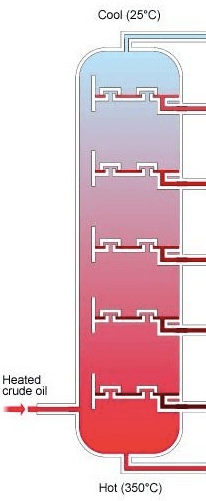
What process happens at each level in the fractionating column?
Evaporation
Condensation
Combustion
What is natural gas mainly made up of?
(a)
Natural gas is usually transported in the gaseous state.
True
False
Boiling point increases as the number of carbon atoms increases.
True
False

