
 Worksheets
Waves Behavior & Properties
Total questions: 38
Worksheet time: 43mins
Refraction occurs when waves enter a new (a) and change (b) .


What is the definition reflection?
The bending of waves as they enter a new medium
Bouncing back of waves from a surface that it can’t pass through
The bending of waves as they pass through openings or around corners
When two interfering waves have a displacement in the same direction, two crests and two troughs overlap. Increased amplitude.
What is the definition of Refraction?
The bending of waves as they enter a new medium
When two interfering waves have a displacement in the opposite direction, crest and trough overlap. Zero amplitude.
When two interfering waves have a displacement in the same direction, two crests and two troughs overlap. Increased amplitude.
What is the definition of Diffraction?
The bending of waves as they enter a new medium
Bouncing back of waves from a surface that it can’t pass through
When two interfering waves have a displacement in the opposite direction, crest and trough overlap. Zero amplitude.
The bending of waves as they pass through openings or around corners
Give an example of Diffraction.
Water droplets act as prisms to separate white light into the ROYGBIV spectrum
Decreased amplitude of the sound wave means softer sound
the smaller the opening the more diffraction, light waves are so small you will have little diffraction.
hearing the bass of the music through the openings in a car (longer wavelengths)

Reflection
seeing your image in a mirror
Refraction
seeing a rainbow after a rainshower
Diffraction
hearing sound from the hallway
Scattering
the reason the sky is blue
Transmission
light passing through the windows
Wave changes direction when moving from one medium to another
Refraction
Wave stays in the same medium but bends around an obstacle.
Diffraction
Wave encounters a barrier that causes the wave to return.
Reflection
Wave completely passes through a medium.
Transmission
Waves combine together to form a larger wave.
Interference
The position the medium would be in if no energy was moving through the medium, or if the medium was at rest
Crest
Trough
Rest position
A mechanical wave is a disturbance in matter that transfers energy through ________.
solid
liquid
gas
all of the above
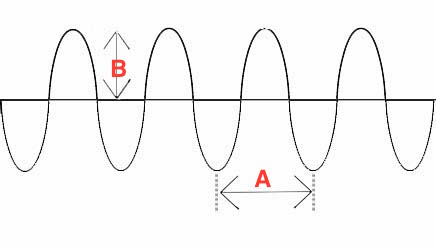


The wavelength can be measured from (Hint: check ALL that apply)
Two identical points of a wave.
crest to crest
top to bottom
trough to trough
A wave in which the movement of the wave’s medium is perpendicular to the movement of the wave traveling through the medium
Transverse waves
Compression waves
Nodular Waves
Ocean Waves

Water waves are __________ waves because the wave moves up and down.
transverse
inverse
longitudinal
flat
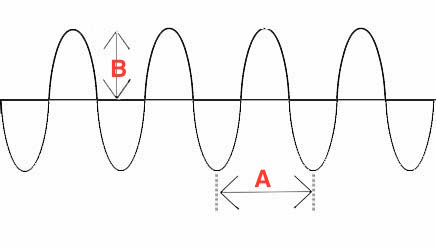


What type of wave is pictured?
Transverse wave
Longitudinal wave
Wave, what wave?
Slinky wave
All waves carry ______________.
Sound
Light
Water
Energy

What type of waves are these?
Transverse waves
Longitudinal waves

In the diagram, which of the following wave characteristics is marked by the letter Y?
wavelength
rarefaction
amplitude
compression

In this diagram, which of the following wave characteristics is marked by X?
wavelength
rarefaction
compression
amplitude

