
 Worksheets
State Testing Review
Total questions: 111
Worksheet time: 2hrs 7mins
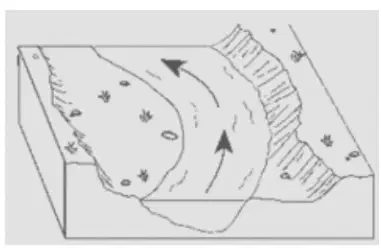
The diagram below shows a section of a meander in a stream. The arrow shows the direction of stream flow. The stream bank on the outside of this meander is steeper than the stream bank on the inside of this meander because the water on the outside of the meander is moving ________________________ .
faster
slower
not moving at all
none of the above
What would be the effect on the landscape if the river is running quickly at a steep angle slant?
There would be less erosion since the river is going faster.
There would be less erosion since the river is going slower.
There would be more erosion since the river is going faster.
There would be more erosion since the river is going slower.
What oceanic landform is similar to the continental landform called a trench?
rift
valley
mid-ocean ridge
canyon
What oceanic landform is similar to the continental landform called a mountain range?
rift
valley
mid-ocean ridge
seamount
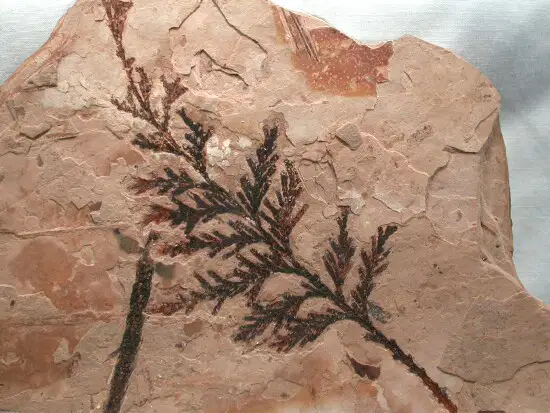
What type of environment was this fossil from?
Ocean
Tundra
Forest

What type of environment was this fossil from?
Ocean
Forest
Grassland
Tundra
A beach forms when waves deposit sand and gravel along the shoreline. What is the name of this process?
Weathering
Erosion
Deposition
None of the Above

What has MOST LIKELY caused a change in the soil in the wheat field shown?
Weathering
Erosion
Deposition
All of the Above
Deltas are created when sediment is deposited at the mouth of a river. Which process is this?
Erosion
Weathering
Vegetation
Deposition
Your science teacher was modeling a type of erosion for you and your classmates to better understand. She used the following materials: an aluminum tin, soil, forks and a watering can filled with water. What type of erosion was she modeling?
Ice Erosion
Wind Erosion
Water Erosion
Vegetation Erosion
This mushroom rock is created by erosion.
What formed the mushroom rock?
Wind Erosion
Water Erosion
Vegetation Erosion
Ice Erosion

Where are you walking when you are wading in the ocean?
Ocean Trench
Abyssal Plain
Continental Slope
Continental Shelf
The flattest area of the ocean is known as the _________________________.
Rift Zone
Abyssal Plain
Mid-ocean Ridge
Subduction zone
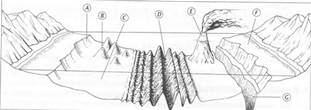
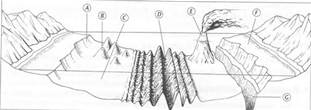
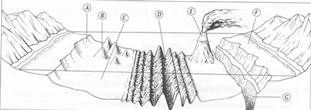

What is letter F pointing to?
continental slope
continental shelf
abyssal plain
sea mount


The map shows the location of a volcano. The winds in this area usually blow from west to east. The smoke and ash from a volcano can be blown great distances, and these are harmful to humans. Based on the information given, what is the safest location for humans to build a town?
A
B
C
D

Based on this map, which of the following places has many earthquakes?
the land area making up Australia
the middle part of the Pacific Ocean
the western part of Africa
along a line in the center of the Atlantic Ocean

Which layer contains fossils of the most recent living organisms?
A
B
C
D

What living things were fossilized in Layer N?
Dinosaurs
Monkeys
Fish
Plants

The Andes Mountains in South America contain dozens of fossils of marine animals. How might you have described the landscape of the Andes mountain area long ago? What type of environment was it long ago.
Marine animals lived on land.
The Andes Mountains once were under water.
The Andes Mountains were formed by an earthquake.

Several layers of rock are illustrated in their unchanged positions. Which of the following conclusions is supported by the data in this illustration?
Rock layer W is the oldest of all the rock layers shown.
Rock layer X was formed just before rock layer Y
Rock layer Y is twice as old as rock layer W.
Rock layer Z is the oldest of all the rock layers shown.
The highest point of the wave is called the ____________.
crest
trough
wavelength
amplitude
The lowest point of the wave is called the ______________.
crest
trough
wavelength
amplitude
The distance from one crest or trough to the next crest or trough is called the _____________.
amplitude
wavelength
circular
The distance from the resting point of the wave to the crest or trough is called the _________________.
wavelength
amplitude
circular
What is wavelength?
is the bottom part of the wave.
the distance from one crest to another crest or one trough to the next.
is the distance from the middle point of a wave to a crest or a trough.
the strength or height of a wave.
1. Sound waves cannot travel through__________.
A solid
Gases
Empty space
Liquids

What is labeled "A" in Gabriella's model?
Amplitude
Crest
Trough
Wavelength

What is labeled "B" in Gabriella's model?
Amplitude
Wavelength
Trough
Crest

What is labeled "C" in Gabriella's model?
Amplitude
Wavelength
Trough
Crest

What is labeled "D" in Gabriella's model?
Amplitude
Wavelength
Trough
Crest

Andy drew a diagram of a transverse wave. Which part of the wave is labeled X?
rarefaction
crest
trough
compression
Through which material do sound waves travel the slowest?
steel
water
plastic
air
Through which material do sound waves travel the fastest?
steel
water
space
air
When you watch fireworks, you always hear the bang after you see the flash. This is because:
when something explodes, the sound always happens after the flash.
sound travels faster through the air than light.
sound travels slower through the air than light.
your ears take longer to send messages to your brain than your eyes do.

Label the Wave. What part of the wave is labeled "B"?
Crest or Peak
Trough
Wavelength
Amplitude
Label the Wave. What part of the wave is labeled "C"?
Crest or Peak
Trough
Wavelength
Amplitude

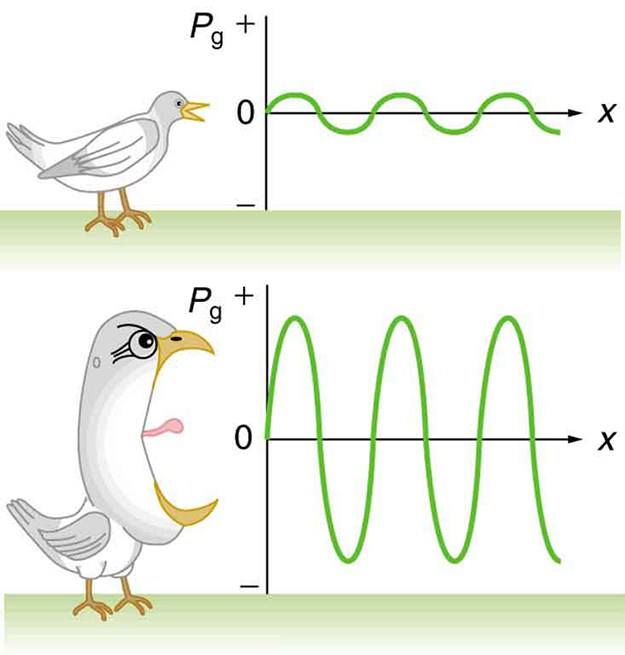
Which wave is the loudest?
Wave 4
Wave 5
Wave 6

1.1 According to the graph, through which medium will a sound wave travel slowest?
iron
glass
oxygen
water

What type of frequency does this wave have?
No frequency
High
Low
Slow
If you are playing outside and can hear a football game a few blocks away, how can you explain this?
The sound is traveling through the people at the game.
The sound vibrations are traveling from the speakers, through the air, to your ears.
You can not explain this.
The sound vibrations are not able to travel that far.
Is it possible to hear a sound in outer space?
No, because there is no air for the vibrations to travel through.
No, because it is too far away.
Yes, because sound travels through the air.
Yes, because you can hear it if you listen closely.

Armando used yarn to create waves on sheets of graph paper. He recorded his wave data in the table. Which heading in the table describes wavelength?
wave
number of crests
distance between crests
height of crests

Wave B's frequency is...
the same as wave A's frequency.
higher than wave A's frequency.
lower than wave A's frequency.
Wave A's wavelength is...
the same as wave B's wavelength.
longer than wave B's wavelength.
shorter than wave B's wavelength.

Wave A's amplitude is...
the same as wave B's amplitude.
larger than wave B's amplitude.
smaller than wave B's amplitude.

Wave B's frequency is...
the same as wave A's frequency.
higher than wave A's frequency.
lower than wave A's frequency.

The bell makes a sound when it is hit by the clapper because the bell
vibrates
rotates
releases heat
produce electricity

According to this chart, sound travels fastest through which form of matter?
solid
liquid
gas
none

Jennie’s class has a small tuning fork, a medium tuning fork, and a large tuning fork. Their teacher tells them to strike the tuning fork and place the fork in a bowl of water. They observe the pitch created and measure the vibrations of the tuning fork in Hertz.
The size of the tuning fork affects the volume of a sound.
Higher pitches produce more vibrations
Lower pitches produce more vibrations
Larger objects produce more vibrations

The picture shows 4 kids around a radio that is playing a song.
Who would hear the song at the lowest volume?
Child 1
Child 2
Child 3
Child 4
An engineering team wants to design a new sled that is faster and more economical. What is a criterion for their solution?
The sled needs to be durable
The sled should be on budget
The sled needs to be built on time.
The sled should slide smoothly over the snow so that it is faster
How do cell phones receive decoded information over long distances?
They receive digitized information and change it to voice.
They receive voice and change it to digitized information.
They receive digitized information and change it to Morse code.
They receive Morse code and change it to digitized information.
A student sends the text message “Hi.” The cell phone turns the message into binary code. How are the H and the I different in binary code?
Each letter is coded as a different pattern of 1s and 0s
One letter is coded as a 1, and the other is coded as a 0.
Each letter is coded as the number that matches its place in the alphabet.
One letter is coded as a dark pixel, and the other letter is coded as a light pixel.
Sonar is most similar to...
Echolocation
binary code
coding
echo

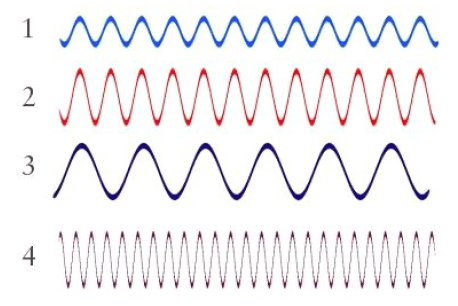


Barry wants to see how white light can separate into different color. Which object could he hold in front of the sun to see this happen?
mirror
silver spoon
prism
When a pencil is viewed in a glass of water, the light passes through the water and the air and causes the path of light to bend. This is an example of...
reflection
refraction
absorption
When light travels through a magnifying glass, it changes direction and we see a larger view of the object. This is an example of ....
reflection
refraction
absorption

Faith and Elijah are using a flashlight and their hands to make shadow puppets. What property of light creates the shapes on the wall?
Light transmits through their hands.
Light refracts when it passes through their hands.
Light travels in a straight line.
Light reflects off their hands back at them.
Which statement is correct about the refraction of light?
Light travels in a straight line.
Light travels from one to medium.
Light travels from one object towards our eyes.
Light travels in all direction.

This polar bear is happy because someone gave him a pumpkin to play with. But, this polar bear is sad because it looks like his head is no longer attached to his body. :( What property of light creates this optical illusion?
Refraction
Reflection
Transparency
Opaqueness

Which coaster has the least amount of energy?
Whirlwind
Freestyle
Xcelerator
They're all the same.

Which object has the most energy?
plane
baseball
car
runner
A basketball and a bowling ball are moving at the same speed. What will happen when the two balls bump together?
The motion of the ball will change in the exact same ways
The motion of the bowling ball will change more than the motion of the basketball
The motion of the basketball will change more than the motion of the bowling ball
There will be no change to the motion of the balls

Four toy cars were pushed on a surface with the same force. They traveled a distance before coming to a stop. The graph shows the distance and time plotted for the motion of the four toy cars.
toy car 2 traveled faster than toy car 1
toy car 1 traveled fastest
toy car 3 traveled faster than toy car 4
Toy car 2 traveled faster than toy car 3
toy car 3 traveled the fastest
Birds have different kinds of beaks depending on _____________
Where it lives
How big it is
How it drinks
The kind of food it eats

What is the function (purpose) of a long think beak? Hint: Their beaks are very thin and long, so it is able to get into small places.
To open nuts and seeds
To eat nectar from flowers
To help grab large prey
To help it tear apart its prey
Check all that are internal structures of an elephant
Stomach
Skin
Teeth
Liver
Esophagus
Check ALL that are external structures of an elephant
Ears
Liver
Feet
Skin
Intestines
How do zebra stripes protect the zebra?
When zebras run as a herd,stripes help the predators pick out one zebra.
When zebras run as a herd,stripes help the zebras by not letting the predator pick out one zebra because they blend together and look like a blur of stripes.
The zebra stripes don't have a purpose.
The arctic fox and snowshoe hare develop a white coat of fur during the winter months. What statement best describes this behavioral response?
The color of the fur will attract a mate
White fur allows the animals to reflect light and stay warm
Snow falls during the winter and the white fur will camouflage the animals
It becomes colder during the winter, so these animals need more fur to stay warm

What stage of the plant life cycle is shown?
Full grown, mature plant
a bud
a seed
a sprout
What is the job of the roots?
to make seeds for the plant
to make food for the plant and take in air
to help the flower reproduce
to support the plant and help deliver food, minerals, and water to other parts of the plant
to anchor the plant in place, soak in water, and store food for the plant
What is the job of the flower?
to make seeds for the plant
to make food for the plant and take in air
to help the flower reproduce
to support the plant and help deliver food, minerals, and water to other parts of the plant
to anchor the plant in place, soak in water, and store food for the plant
What is the job of the leaves?
to make seeds for the plant
to make food for the plant using the sun's light, and to take in air
to help the flower reproduce
to support the plant and help deliver food, minerals, and water to other parts of the plant
to anchor the plant in place, soak in water, and store food for the plant
What is the job of the stem?
to make seeds for the plant
to make food for the plant and take in air
to help the flower reproduce
to support the plant and help deliver food, minerals, and water to other parts of the plant
to anchor the plant in place, soak in water, and store food for the plant
What is the job of the seeds?
to make seeds for the plant
to make food for the plant and take in air
to help the flower reproduce
to support the plant and help deliver food, minerals, and water to other parts of the plant
to anchor the plant in place, soak in water, and store food for the plant

What is the function of the skeleton?
to digest food
to provide support and give the body its shape
to circulate blood
to provide nutrients for the body
Flowers' stems give them structure to stand upright and trees have trunks. Which human system is similar, in that it gives us support to stand upright?
muscular system
skeletal system
integumentary system
nervous system
In what part of the plant is food made?
The flowers
The leaves
The roots
The stem
If plants didn't adapt as their environments changed, they would
save a lot of time.
not survive.
get taller every year.
be safe forever because they were already fine.
What is one reason that some plants have a strong scent?
to shed extra water off the plant
to take in nutrients from the soil
to attract animals to spread its pollen
to conserve water during dry periods

What is one possible reason for seeds to have hooks or barbs?
to stay warm during the winter
to protect themselves from sunlight
to get attached to passing animals and get carried away
to stick to animals and steal nutrients from them

Water lilies live in lakes and ponds. The lilies have very long stems. The picture above shows a water lily in a pond. How do long stems help water lilies live in ponds?
They absorb food for the plant.
They absorb water from the pond.
They enable the pads and flower to reach sunlight.
They help the plants float away.

In a rainforest, the large canopy can block sunlight. Plants living under the canopy must be able to tolerate shade or adapt in order to get light. What adaptation could help plants get more sun?
strong roots
climbing vines
needles
spores
How have some rainforest plants adapted to receive enough sunlight?
by growing poisonous flowers
by growing giant, slippery leaves
by growing giant, bright flowers
by growing long, deep roots
What is sensory input?
The information that the senses gather from the outside world
The parts of an animal's body that enable them to receive sensory input
The special parts of sense organs that detect signals
The body system that allows us to move, feel, and think
What are sensory receptors?
The information that the senses gather from the outside world
The parts of an animal's body that enable them to receive sensory input
The special parts of sense organs that detect signals
The body system that allows us to move, feel, and think
Four students write what they know about sense receptors. Evaluate each student's response. Who is not correct?
Julia says sense organs like the ear, mouth, and skin all have sense receptors.
Sam says sense receptors collect information from our environments.
Miriam says all sense organs are the same.
Juan says sense organs are connected to nerves.
Sarah is creating a model to show the path that information travels in the nervous system. She has drawn sensory receptors. What should she draw next?
She should draw a nerve cell in the brain.
She should draw nerves extending from the sensory receptors to the spinal cord.
She should connect the sensory receptors to the muscles.
She should label the drawing with the words "output."
On a hot summer day, Jack left the pool and began to climb a ladder to his tree house. He hurt his toe by bumping it on the ladder as he climbed into the tree house. How did Jack know that he had hurt his toe?
The nerves in his hurt toe sent a signal through his body to his brain.
The blood cells in his toe sent a signal through his body to his brain.
Jack's toes became very cold and numb.
D.
Jack's toe became smaller than before he had bumped it on the ladder.
Amanda suddenly woke up and smelled something burning. She crept down the stairs to see what was happening. She found her parents reading and sitting by the fireplace, which was burning wood. Why did Amanda wake up?
The smell of the fire sent a signal through her blood cells to her brain and she woke up.
The smell of the fire sent a signal through her nerves to her brain and she woke up
Amanda's nose was stuffy from a cold and she could not sleep.
Amanda was too cold upstairs to sleep.

