
 Worksheets
Unit 5: Exploration and Migration
Total questions: 10
Worksheet time: 50mins
Name
Class
Date
1.
Most early settlements were near rivers or streams. Which of the following is NOT a reason why people settled near rivers or streams.
a)
a. The rivers provided transportation.
b)
b. The rivers provided drinking water.
c)
c. The rivers provided food like fish.
d)
d. The rivers provided materials for clothing.
2.
Which of the following is an economic reason that Europeans wanted to explore the world.
a)
a. Explorers wanted to find new worlds to spread their religion.
b)
b. Explorers wanted to discover new lands for the adventure.
c)
c. Explorers wanted to find new trade routes so they could trade spices, silks, and gold.
d)
d. Explorers wanted to learn about the geography of the Earth to make maps.
3.

Using the map below, what patterns do you notice about the explorers' routes?
a)
a. Many explorers sailed across the Pacific Ocean to North America to find different resources.
b)
b. Many explorers sailed across the Pacific Ocean to England and France to find different resources.
c)
c. Many explorers sailed across the Atlantic Ocean to North America to find different resources.
d)
d. Many explorers sailed across the Atlantic Ocean to England and France to find different resources.
4.
Many countries like England, France, and Spain paid explorers to travel around the world. Which of the following is a political motivation these countries paid for explorers?
a)
a. Countries wanted to find new land because they were running out of room for their people.
b)
b. Countries wanted to find new land to because they wanted to move.
c)
c. Countries wanted to find new land to learn about the world.
d)
d. Countries wanted to find new land to conquer and expand their empires.
5.

What is the best conclusion you can draw about European exploration from the map below?
a)
a. Christopher Columbus was the most successful explorer in North America.
b)
b. Many different countries wanted to explore North America.
c)
c. Countries mostly traveled by land to explore North America.
d)
d. Every countries explored the same spots in North America.
6.
Religion was important to many explorers. Some explorers wanted to bring their Christian beliefs to the places they explored and to convert people to their religion. This is an example of what type of motivation for exploring?
a)
a. economic
b)
b. social
c)
c. political
d)
d. geographic
7.
People migrate, or move, for many different reasons. People can choose to move for voluntary reasons, or they can be forced to move for involuntary reasons. Which of the following is an involuntary reason that someone might be forced to move?
a)
a. An earthquake destroyed their home and they have to move to a new city.
b)
b. The climate is cold where they live and they want to go to a city with warmer weather.
c)
c. They can get a better job in a new city.
d)
d. They want to move to a new city to be closer to family.
8.

Using the map below, what is the best reason why someone might migrate from Africa to North America?
a)
a. The food is much better in North America.
b)
b. There are more religions in North America.
c)
c. The temperature is cooler in North America.
d)
d. There are less natural disasters in North America.
9.
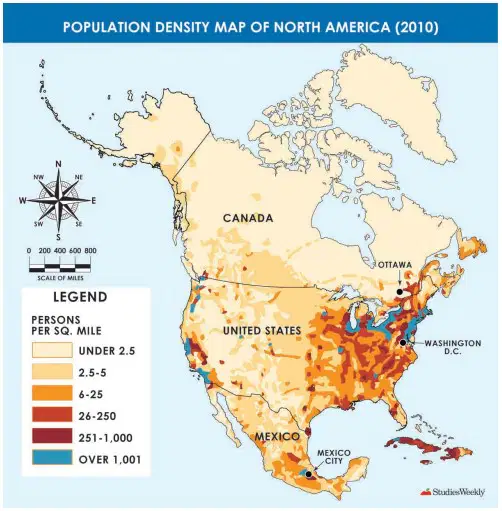
Which of the following statements is the most accurate based on the map below?
a)
a. Most people migrated out west because it is easy to drive there.
b)
b. Most people migrated to cities near the ocean because there are many job opportunities by the water.
c)
c. Most people migrated to Canada because the temperature is cooler there.
d)
d. Most people migrated to Mexico because there are less natural disasters there.
10.

Based on the maps below, what can you infer about where most people want to live?
a)
a. Most people choose to live in dry climates away from water.
b)
b. Most people choose to live in tropical climates away from water.
c)
c. Most people choose to live in polar climates near water.
d)
d. Most people choose to live in continental climates near water.
100 %

