
 Worksheets
Types of electrical circuits
Total questions: 47
Worksheet time: 55mins

La gráfica representa un circuito?
en serie y en paraleo, es decir, mixto
en serie
en paralelo
ninguno de los anteriores

¿Qué circuito representa la imagen?
mixto
serie
paralelo
Ninguno de los anteriores

What kind of circuit is this?
(¿Qué tipo de circuito es este?)
series
(circuito en serie)
parallel
(circuito paralelo)

What is a circuit with several paths for electricity to flow?
(¿Qué es un circuito con varios caminos para que fluya la electricidad?)
conductor
(conductor)
series circuit
(circuito en serie)
parallel circuit
(circuito paralelo)
open circuit
(circuito abierto)

Which circuit below would be described as "closed"?


Which picture below shows a parallel circuit?


In which circuit below, will all lights go out when one light is broken?


What is a material that resists, or does NOT allow, energy to flow through?
circuit
insulator
series
conductor
What is a circuit with several paths for electricity to flow?
conductor
series circuit
parallel circuit
open circuit

A PATH along which electricity can flow is a ___________________?
light bulb
switch
insulator
circuit

What is a circuit that only has ONE path for electricity to flow?
series circuit
closed circuit
parallel circuit
light bulb
In a parallel circuit, the effective resistance can be calculated with the following formula:
R = R1 + R2
R =R1 = R2
R1 = R11 + R21
R = R1 × R2

Which of the following is the correct diagram for the circuit shown in the picture?


In which configuration is the current supplied by the battery the greatest?
A
B
C
A, B, and C are the same.
How to you calculate the total resistance in a series circuit?
R1 + R2+ R3
R1 - R2 - R3
1/R1 + 1/R2 + 1/R3
R1 = R2 = R3


What will happen if one of these light bulbs goes out (turns off)?
The other light bulbs will get brighter
The other light bulbs will go out
The other light bulbs will get dimmer
The other light bulbs will stay lit

What will happen if one of these light bulbs goes out (turns off)?
The other light bulbs will get brighter
The other light bulbs will go out
The other light bulbs will get dimmer
The other light bulbs will stay lit


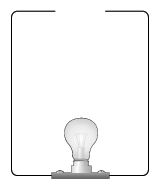
In a Series Circuit the Current...
is the same at every point
is shared between the energy users
In a Parallel circuit the current is
the same at every point
split between the branches

This diagram represents a closed circuit with three identical lightbulbs.
If bulb Y stops working in the circuit, what will happen to bulbs X and Z?
Bulb X and bulb Z will not glow.
Bulb X will glow, but bulb Z will not glow.
Bulb X and bulb Z will glow.
Bulb X will not glow, but bulb Z will glow.
How would decreasing the diameter of the wires in a circuit influence the resistance and flow of electrons in the circuit?
It would decrease the resistance, causing fewer electrons to flow through the circuit.
It would increase the resistance, causing fewer electrons to flow through the circuit.
It would decrease the resistance by allowing more electrons to flow through the circuit.
It would increase the resistance by allowing more electrons to flow through the circuit.


Which statement is true?
The light bulb will light up because the circuit is complete.
The light bulb will light up because the circuit is broken.
The light bulb will not light up because the circuit is complete.
The light bulb will not light up because the circuit is open.
A short circuit occurs when
electrons have an easier path to take from one end of the battery to the other without any resistance
the wires in a circuit are cut into smaller pieces
exposed wires touch, creating a faster route for electrons to take
a switch is turned off

The circuit on the left is not complete (the light is off) because:
the switch is closed
the switch is open
the battery is missing
the battery is in backwards

How many light bulbs would be ON with this complete circuit?
1
3
2
4

How many light bulbs would be ON if the wire of this circuit was cut where the scissors are?
1
3
2
0

How many light bulbs would be ON if the wire of this circuit was cut where the scissors are?
1
3
2
0
Devices in a series circuit receive
Equal current but different voltage
Equal voltage but different current
Equal voltage and equal current
different voltage and different current
Two devices are connected between two points say A and B in parallel. The physical quantity that will remain the same between the two points is
Current
Voltage
Resistance
Resistivity
The electric current in a closed circuit always flows from the ____ terminal of the electric cell to the _____ terminal.
NEGATIVE TO POSITIVE
NEGATIVE TO NEGATIVE
POSITIVE TO POSITIVE
POSITIVE TO NEGATIVE

