
 Worksheets
Early Christian, Byzantine Art - 60
Total questions: 86
Worksheet time: 44mins
Which city became the capital of the Eastern Roman Empire, also known as the Byzantine Empire?
Rome
Constantinople
Athens
Alexandria
What was the Western part of the Roman Empire referred to after its division in 395 C.E.?
Byzantine Empire
Ottoman Empire
Western Empire
Holy Roman Empire
Which event marked the division of the Roman Empire into the Eastern and Western Empires?
The sacking of Rome by the Visigoths
Constantine moving the capital to Byzantium
The death of Romulus Augustulus
The permanent split by Emperor Theodosius I
Who was the last Western Roman emperor removed by the German Odoacer?
Constantine
Theodosius I
Romulus Augustulus
Justinian
In what year did Justinian become the Eastern Roman Emperor?
395
1476
527
832
What was a significant change in art style after the fall of the Western Roman Empire?
Emphasis on realistic proportions
Focus on abstract forms
Shift towards teaching narratives and symbolism of Christianity
Increased use of secular themes
What does the term "didactic" imply about the art from the period after the Western Roman Empire fell?
Art was primarily used for entertainment
Art was used for educational or instructive purposes
Art was less structured and more expressive
Art focused solely on aesthetic values
Which two basic types of plans were originally used in Christian Church architecture?
Gothic and Romanesque
Central Plan and Basilica Plan
Baroque and Classical
Modern and Postmodern
How did the function of Christian churches influence their architectural form?
It had no influence on the design
Designs were influenced to accommodate large gatherings
Designs were influenced to reflect the wealth of the church
Designs were influenced to accommodate educational and liturgical needs
Who played a critical role in the spread of Christianity beyond the Jewish communities of Palestine into the Greco-Roman world?
Emperor Nero
Apostle Paul
Emperor Augustus
Apostle Peter
In which century did Emperor Constantine accept Christianity and become its patron?
3rd century
4th century
5th century
2nd century
What was the primary focus of art during the Byzantine period from 500 CE to 1453 CE?
Political events
Religious expression and court life
Natural landscapes
Abstract concepts
What cultural aspect was strongly endorsed in Byzantine art?
Military achievements
Scholarship (learning)
Economic trade
Technological advancements
During the Byzantine period, how did art typically treat naturalistic depictions, such as the human body?
Avoided
Embraced
Used only in secular contexts
Focused on landscapes
What term describes the action of rejecting, destroying, or removing images due to religious beliefs during the Byzantine period?
Iconoclasm
Vandalism
Censorship
Abstraction
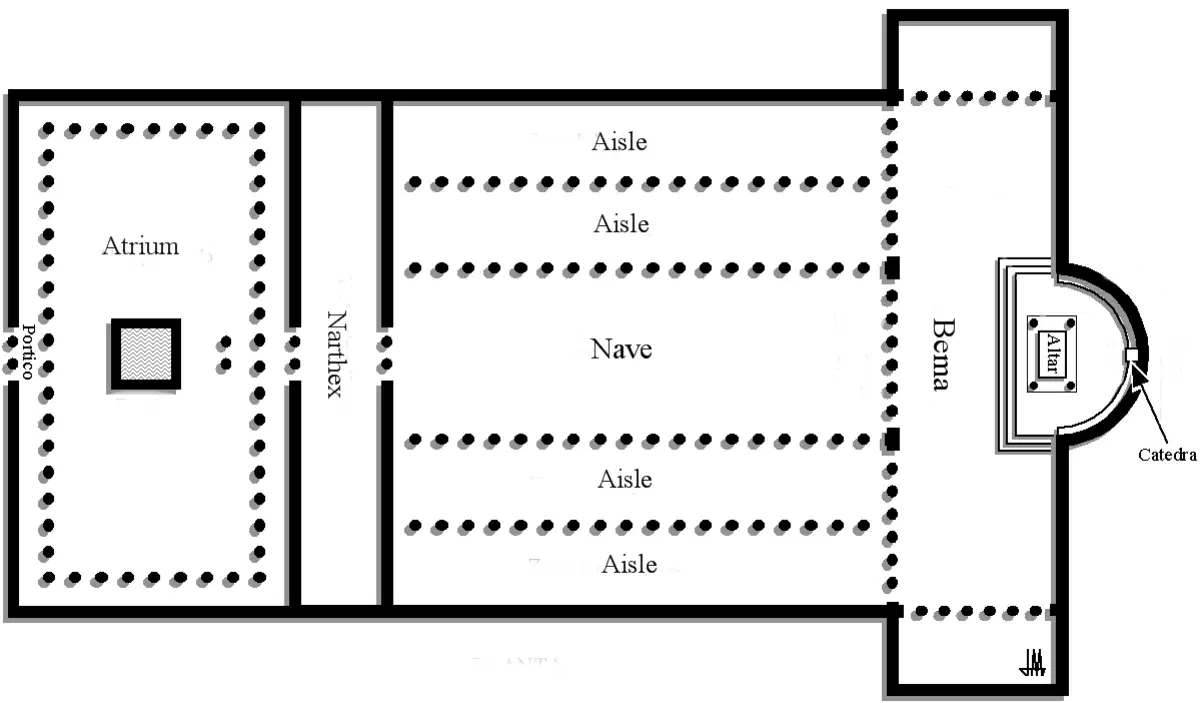
What is the term used to describe the entrance hall or lobby area at the west end of the nave in a basilica-plan church?
Aisle
Narthex
Apse
Nave
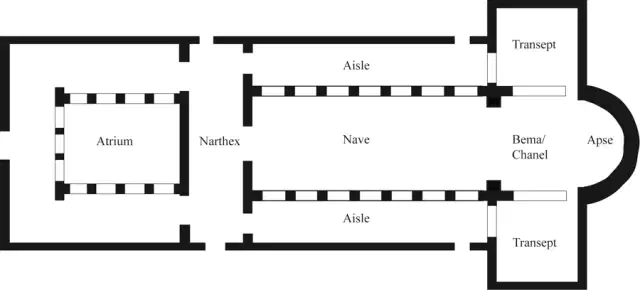
Which part of the church is typically semicircular and houses the altar in both the basilica-plan and central-plan churches?
Dome
Atrium
Apse
Nave
Central Plan churches were most common in the
Eastern Roman Empire
Western Roman Empire
What architectural feature is identified as 'clerestory' in the basilica-plan church?
The series of windows high up in the walls to admit light
The central dome of the church
The main body of the church where the congregation sits
The entrance hall of the church
What term is used to refer to the preserved works of the first five centuries CE in the context of Christianity?
Ancient Christian
Late Christian
Medieval Christian
Early Christian
What were the catacombs used for by early Christians?
Markets
Residential areas
Worship and burial sites
Battle grounds
What was a common Roman practice for dealing with their dead during the early Christian era?
Burial in catacombs
Sea burials
Cremation
Mummification
Where is the Catacomb of Priscilla's Greek Chapel located?
Athens, Greece
Rome, Italy
Paris, France
Istanbul, Turkey
What unique feature is the Greek Chapel named for?
Its Roman inscriptions
Its Gothic architecture
Its Greek inscriptions
Its Egyptian motifs
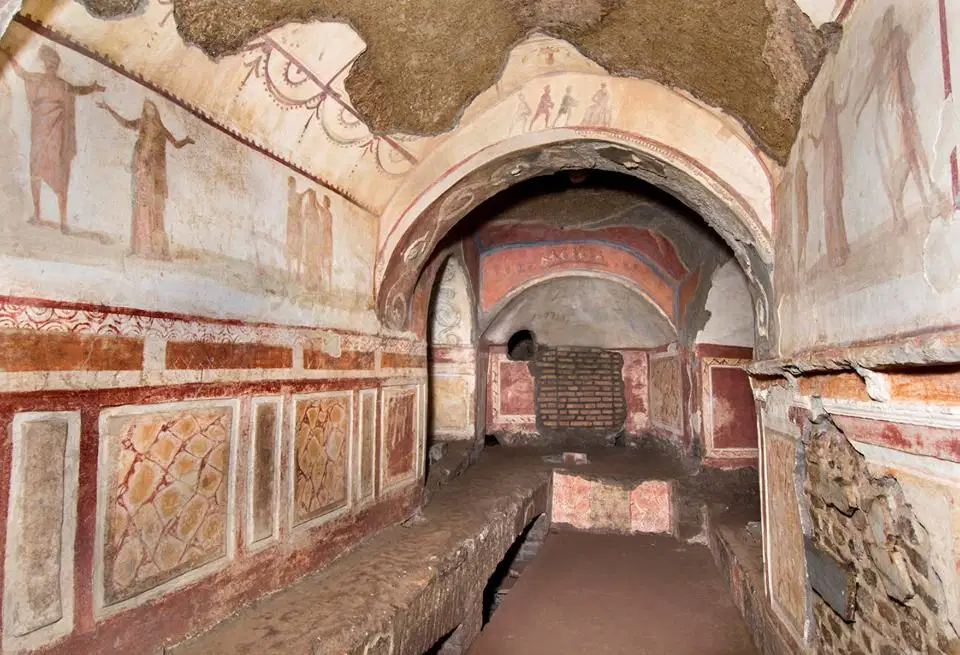
What type of art style decorates the Greek Chapel?
Byzantine
Romanesque
Gothic
Pompeian
What is a characteristic of the fresco technique used in the Greek Chapel?
It uses loose and fluid brushstrokes.
It forms a permanent bond with the wall.
It is typically done in monochrome.
It peels off easily from the surface.
What is the Greek Chapel named for?
The Greek inscriptions painted on the right niche
The location it was found
The type of architecture used
The artifacts found inside
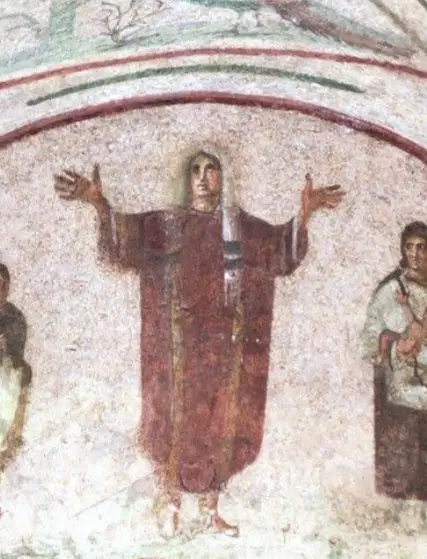
What is the setting of the Orant Fresco depicted in the image?
A public square in Rome
A marketplace in Italy
A church in Priscilla
A family vault in a cemetery
What pose is the central female figure in the Orant Fresco adopting?
Sitting with crossed legs
Standing with arms raised in prayer
Kneeling with hands folded
Lying down with eyes closed

In the Orant Fresco, what does the figure on the left represent?
A teacher with children
A soldier with a spear
A merchant with goods
A priest with a book
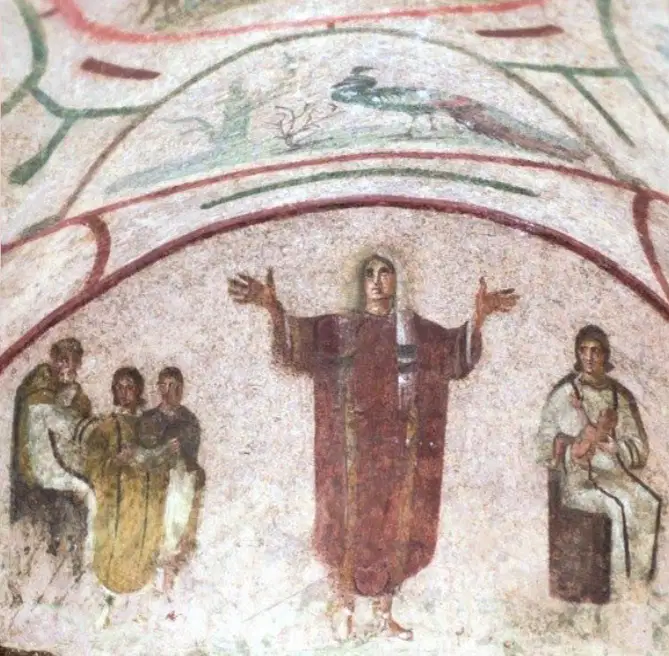
Who might the figures on the right side of the Orant Fresco represent?
Disciples of a philosopher
A mother and child, possibly Mary with Christ or the Church
Roman senators
Local townspeople

What is the primary subject depicted in the ancient fresco shown in the image?
A marketplace scene
A good shepherd.
A royal court gathering
A landscape painting
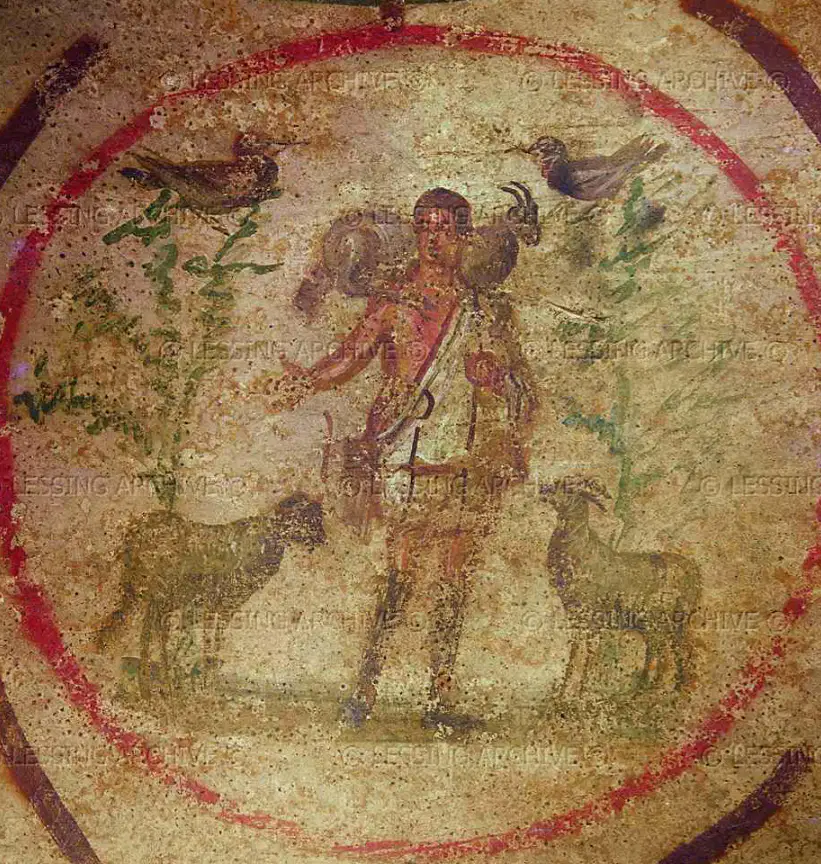
Which artistic technique is primarily used in the creation of the artwork shown in the image?
Oil painting
Watercolor painting
Fresco
Acrylic painting
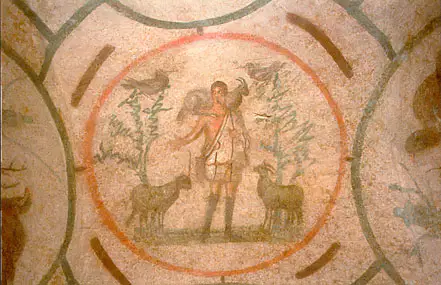
What century does the Good Shepherd fresco in the Catacomb of Priscilla date back to?
1st century
2nd century
3rd century
4th century
Which biblical figure is depicted in the Good Shepherd fresco from the Catacomb of Priscilla?
Moses
Jonah
Jesus Christ
Paul
What artistic style is Christ's physical form based on in the Good Shepherd fresco?
Byzantine
Greco-Roman
Gothic
Baroque
What pose is Christ depicted in within the Good Shepherd fresco?
Orant pose
Contrapposto pose
Pensive pose
Reclining pose
What does the Good Shepherd symbolize in early Christian art as depicted in the fresco?
The rescue of sinners who stray
The resurrection of Christ
The baptism of Christ
The birth of Christ
What is the term used to describe the upper level of a basilica-plan church that allows light into the nave?
Narthex
Apse
Triforium
Clerestory
What is the central part of a basilica-plan church called, typically flanked by aisles?
Narthex
Clerestory
Nave
Triforium
What major question threatened to split the early Christian community?
Was Jesus a historical figure?
Was Jesus divine, and how?
Should the Church pay taxes?
Should Christians observe Jewish laws?
In what year did Constantine take action to quell the controversy within the Christian community?
A.D. 300
A.D. 318
A.D. 325
A.D. 350
Where did Constantine invite 318 bishops to resolve the Christian controversy?
Rome
Nicaea
Constantinople
Jerusalem
Who convened the First Council of Nicaea?
Emperor Augustus
Emperor Nero
Emperor Constantine I
Emperor Tiberius
What was the primary goal of the First Council of Nicaea?
To address economic reforms
To establish a consensus in the church representing all of Christendom
To discuss territorial expansions
To depose rival claimants to the throne

What architectural style is the Basilica of Santa Sabina built in?
Gothic
Romanesque
Early Christian
Baroque
What type of material is used for the windows of Santa Sabina instead of glass?
Marble
Selenite
Stained Glass
Plexiglass
What is the layout of the Santa Sabina?
Central plan
Axial basilica plan
Circular plan
Complex plan
During which centuries was the Santa Sabina constructed?
5th-6th Century
4th-5th Century
3rd-4th Century
6th-7th Century

How are men and women arranged in the seating within Santa Sabina?
Mixed in the main aisle
Men in the main aisle and women in side aisles
Women in the main aisle and men in side aisles
No specific arrangement
What does all the spolia (marble veneer and 24 fluted marble columns with Corinthian capitals) in the Santa Sabina represent?
Triumph of Christianity over paganism
The decline of the Roman Empire
The rise of Gothic architecture
The influence of Eastern trade

What architectural feature do the columns in Santa Sabina support?
Barrel vaults
Nave arcade
Dome
Clerestory windows
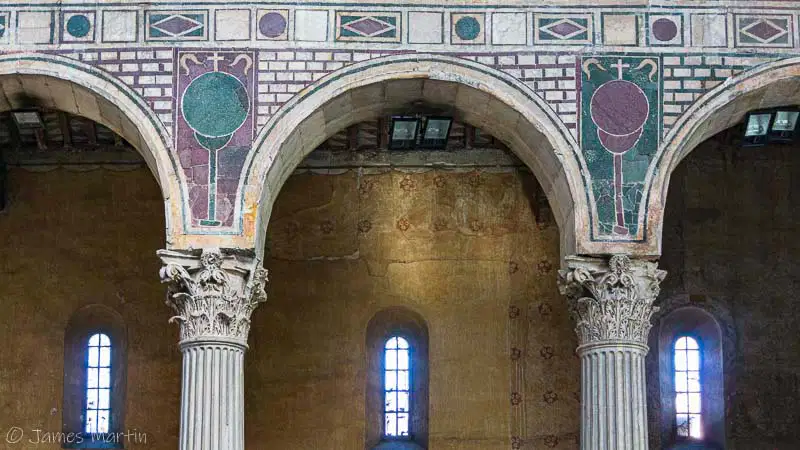
What are the spandrels in Santa Sabina made of?
Inlaid marble of chalice and paten
Gold leaf and frescoes
Stained glass
Wooden carvings

What does the flat wooden ceiling with coffered architecture in Santa Sabina indicate?
Byzantine influence
Renaissance revival
Early Christian architecture
Baroque style
Which ancient structure is Santa Sabina similar to?
Pantheon
Colosseum
Basilica Ulpia (Trajan’s Forum)
Library of Celsus
Who was the first Emperor of the Roman Empire?
Julius Caesar
Augustus
Nero
Trajan
What event marked the end of the Roman Republic and the beginning of the Roman Empire?
The assassination of Julius Caesar
The Battle of Actium
The reign of Augustus Caesar
The fall of Rome
What was the cause of the fall of the Roman Empire?
A single catastrophic event
Invasion by barbarian tribes
Economic troubles and overreliance on slave labor
Both B and C are correct
What was the Roman forum?
A marketplace
A residential area
A public square
Both A and C are correct
Which Roman Emperor is famous for building a wall across Britain?
Julius Caesar
Nero
Hadrian
Augustus

What is this form of art called?
Painting
Drawing
Mosaic
Sculpture

Who was the famous lady that influenced her husband, Emperor Justinian, to increase some legal rights of women?
Irene
Theodora
Joan of Arc
Eleanor of Aquitaine

Justinain was known for building this famous church.
Ankor Wat
Hagia Sophia
Colosseum
Parthenon

The Byzantine Empire and Eastern Roman Empire are referring to the same empire
True
False
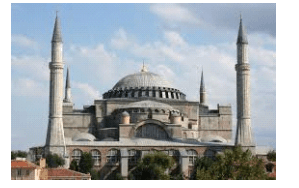
Identify this Byzantine Church.
Hagia Sophia
National Cathedral
Notre Dame
Taj Mahal
Which of the following groups brought an end to the Byzantine Empire in 1453?
The Crusaders
The Seljuk Turks
The Persians
The Ottoman Turks
What language became the main language of the liturgy of the Orthodox Church and for the Byzantine Empire
Arabic
Latin
Greek
Hebrew

Pantheon
Colossuem
Acropolis
Stonehenge

Byzantine
Stone age
Ancient Egyptian
Mesopotamian

This megalith uses
arches
post-and-lintel system
aqueducts
relief sculpture

Stonehenge
The Pantheon
The Parthenon
Pyramids at Giza

Byzantine
Stone Age
Islamic
Mesopotamian

The Standard of Ur
Venus of Hohle Fels
Victory Stele of Narm-Sin
Pyramids at Giza

This is meant to depict
life and death
war and peace
victory and defeat
fast and slow

Mesopotamian
Stone Age
Ancient Roman
Ancient Egyptian

Colosseum
Pantheon
Parthenon
Column
The Hagia Sophia was originally a church and has become a mosque and museum.
true
false
Hagia Sophia means
Angel of God
Holy Wisdom
Holy Sepulchre
Pieces used to create mosaics are called:
tesserae
terra firma
terrestrial components
San Vitale is shaped like an octogon.
True
False

This is a picture of:
Hagia Sophia
San VItale
Vienna Genesis

This is a picture of the interior dome of:
Vienna Genesis
San Vitale
Hagia Sophia
The illustrated codex was a new luxury item and started to replaced scrolls as way to write and read text. The Vienna Genesis is one of the earliest examples we have.
True
False
The Vienna Genesis is a translation from the original Hebrew into Greek, written in silver ink with the parchment soaked in purple dye.
True
False
The color purple, as is prominent in the Vienna Genesis, is associated with the impoverished & poor citizens of the Byzantine Empire.
True
False

This is a picture of:
San Vitale
Hagia Sophia
Vienna Genesis

