wayground logo

Free Printable Worksheets

Font size

S
M
L
XL
Worksheets

CLASSWORK 8.1-8.3

Total questions: 90

Worksheet time: 5hrs 30mins
Name
Class
Date
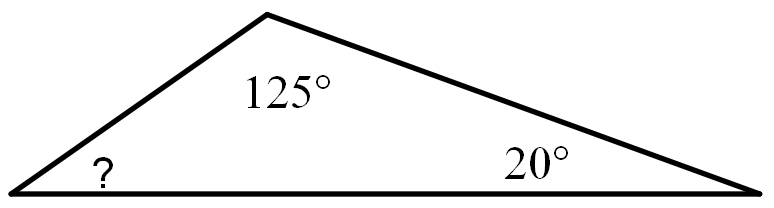
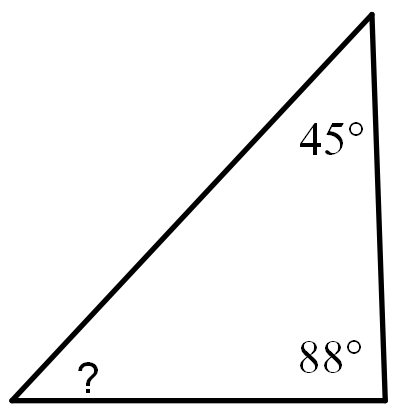
1.
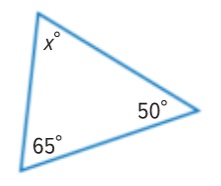
Find the measure of the missing angle.
a)
47
b)
57
c)
53
d)
133
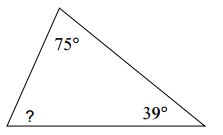
2.
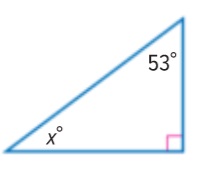
Find the measure of the missing angle.
a)
145
b)
55
c)
35
d)
45
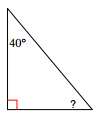
3.
Find the measure of the missing angle.
a)
139°
b)
66°
c)
138°
d)
116°
4.
Find the measure of the missing angle.
a)
140°
b)
21°
c)
105°
d)
25°
5.
A triangle's angles add up to...
a)
90 Degrees
b)
180 Degrees
c)
360 Degrees
d)
OVER 9000 Degrees
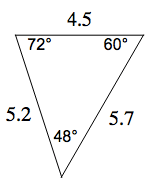
6.
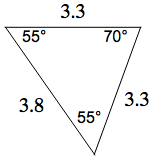
Which would be the best classification for the triangle shown?
a)
acute isosceles
b)
right scalene
c)
acute scalene
d)
obtuse scalene
7.
What is the measure of ∠3?
a)
51
b)
88
c)
45
d)
39
8.
What is the measure of angle b?
a)
36o
b)
56o
c)
63o
d)
117o
9.
Find the measure of the missing angle.
a)
90o
b)
100
c)
130o
d)
50o
10.
Find the measure of the missing angle.
a)
135o
b)
35o
c)
45o
d)
30o
11.
If 2 of the angles of a triangle are 30 and 70 degrees, the third angle measures...
a)
80
b)
100
c)
60
d)
90
12.
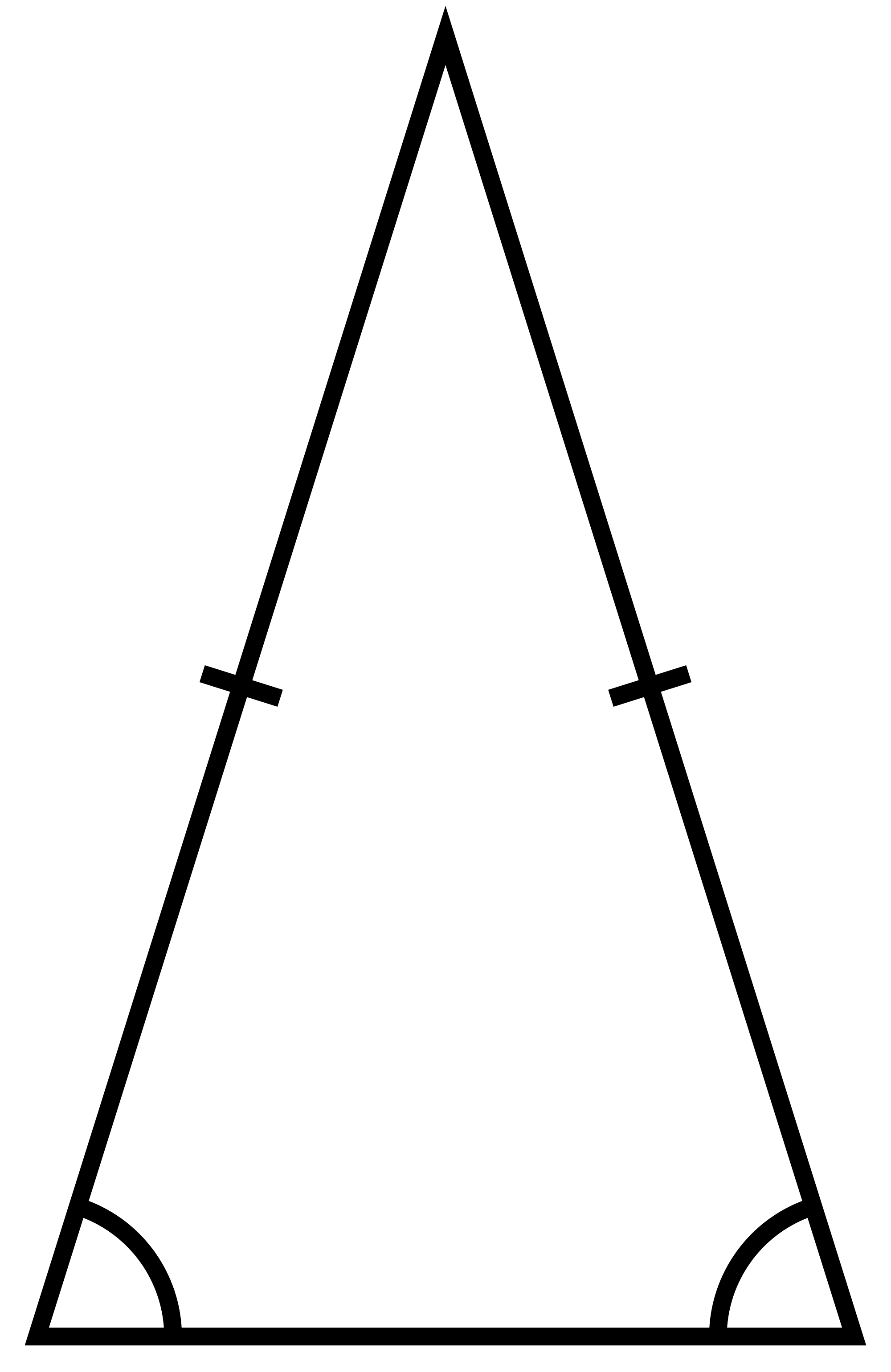
What type of triangle is this?
a)
Equilateral
b)
Isosceles
c)
Scalene
13.
How many acute angles must an acute triangle have?
a)
2
b)
1
c)
4
d)
3
14.
What is an "Acute" Angle?
a)
Angle that measures 180
b)
An Angle that measures 90
c)
An angle that measures more than 90
d)
An angle that measures less than 90
15.
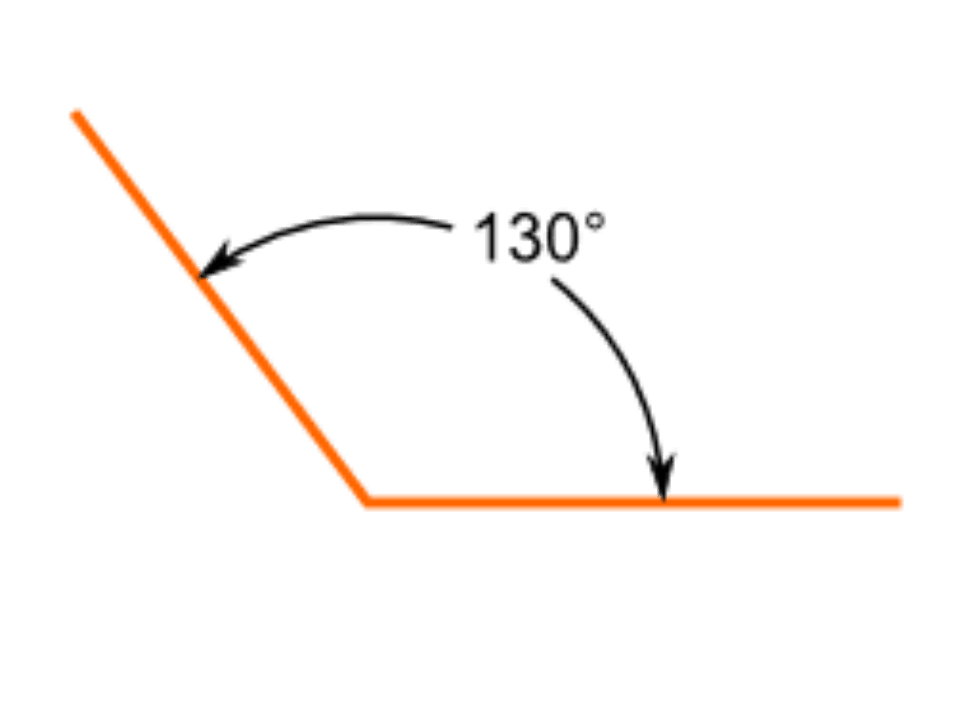
Which angle type is pictured?
a)
Acute
b)
Right
c)
Obtuse
d)
Straight
16.

If the longest side of the triangle was 10. Then the two shorter sides must have a sum that is ....?

a)

any length

b)

equal to 10

c)

greater than 10

d)

less than 10

17.
Which set of numbers may represent the lengths of the sides of a triangle?
a)
{2,5,9}
b)
{6,6,7}
c)
{6,4,2}           
d)
{7,8,1}
18.

Which of the following would NOT work to make a triangle with the two side lengths of 2 and 6?

a)

6

b)

7

c)

5

d)

4

19.

Can the sides of a triangle have lengths 3, 4, and 9?

a)

Yes

b)

No

c)

I don't know

d)

Cannot be determined

20.

Does a triangle with these side lengths exist?

15, 12, 9

a)

Yes

b)

No

c)

I don't know.

d)

Cannot be determined

21.

How many triangles can be created when you know two angles and one non-included side?

a)

Only 1 unique triangle

b)

multiple triangles

c)

no triangles

22.

In this triangle, if angle A is 45 degrees, angle C is 45 degrees, and line AB is 5 cm, how many triangles can you create?

a)

one unique triangle

b)

multiple triangles

c)

no triangles

23.

In this triangle, if angle A is 45 degrees, angle C is 45 degrees, and line AB is 5 cm, how many triangles can you create?

a)

one unique triangle

b)

multiple triangles

c)

no triangles

24.
Two angles of a triangle measure 30° and 108°. What is the measure of the third angle of the triangle?
a)
42
b)
45
c)
62
25.

How many triangles can be created when you know two sides and one non-included angle?

a)

Only 1 unique triangle

b)

multiple triangles

c)

no triangles

26.

How many triangles exist with the following angle measures?

100°, 100°, 50°

a)

No triangle exists with the given angle measures.

b)

More than one triangle exists with the given angle measures.

c)

Exactly one unique triangle exists with the given angle measures.

27.

How many triangles can be created when you know two angles and 1 included side?

a)

Only 1 unique triangle

b)

multiple triangles

c)

no triangles

28.

How many triangles can be created with the side lengths of 3 cm, 4cm, and 5 cm?

a)

Only 1 unique triangle

b)

multiple triangles

c)

no triangles

29.

Given three angle measures, how many triangles can you create?

a)

One unique triangle

b)

Multiple triangles

c)

No triangles

30.

How many triangles can be created with the side lengths of 3 cm, 4cm, and 5 cm?

a)

Only 1 unique triangle

b)

multiple triangles

c)

no triangles

31.

To classify triangles by the measure of their sides you must use the names ______.

a)

Equilateral, Equiangular and Obtuse

b)

Equilateral, Isosceles and Scalene

c)

Right triangle, Scalene and Equiangular

d)

Isosceles, Scalene and Equilateral

32.

To classify triangles by the measure of their angles we use the names ______

a)

Equiangular, Isosceles and Acute

b)

Acute, Obtuse and Isosceles

c)

Right triangle, Isosceles triangle and Scalene triangle

d)

Right triangle, Obtuse triangle and Acute triangle

33.

When a triangle has an obtuse angle, it is called _______.

a)

Right triangle

b)

Obtuse triangle

c)

Acute triangle

d)

Isosceles triangle

34.

If a triangle has three acute angles, it is called ______.

a)

Acute triangle

b)

Obtuse triangle

c)

Right triangle

d)

Isosceles

35.

Which of the following angle measures can form a triangle?

a)

50, 50 and 50

b)

60, 60, and 60

c)

90, 50 and 50

d)

45, 45 and 45

36.

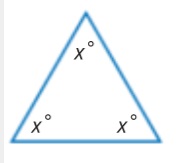
What is the value of x?

a)

65

b)

70

c)

90

d)

55

37.

What is the value of x?

a)

37

b)

47

c)

7

d)

90

38.

What is the value of x?

a)

17

b)

27

c)

37

d)

47

39.

What is the value of x?

a)

45

b)

60

c)

90

d)

15

40.

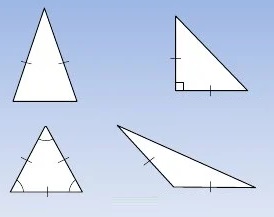
How many right triangles are in the figure?

a)

1

b)

2

c)

3

d)

4

41.

How many triangles in the figure are obtuse?

a)

1

b)

2

c)

3

d)

4

42.

How many triangles in the figure are acute?

a)

1

b)

2

c)

3

d)

4

43.

The sum of the interior angles in a triangle is ...

a)

360 degrees

b)

180 degrees

c)

90 degrees

d)

540 degrees

44.

If two angles in a triangle are 45°45\degree  and  75°\ 75\degree , what is the measure of the third angle?

a)

75°75\degree  

b)

90°90\degree  

c)

60°60\degree  

d)

70°70\degree  

45.

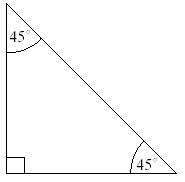
How do you classify this triangle?

a)

acute

b)

obtuse

c)

right

d)

scalene

46.

The triangle inequality theorem states that the sum of any two sides must be ________________ the length of the third side.

a)

less than

b)

greater than

c)

equal to

d)

less than or equal to

47.

Three line segments have measures of 12 cm, 7 cm, and 5 cm. Will the segments form a triangle?

a)

Yes

b)

No

48.

Three line segments have measures of 9 cm, 5 cm, and 6 cm. Will the segments form a triangle?

a)

Yes

b)

No

49.

A triangle has two angles that are 65 degrees and 50 degrees. What must the third angle be?

a)

65

b)

75

c)

25

d)

60

50.

Is it possible to draw a triangle with the following angle measures: 80 degrees, 35 degrees, 55 degrees?

a)

Yes

b)

No

51.

Is it possible to draw a triangle with the following angle measures: 45 degrees, 120 degrees, and 15 degrees?

a)

Yes

b)

No

52.
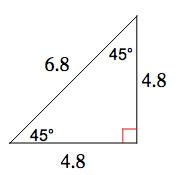
Which would be the best classification for the triangle shown?
a)
right isosceles
b)
obtuse scalene
c)
obtuse isosceles
d)
right scalene
53.
Which would be the best classification for the triangle shown?
a)
right isosceles
b)
obtuse scalene
c)
obtuse isosceles
d)
acute scalene
54.
If a triangle has no equal sides, what type of triangle is it?
a)
Scalene
b)
Equilateral
c)
Right 
d)
Obtuse
55.
Which would be the best classification for the triangle shown?
a)
acute isosceles
b)
obtuse scalene
c)
obtuse isosceles
d)
acute scalene
56.

Complementary angles are angles that together equal

a)

180 degrees

b)

90 degrees

c)

45 degrees

d)

100 degrees

57.

Find the missing angle.

a)

53

b)

67

c)

77

d)

43

58.

Find the missing angle.

a)

28

b)

32

c)

60

d)

38

59.

Find the missing angle.

a)

48

b)

68

c)

52

d)

72

60.

Find the missing angle.

a)

25

b)

15

c)

10

d)

20

61.
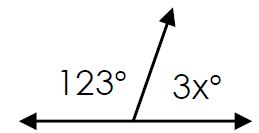
Tell whether the angles are complementary or supplementary. Then find the value of x.
a)
Complementary; x=25
b)
Complementary; x=5
c)
Supplementary; x=25
d)
Supplementary; x=5
62.
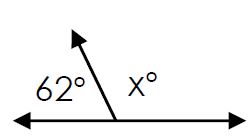
Find the value of x.
a)
15
b)
16
c)
18
d)
19
63.
What are supplementary angles?
a)
Angles that add up to 180°
b)
Angles that add up to 90°
c)
Angles that are equal to each other
d)
Angles that are opposite of each other when lines intersect
64.
These angles are...
a)
Complementary
b)
Supplementary
c)
Neither
65.
Find the missing angle.
a)
60
b)
70
c)
50
d)
140
66.
Find the missing angle.
a)
41
b)
32
c)
51
d)
31
67.
Find the missing angle.
a)
45
b)
65
c)
75
d)
55
68.
What is the measure of the missing angle?
a)
76
b)
86
c)
166
d)
156
69.
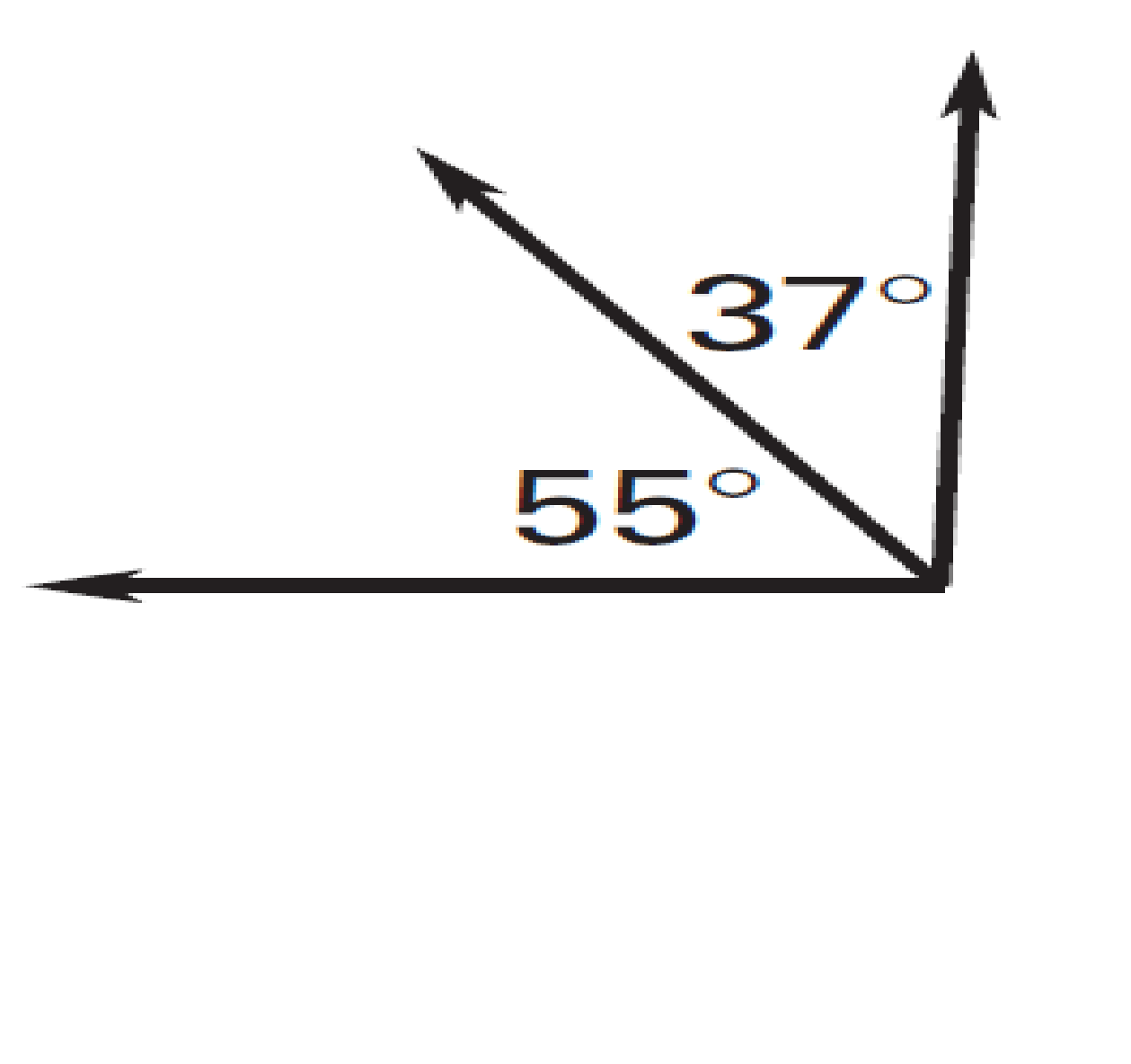
Are these angles complementary, supplementary or neither?
a)
complementary
b)
supplementary
c)
neither
70.
a)
x = 56
b)
x = 66
c)
x = 156
d)
x = 166
71.
What kind of angles are shown?
a)
complementary
b)
supplementary
c)
adjacent
d)
corresponding
72.
These angles are...
a)
Complementary
b)
Supplementary
c)
Neither
73.
Find the missing angle.
a)
47
b)
37
c)
57
d)
137
74.
What is the measure of the missing angle?
a)
76
b)
66
c)
156
d)
154
75.

Would ∠1 and ∠2 be complementary, supplementary, or neither?

a)

complementary

b)

supplementary

c)

neither

d)

I have no idea

76.

What is the supplement of an angle whose measurement is 84 degrees?

a)

96 degrees

b)

6 degrees

c)

86 degrees

d)

16 degrees

77.

A straight line measures...

a)

90 degrees

b)

180 degrees

c)

0 degrees

d)

360 degrees

78.
Are these angles an example of complementary, supplementary, or neither?
a)
Complementary
b)
Supplementary
c)
Neither
79.

Find the supplement of the angle

a)

160 degrees

b)

20 degrees

c)

-70 degrees

d)

180 degrees

80.
complementary, supplementary, or neither?
a)
Complementary
b)
Supplementary
c)
Neither
81.
Find the value of x. 
a)
14
b)
112
c)
108
d)
104
82.
These angles are...
a)
Complementary
b)
Supplementary
c)
Neither
83.
What is an example of a pair of complementary angles?
a)
13° and 45°
b)
10° and 170°
c)
81° and 9°
d)
90° and 3°
84.
Find the value of x.
a)
15
b)
16
c)
18
d)
19
85.
Solve for x
a)
20
b)
25
c)
120
d)
180
86.
a)
x = 118
b)
x = 108
c)
x = 28
d)
x = 58
87.

What is the complement of an angle whose measurement is 84 degrees?

a)

96 degrees

b)

6 degrees

c)

86 degrees

d)

16 degrees

88.

Solve for x

a)

5

b)

90

c)

25

d)

10

89.
Tell whether the angles are complementary, supplementary or neither.
a)
Complementary
b)
Supplementary 
c)
Neither
90.
Are these angles an example of complementary, supplementary, or neither?
a)
Complementary
b)
Supplementary
c)
Neither