
 Worksheets
quiz on wave STEM 12
Total questions: 25
Worksheet time: 19mins
What is the relation between Sound Intensity and Amplitude?
A. They are Inversely Proportional
B. They are Directly Proportional
C. They are Non – Linearly Proportional
D. None of these

Which part of the wave is shown at letter B?
crest
wavelength resting point
trough
What happens to frequency when the energy increases?
it increases
it stays the same
it decreases
The visible light spectrum ranges between
radio waves and X-rays
infrared rays and ultraviolet rays
television waves and infrared rays
ultraviolet rays and gamma rays
The waves with the longest wavelengths in the electromagnetic spectrum
Infrared rays
gamma rays
radio waves
X-rays
The full range of frequencies of electromagnetic radiation is called
visible light
the electromagnetic spectrum
radio waves
invisible radiation
To calculate the frequency of an electromagnetic wave, you need to know the speed of the wave and its
wavelength
refraction
intensity
amplitude
Electromagnetic waves vary in
the speed they travel in a vacuum
wavelength and frequency
the way they reflect
the orientation of their electric and magnetic fields

Radio waves and _______ are used in communication
Microwaves
Gamma rays
Visible light
Ultraviolet

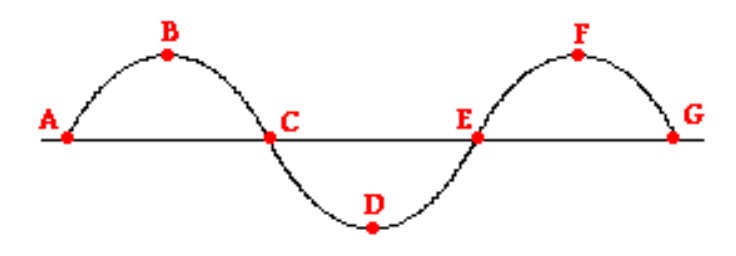
Which letter(s) represent the trough of the wave?
A
B & D
D
C & G
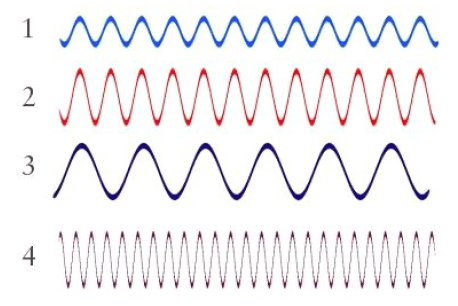
Which wave in the diagram has the greatest wavelength?
1
2
3
4
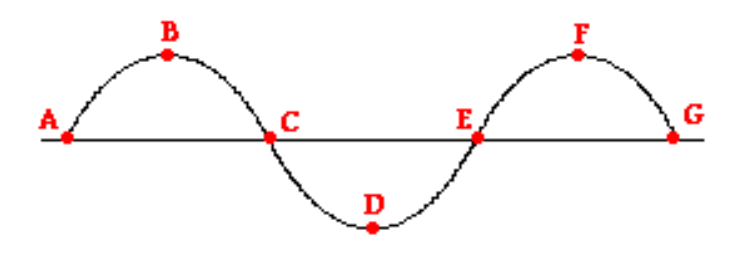
Which letter(s) represent the crest of the wave?
A
B & D
B & F
F

All waves carry ________ as they travel from one place to another.
matter
space
energy
water


The highest point on a wave is:
the crest
the trough
the top
the coast
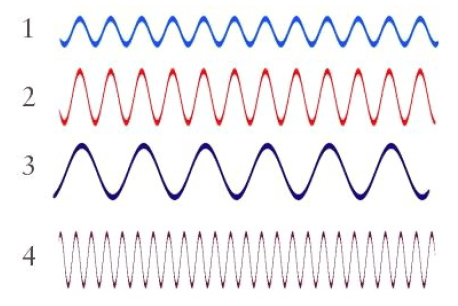
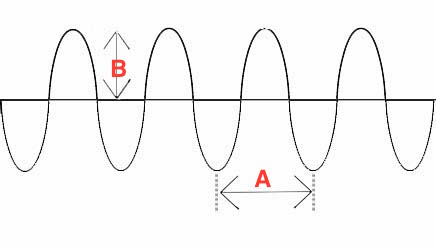
What property of the wave is represented by the letter "A"?
amplitude
crest
trough
wavelength
Waves that can travel through space where there is no matter are called:
tidal waves
electromagnetic waves
sound waves
none of the above
Which has the greatest energy among the colors in a rainbow?
green
orange
red
violet

