
 Worksheets
Cardirespiratory
Total questions: 65
Worksheet time: 35mins
What happens to the diaphragm muscle during inspiration?
It relaxes and rises
It contracts and flattens
It contracts and bulges upwards
It remains unchanged
During inspiration, how does the size of the chest cavity change?
It decreases
It remains the same
It increases
It fluctuates rapidly
What is the primary function of the respiratory system?
To digest food
To circulate blood
To transfer oxygen into the blood
To filter waste from the kidneys
How does air typically move during inspiration?
From lower pressure areas to higher pressure areas
From higher pressure areas to lower pressure areas
In a circular motion within the lungs
It does not move
Which of the following is NOT a function of the respiratory system?
To create speech
To remove carbon-dioxide from the blood
To return air back to the environment
To filter blood
What happens to the diaphragm muscle during expiration?
It contracts and moves upward
It relaxes and forms a dome shape
It expands and flattens
It remains unchanged
During expiration, how does the size of the chest cavity change?
It increases
It decreases
It remains the same
It fluctuates rapidly
What is the relationship between air pressure in the lungs and the external environment during expiration?
Pressure in the lungs is lower than the external environment
Pressure in the lungs is higher than the external environment
Pressure in the lungs is equal to the external environment
Pressure in the lungs is unrelated to the external environment
Where does the transfer of gases primarily take place in the lungs?
Trachea
Bronchi
Alveoli
Pharynx
What is the maximum amount of air that can be breathed out after a maximum inspiration called?
Tidal Volume
Inspiratory Reserve Volume
Vital Capacity
Residual Volume
During exercise, how does the tidal volume change compared to resting conditions?
Decreases from 0.5 liters to 0.25 liters
Increases from 0.5 liters to 2.5 liters
Remains constant at 0.5 liters
Increases from 2.5 liters to 5 liters
What is the term for the total amount of air left in the lungs after a maximal forced expiration?
Total Lung Capacity
Vital Capacity
Residual Volume
Expiratory Reserve Volume
Which of the following best describes why gaseous exchange occurs in the lungs?
Due to equal concentration of gases
Because of differences in concentration or pressure levels
Due to movement of gases from low to high pressure
None of the above
What is the primary reason gases move in the respiratory system?
From an area of low concentration to an area of high concentration
From an area of high pressure to an area of low pressure
From an area of high concentration or pressure to an area of low concentration or pressure
Random movement without any concentration gradient
What happens when air is breathed in and arrives at the alveoli?
It has a low concentration of oxygen.
It combines with carbon dioxide.
It has a high concentration of oxygen.
It exits the body immediately.
Where does oxygen diffuse after being in the alveoli?
Into the bloodstream directly.
Into the capillaries and combines with hemoglobin.
Into the surrounding air.
Back to the lungs.
What is the oxygen concentration like in the capillaries surrounding the alveoli?
High concentration of oxygen.
No oxygen.
Low concentration of oxygen.
Equal to atmospheric oxygen.
What happens when oxygenated blood arrives at the muscle tissue?
It has a low concentration of oxygen.
It has a high concentration of oxygen.
It has no oxygen left.
It turns into carbon dioxide.
How does the concentration of oxygen in working muscle compare to the oxygen in the blood arriving at it?
Higher concentration in muscle.
Lower concentration in muscle.
Same concentration as in blood.
No oxygen in muscle.
From where does oxygen diffuse into muscle cells?
Directly from the lungs.
From the surrounding air.
From the capillaries.
From the bone marrow.
Which one of these is a primary waste product produced from working muscles?
Oxygen
Carbon monoxide
Carbon dioxide
Nitrogen
What percentage of carbon dioxide is carried by hemoglobin?
10%
20%
30%
40%
How is the rest of the carbon dioxide transported in the body?
As a bicarbonate ion
Attached to plasma proteins
In the form of glucose
As a chloride ion
What causes carbon dioxide to diffuse from the muscle into the capillaries?
High concentration of CO2 in the capillaries
Low concentration of CO2 in the capillaries
Equal concentration of CO2 in muscles and capillaries
Absence of CO2 in the muscles
What are the main components of the cardiovascular system?
Heart, lungs, kidneys
Heart, blood vessels, blood
Heart, stomach, blood
Heart, liver, spleen
Which circuit in the cardiovascular system is responsible for blood flow between the heart and the lungs?
Pulmonary circuit
Systemic circuit
Renal circuit
Coronary circuit
What is the primary function of the systemic circuit in the cardiovascular system?
To transport blood between the heart and the brain
To transport blood between the heart and the lungs
To transport blood between the heart and the rest of the body
To transport blood between the heart and the liver
Which of the following is NOT a function of the cardiovascular system?
Blood clotting
Fight disease
Digest food
Circulate blood
Where does oxygenated blood enter after arriving from the lungs?
Right atrium
Left ventricle
Left atrium
Right ventricle
Through which vessel does deoxygenated blood return to the lungs?
Aorta
Pulmonary veins
Pulmonary arteries
Superior vena cava
What is the role of the left ventricle in the circulation of blood?
It receives deoxygenated blood from the body.
It pumps oxygenated blood out through the aorta.
It passes blood to the right atrium.
It collects blood from the pulmonary vein.
Which part of the heart receives deoxygenated blood from the body?
Left atrium
Left ventricle
Right atrium
Right ventricle
What is the primary function of arteries in the circulatory system?
To carry blood away from the heart
To carry blood back to the heart
To allow exchange of gases and nutrients
To filter blood
Which type of blood vessel is primarily responsible for the exchange of gases, nutrients, and wastes between the blood and tissues?
Arteries
Veins
Capillaries
Venules
What is the function of veins in the circulatory system?
To filter blood
To carry blood back to the heart
To exchange gases
To carry blood away from the heart
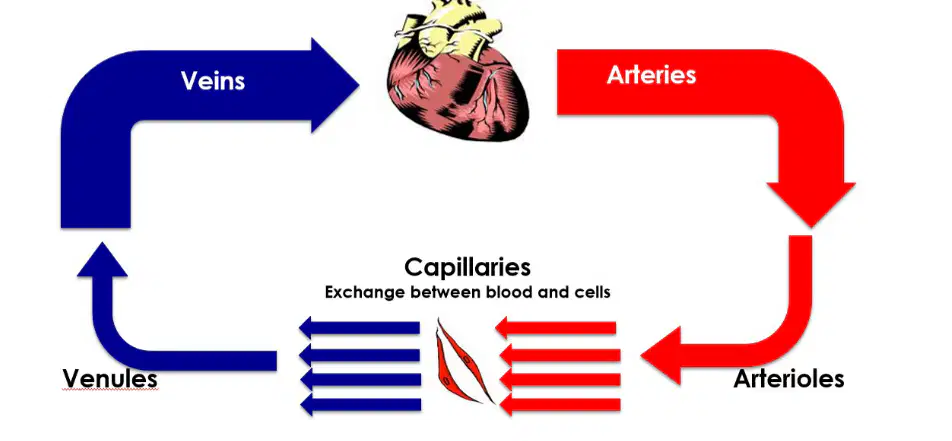
Refer to the diagram below to answer: Which blood vessel is shown as carrying blood back to the heart?
Arteries
Veins
Capillaries
Arterioles
What is the primary function of red blood cells in the human body?
To fight infection
To carry oxygen
To clot blood
To regulate body temperature
What percentage of the blood volume is plasma?
55%
45%
90%
10%
Which component of blood is primarily responsible for clotting?
Red blood cells
White blood cells
Platelets
Plasma
What is the typical blood volume in adult males?
3-4 liters
4-5 liters
5-6 liters
6-7 liters
What is the systolic blood pressure at rest as described?
80 mmHg
90 mmHg
100 mmHg
120 mmHg
Which of the following is NOT a function of the blood?
Transport of gases, nutrients, wastes
Regulation of temperature and hydration
Synthesis of vitamins
Fighting infection
What is the normal range for resting heart rate in adults?
A) 50-70 bpm
B) 60-100 bpm
C) 70-110 bpm
D) 80-120 bpm
How much blood is typically ejected by the left ventricle in one contraction at rest?
A) 50ml/beat
B) 75ml/beat
C) 100ml/beat
D) 125ml/beat
What is the formula for calculating cardiac output?
A) Cardiac Output = Heart Rate + Stroke Volume
B) Cardiac Output = Heart Rate / Stroke Volume
C) Cardiac Output = Stroke Volume x Heart Rate
D) Cardiac Output = Stroke Volume - Heart Rate
What is the typical range of cardiac output at rest in liters per minute?
A) 3-4 liters
B) 4-5 liters
C) 5-6 liters
D) 6-7 liters
What is the primary function of thermoregulation in the human body?
To maintain the body's hydration level
To maintain the body's core internal temperature
To increase the body's metabolic rate
To decrease the body's oxygen consumption
Which mechanism does the body employ to cool down?
Vasoconstriction
Vasodilation
Decreasing sweat gland activity
Reducing blood flow to the skin
What happens during vasodilation?
Blood vessels under the skin constrict
Blood vessels under the skin widen
Sweat glands stop producing sweat
Blood flow to the skin decreases
What is arteriovenous oxygen difference (aVO2)?
The difference in glucose levels between arterial and venous blood
The similarity in oxygen content between arterial and venous blood
The difference in oxygen content between arterial and mixed venous blood
The rate of oxygen usage during exercise
How is aVO2 expressed?
As percentage per 100ml of blood
As milliliters per 100ml of blood
As liters per 100ml of blood
As grams per 100ml of blood
Steady State is best described as?
O2 demand exceeds O2 supply
O2 supply exceeds demand during recovery
O2 supply meets O2 demand
Oxygen Deficit is best described as?
O2 demand exceeds O2 supply
O2 supply exceeds demand during recovery
O2 supply meets O2 demand
EPOC is best described as?
O2 demand exceeds O2 supply
O2 supply exceeds demand during recovery
O2 supply meets O2 demand
EPOC stands for
Excess pre-exercise oxygen consumption
Excess- Past-exercise oxygen consumption
EPOC
Excess post-exercise oxygen consumption
In 3 minutes how much PC does the body replenish after exercise
70%
98%
30%
80%
What role do white blood cells play in the body's defense mechanism?
They carry oxygen to tissues
They clot the blood
They fight infections and foreign bodies
They produce red blood cells
How does the heart rate change during vigorous physical activity?
It decreases significantly
It remains constant
It increases to supply more oxygen
It stops momentarily
How does the stroke volume change during vigorous exercise?
Decreases significantly
Increases significantly
Remains the same
Varies unpredictably
When Stroke Volume reaches its max, what could increase to increase blood flow?
Tidal volume
Cardiac output
Heart rate
Blood flow
Reorder the following
Nose and Mouth
Pharynx
Larynx
Trachea
Label the Heart
Superior Vena Cava
Right Atrium
Inferior Vena Cava
Right Ventricle
Aorta
Pulmonary Artery
Pulmonary Vein
Left Atrium
Left Ventricle
Achieving a constant internal environment for the optimal function of the body and its systems is known as:
Thermoregulation
Homeostasis
Hyperthermia
Hypothermia
The movement of gas molecules from a high concentration to a low concentration is called:
Ventilation
Diffusion
Inspiration
Oxygen uptake
The hormone responsible for regulation of red blood cell production is called:
EPO- Erythropoietin
EPO- Erythroprotein
EPP- Erythropropatine
EPE- Erythropine

