
 Worksheets
Water Cycle and Precipitation Quiz
Total questions: 20
Worksheet time: 11mins
In a real-world simulation of the water cycle conducted by students Harper, Nora, and Aiden using an empty plastic water bottle, water is poured into the bottle, sealed, and placed next to a sunny window. Which of the following would best represent the step of precipitation?
water drops in the bottle collecting at the top
water drops in the bottle moving down the sides
the amount of water decreasing at the bottom of the bottle
sunlight from the window warming the water at the bottom of the bottle
During February, students Scarlett, Aiden, and Abigail are observing a weather phenomenon as a storm system moves northeast from the Gulf of Mexico through the United States, causing various types of precipitation along its path. The air temperature at the south end of the storm system is slightly above freezing, while at the north end it is several degrees below freezing. This storm system is not associated with strong winds or thunder and lightning. Which statement best describes the types of precipitation likely to occur at each end of the storm system as it progresses?
Hail will fall from both the north and south ends of the storm system.
Rain will fall from both the north and south ends of the storm system.
Rain will fall from the south end of the storm system, and snow will fall from the north end of the storm system.
Freezing rain will fall from the south end of the storm system, and rain will fall from the north end of the storm system.

The thermometers in the geography classroom show the average winter and summer temperatures for a climate zone. Aiden, Scarlett, and Noah are discussing which climate zone would most likely have these temperatures. Which climate zone do they think it is?
Ocean
Polar
Temperate
Tropical
Ethan is studying Earth's water cycle for his science project. He wants to know which of the following is the primary source for most of the water in the Earth's atmosphere: (a) .
While planning a picnic, Hannah notices cumulonimbus clouds gathering in the sky. Which type of weather should she expect?
sunshine
thunderstorms
cold temperatures
warm temperatures

Ethan and Mia are studying a map that shows climate zones within the United States. Which statement CORRECTLY explains the difference in climate between Florida and Ohio
Florida has more sand than Ohio
Ohio has a higher latitude than Florida
Ohio is closer to the ocean than Florida
Florida has a higher elevation than Ohio
As Benjamin and Evelyn observe the weather during their winter hike, they notice that as the precipitation approaches the ground, the air temperature decreases from 2 degrees Celsius (36 degrees Fahrenheit) to -4 degrees Celsius (24 degrees Fahrenheit). What form will it most likely be when it strikes the ground?
A) hail
B) rain
C) sleet
D) snow
Evelyn, Aiden, and James are planning a science project to measure humidity levels in different environments. Which environment are they most likely to find days with a relative humidity of less than 10%?
A) a desert
B) a swamp
C) a rainforest
D) a deciduous forest

A model for the water cycle is shown to the left. What is the purpose of the ice cubes in the model?
to cool the water vapor to cause evaporation
to heat the water vapor to cause evaporation
to cool the water vapor to cause condensation
to heat the water vapor to cause condensation
Jon lives on the coast of California, near the Pacific Ocean. A cold ocean current flows past the coast. What effect is the cold water current most likely to have on the climate where Jon lives?
The climate would be less humid than nearby inland areas.
The cold water current would keep summer weather cooler than nearby inland areas.
The climate would have weather that changes more throughout the year than nearby inland areas.
The cold water current would cause the area to have warmer weather year-round than nearby inland areas.
Grace, Arjun, and Luna are planning a field trip and want to visit the environment with the least precipitation. Which should they choose?
forest
grassland
tundra
wetland
Why is it crucial for Sophia and William's family in Florida to have a preparedness plan?
to provide a shelter for the community
to be able to predict strong storms such as hurricanes
to be able to continue working during a natural disaster
to be able to deal with dangerous situations with little warning
Nora, a meteorologist for a local radio station, announces that the humidity is high and the air pressure is low. Which additional data would also describe the current local weather?
the current times for sunrise and sunset
the current wind speed and wind direction
the average rainfall for the current month
the average temperature for the current month
During a geography lesson, Lily asked how water moves from the Pacific Ocean to a high mountain glacier in the Rockies. Can you explain this process?
Ocean currents move water near the mountains where the water is evaporated and then falls as rain and condenses on a glacier.
Ocean currents move water near the mountains where the water is condensed and then falls as snow and evaporates into a glacier.
Water evaporates from the ocean and condenses in clouds where wind currents move the clouds to the mountains. There it falls as snow and becomes part of the glacier.
Water evaporates from the ocean and precipitates into clouds where wind currents move the clouds to the mountains. There it falls as snow and becomes part of the glacier.
Match the following environmental characteristics with the environments they are commonly associated with:
high elevations
Typically found in mountainous regions
low temperatures
Common in polar areas
low number of living things
Characteristic of deserts
high amounts of precipitation
Common in both wetlands and rainforests

The table below, prepared by students Aria, Sophia, and Noah for their geography project, shows the average rainfall, in centimeters (cm), and average temperature, in degrees Celsius (°C), for four cities over the course of one year. (a) most likely has a tropical climate.
During a school science fair, Grace, Aria, and Evelyn are presenting a weather simulation. Which conditions are most likely to produce precipitation that falls to the ground as hail?
Moderate temperatures, overcast, with no wind
Cold temperatures, mostly cloudy, with mild wind
Cooling temperatures, high clouds, with strong winds
Hot temperatures, partly cloudy, with occasional wind
Harper is conducting an experiment to observe physical changes. She cuts a banana into equal pieces and places an equal amount of banana slices on each of three different plates. She then puts one plate in a cool pantry, one on a kitchen counter, and one outside in the garden to see how quickly the banana slices will brown in each environment. She notes the start time of her experiment and the temperature at each location. Which of these is NOT a variable in Harper's investigation?
The type of banana used
Where the banana slices are placed
The duration it takes for the banana slices to brown
The air temperature where the banana slices are placed
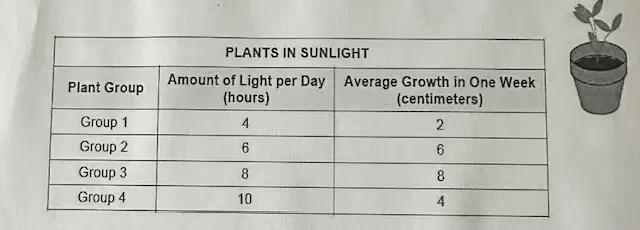
Match the following plant observations with their corresponding conclusions:
The plants that received 4 hours of sunlight a day had the most leaves
Observation of plants with 4 hours of daily sunlight
The plants given less than 6 hours of sunlight had the thickest stems
Observation of plants with less than 6 hours of daily sunlight
The plants that received 8 hours of sunlight a day grew the tallest
Observation of plants with 8 hours of daily sunlight
The plants given more than 10 hours of sunlight a day wilted
Observation of plants with more than 10 hours of daily sunlight

Evaporation
A
Condensation
B
Precipitation
C
Transpiration
D
Groundwater
E

