
 Worksheets
Honors Chemistry Acids and Bases Review 23-24
Total questions: 75
Worksheet time: 2hrs 30mins
What is an Arrhenius acid?
A substance that produces H+ in water.
A substance that produces OH- in water.
What is an Arrhenius base?
A substance that produces H+ ion in water
A substance that produces OH- ion in water.
A substance that produces OH+ ion in water
A substance that produces H- ion in water.
A student tests an unknown aqueous solution and finds it conducts electricity and turns litmus paper red. What can the student infer?
The solution contains an acid.
The solution contains a base.
The solutions is neutral.
A student tests an unknown aqueous solution and finds it conducts electricity and turns litmus paper blue. What can the student infer?
The solution contains an acid.
The solution contains a base.
The solutions is neutral.
(a) conduct electricity and turn litmus paper red.
Label the acid, base, conjugate acid and conjugate base.
Click on the acid.
Click on the base.
Click on the conjugate base.
Click on the conjugate acid.
Which of the following is a Bronsted-Lowry Conjugate acid-base pair.
HCl and NaOH
H3O+ and OH-
H2SO4 and HSO4-
H2S and S2-
According to Bronsted-Lowry, what does an acid do?
It donates a proton (H+).
It accepts a proton (H+)
It produces H+ in water.
It produces OH- in water.
According to Bronsted-Lowry, what does a base do?
It donates a proton (H+).
It accepts a proton (H+)
It produces H+ in water.
It produces OH- in water.
What happens to acids when they react to metals?
Produce Oxygen gas
Helium Gas
Hydrogen gas
Which are slippery when touched?
Acids
Bases
What would the expected pH of a cola be?
2.5 - 3.5
7
8-9

Examine the results (color change) of the pH paper shown in the picture. What type of substance was tested?
an acid
a base
a neutral substance
none of the above
If the substance is neutral, what would the pH be?11
3
5
7
9
11
Ocean water is only slightly basic. What might its pH value be?
5
8
12
2
The strongest bases have pH values close to
0
14
7
5
Which of the following pH values represents a base?
2.1
4.6
6.8
8.1
Which of the following is a property of a base?
bitter taste
reacts with metals
salty
sour taste

Milk is a very weak acid. What might its pH value be?
6.5
7.8
4.2
12.2
Which pH has the most hydrogen ions (H+)?
2
7
10
13
A substance with a pH of 7 is which of the following?
acid
base
neutral
What is the [H+] if the pH is 4.0?
1.0 x 10⁻¹⁰ M
1.0 x 10⁻⁴ M
1.0 x 10⁻¹⁴ M
1.0 x 10⁻⁷ M
What is the pOH of a 1 x 10⁻⁸ M solution of HNO3?
8
6
7
9
What is a titration?
when the moles of hydrogen ions is equal to the moles of hydroxide ions
adding a known amount of solution of known concentration to determine the concentration of an unknown
reaction in which an acid and a base react in an aqueous solution to produce a salt and water
the extent of ionization of an acid or base
Phenolophalein turns from clear to pink when the pH turns
acidic
basic
saline
ionic
What completely ionizes in solution?
Weak acids
Strong acids
Strong Salts
Neutral salts

The table shows the pH of several solutions. Which solution is the most acidic?
vinegar
milk
water
bleach
Zn(OH)2 is an example of a...
acid
base
salt
water
H3PO4 is an example of a ...
acid
base
salt
non-electrolyte
The table shows the pH of several solutions. Which solution has the greatest concentration (amount) of H+ ions?
vinegar
milk
water
bleach
The table shows the pH of several solutions. Which solution has the greatest concentration (amount) of OH- ions?
vinegar
milk
water
bleach
For a solution, pH + pOH =
7
14
1.0 x 10⁻¹⁴
-log (1.0 x 10 -14)
If the pH of a solution is 4.0, what is the pOH?
4.0
10.0
1.0 x 10 -4
cannot be determined from the information
The pH of a solution is 8.43. What is the [H3O+]concentration?
3.7 x 10 -9
1.0 x 10-8.43
2.7 x 10⁻⁶
1.0 x 10⁻¹⁴
For a solution, pH + pOH =
7
14
1.0 x 10⁻¹⁴
-log (1.0 x 10 -14)
If the pH of a solution is 4.0, what is the pOH?
4.0
10.0
1.0 x 10 -4
cannot be determined from the information
The pH of a solution is 8.43. What is the [H3O+]concentration?
3.7 x 10 -9
1.0 x 10-8.43
2.7 x 10⁻⁶
1.0 x 10⁻¹⁴
If the [H3O+] of a solution is 1 x 10⁻³ M, the pH is
11
-3
3
1
If the pH of a solution is 8 the [H3O+] is
1.0 x 10⁶ M
8.0 x 101 M
1.0 x 10⁸ M
1.0 x 10⁻⁸ M
If the [OH-] of a solution is 2.7 x 10⁻⁴ M, the pOH of the solution is
10.44
1.00
3.57
-4.43
Oranges have a [H3O+] of 1.7 x 10⁻² M. Their pOH is
1.77
12.23
10.91
3.09
Ammonia has a pOH of 2. Ammonia is a(n) __________.
acid
base
neutral
metal
Find the pH of a solution with [OH-] = 8.41 x 10⁻⁴.
3.08
10.92
9.88
11.23
What is the pOH of a solution with [H+] = 1.24 x 10 -2?
1.91
1.61
12.09
12.39
What is the [OH-] if the [H+] is 1.0 x 10⁻³M?
1.0 x 10⁻³ M
1.0 x 10⁻¹⁴ M
6.02 x 10⁻²³ M
1.0 x 10⁻¹¹ M
A solution has a pH of 6.9. This solution is _____.
an acid
a base
neutral
If a solution has a very low pH, the hydroxide concentration is _______.
very high
very low
zero
If a solution has a very high pH, the hydroxide concentration is _______.
very high
very low
zero
If a solution has a very high hydrogen ion concentration, the hydroxide concentration is _______.
very high
very low
zero
Find the pH of a solution with [OH-] = 8.41 x 10⁻⁴.
3.08
10.92
9.88
11.23
If the [H3O+] of a solution is 9.3 x 10⁻³ M, the pOH of the solution will be
2.03
1.02
11.97
12.98
0.00020 M. FInd the pH of orange juice.


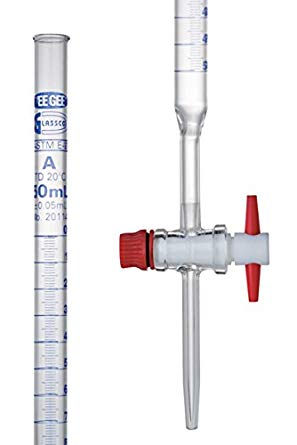
What is this piece of apparatus called
Pipette
Burette
Janette
Cuvette
Why do we perform a titration?
To determine the concentration of an unknown solution
To see if a reaction will occur between an acid and base
To find the mass of an unknown acid
To find the molar mass of an unknown solution
To calculate the viscosity of the solution
If it takes 54 mL of 0.1 M NaOH to neutralize 125 mL of an HCl solution, what is the concentration of the HCl? (record you answer with the correct unit)
0.043 M
0.034 M
0.065 M
0.77 M
A 25.0 mL sample of HCl was titrated to the endpoint with 15.0 mL of 2.0 M NaOH. What is the molarity of HCl?
1.6 M HCl
0.03 M HCl
0.6 M HCl
1.2 M HCl
If it takes 25 mL of 0.05 M HCl to neutralize 345 mL of NaOH solution, what is the concentration of the NaOH solution?
0.0036 M NaOH
0.00125 M NaOH
3.62 M NaOH
1.25 M NaOH

A 10.00 mL sample of H2SO4 was neutralized by 13.5 mL of 1.00 M KOH by the following reaction: H2SO4 + 2KOH → K2SO4 + 2H2O
What is the molarity of H2SO4?
0.675 M
0.910 M
1.05 M
1.20 M
A 25.00 mL sample of HCl was titrated to the end point with 15.00 mL of 2.00 M NaOH. The following neutralization reaction occured: HCl + NaOH → NaCl + H2O
What is the molarity of the HCl?
0.650 M
1.05 M
1.20 M
1.50 M

