wayground logo

Free Printable Worksheets

Font size

S
M
L
XL
Worksheets

Optics Test Review

Total questions: 29

Worksheet time: 1hrs 27mins

Name
Class
Date
1.
The line that passes through the center of a curved mirror is called
a)
focal point
b)
center of curvature 
c)
principle axis
d)
light ray
2.
The point in the middle way between a curved mirror and the center of curvature is the
a)
principle point
b)
focal point
c)
center of curvature
d)
principle axis
3.
The distance between the focal point and the mirror is
a)
raduis
b)
diameter
c)
focal point
d)
focal length
4.
The focal length is equal to the:
a)
radius of curvature
b)
diameter of curvature
c)
half radius of curvature
d)
half diameter of curvature
5.
All rays that are parallel to the principle axis in a concave mirror reflects 
a)
Towards the focal point
b)
Away from the focal point
c)
Towards the center of curvature
d)
Away from the center of curvature
6.
In a concave mirror, if an incident ray passes through F and hits the mirror then it will reflect
a)
Towards C
b)
Towards F
c)
Parallel
d)
Away from the mirror
7.
According to the Law of reflection, a light ray striking a mirror
a)
continues moving through the mirror in the same direction
b)
moves into the mirror at a slightly different angle
c)
bounces off the mirror toward the direction it came from
d)
bounces off the mirror at the same angle it hits.
8.
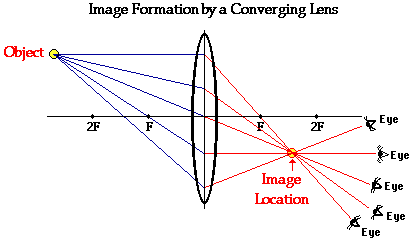
Compared to the object in front the lens, its image is.....
a)
inverted and smaller
b)
inverted and larger
c)
not inverted and smaller
d)
not inverted and larger
9.
What type of image does this lens form?
a)
Virtual image
b)
Real Image
c)
No Image
10.

A 25.0 m object is placed 30.0 m from a convex lens, which has a focal length of 5.0 m. What is the distance of the image?

a)

6 m

b)

7 m

c)

8 m

d)

9 m

11.
What is the index of refraction of a refractive liquid if the angle of incidence in the air is 35 degrees and the angle of refraction is 14 degrees?
a)
1.33
b)
2.21
c)
2.37
d)
1.72
12.

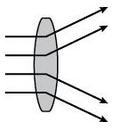
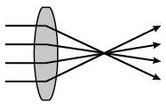
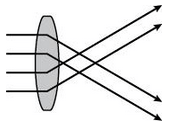
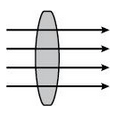
Which figure represents the path light takes through a converging lens?
a)
b)
c)
d)
13.
Light travels at 300,000,000 m/s.  Approximately, what is the speed of light traveling through ICE? 
a)
229,000,000 m/s
b)
22,900,000 m/s
c)
226,000,000 m/s
d)
200,000,000 m/s
14.

A ray of light traveling from air into crown glass (n = 1.523) strikes the surface at an angle of 40 degrees. What will the

angle of refraction be?

a)

0.49

b)

24.96

c)

0.39

d)

37.28

15.
An object is located 30 cm from a convex lens.  The lens forms a real image at a distance of 20 cm.  What is the focal length of this lens?
a)
13.5 cm
b)
0.0833 cm
c)
12.0 cm
d)
8.7 cm
16.

If an object placed 10.0 cm in front of the lens produces an image 15 cm from the lens on the opposite side, what is the magnitude of the focal length for the lens?

a)

5.00 cm

b)

6.00 cm

c)

25.0 cm

d)

30.0 cm

17.

How does the density of glass compare to the density of air?

a)

Equal

b)

Glass has a greater density.

c)

Air has a greater density.

d)

Impossible to say

18.

What type of reflection is shown in the image?

a)

Regular reflection

b)

Diffuse reflection

c)

Total internal reflection

19.
A converging lens has a focal length of 30 cm. A 5 cm tall candle is placed at a distance of 10 cm in front of the lens. Determine the image distance.
a)
- 45 cm
b)
-30 cm
c)
-15 cm
d)
6 cm
20.

Which TWO of the following statements about total internal reflection is true?

a)

Total internal reflection can occur when light moves from a less dense medium to a more dense medium.

b)

Total internal reflection occurs when the angle of incidence is the same as the critical angle.

c)

When the angle of incidence is greater than the critical angle, total internal reflection occurs.

d)

Total internal reflection can occur when light moves from a more dense medium to a less dense medium.

21.
A converging lens produces an image twice the size of the original. If the object is placed 0.40 m from the lens, and the image produced is 0.80 m from the lens. What is the focal length of the lens? 
a)
0.351 m
b)
0.267 m
c)
0.416 m
d)
0.112 m
22.

A converging lens produces an image twice the size of the original. If the object is placed 0.40 m from the lens, and the image produced is 0.80 m from the lens. What is the optical power of the lens? 

a)

2.849 D

b)

3.745 D

c)

2.403 D

d)

8.929 D

23.
What type of image is formed when rays of light actually intersect?
a)
real
b)
virtual
c)
projected
d)
curved
24.

Choose all correct statements for a virtual image

a)

Cannot be projected on to a screen

b)

Can be projected on to a screen

c)

Light rays do not pass through image

d)

Light rays do pass through image

25.

Describe the image that will be formed by this lens diagram? (Look at where the lines intersect and draw an arrow)

a)

Enlarged, Upright, Virtual

b)

Reduced, Inverted, Real

c)

Enlarged, Upright, Real

d)

Reduced, Upright, Virtual

26.
Individuals that are farsighted need to have prescription lenses that are _________. 
a)
convex
b)
concave
c)
plane
d)
flat
27.
Individuals that are nearsighted need to have prescription lenses that are ___________. 
a)
convex
b)
concave
c)
plane 
d)
flat
28.

A magnifying glass is used to enlarge a 2-cm tall picture up to a height of 5.5 cm tall. What is the magnification of this lens, and what type of lens would make this image?

a)

0.36; convex

b)

0.36; concave

c)

2.75; convex

d)

2.75; concave

29.

Your image behind a plane mirror is at a distance equal to

a)

a. half your height.

b)

b. half your distance from the mirror.

c)

c. your distance in front of the mirror.

d)

d. slightly more than your distance in front of the mirror.