
 Worksheets
Learning Strategies Final Exam
Total questions: 45
Worksheet time: 39mins

What are the benefits of taking notes in class?
notes keep you focused in class
notes can be used as a study guide
notes provide a journal of instruction
all of the above

Match the difference between To-Know Information, To-Do Information and Abbreviations
To-Know
Material that will be on test
To-Do
Due dates, deadlines & directions
Abbreviations
shortened forms of a word or phrase

Match the abbreviations to the correct words
ASAP
As soon as possible
rqd
required
w/o
without
St.
street
2
two

How many sentences should should the summary column in the Cornell Notes contain?
1 sentence
10 sentences
6 to 8 sentences
3 to 5 sentences

The most effective way to student form Cornell Notes is:
write out flash cards
fold in half & read summary
folding the paper vertically & study
make a paper airplane

Which is NOT a type of Cornell Note?
sticky
matrix
hybrid
indie

While using the outlining method, what reading strategy can you use when gathering information?
SAT
SQ3R
FAS
PAT

What is a MNEMONIC device?
technique to help you remember
technique to help to write
technique to help you spell
a new video player
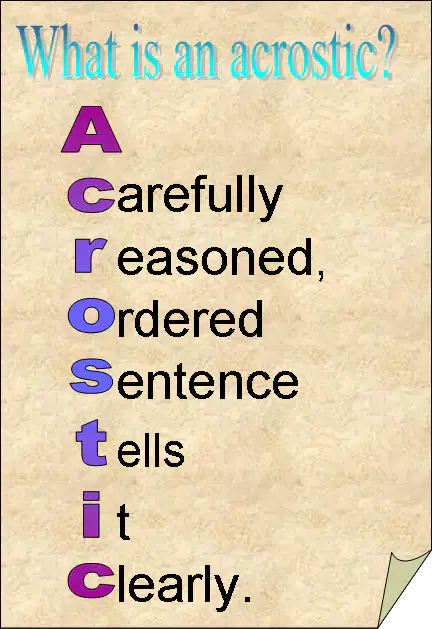
Make an acrostic (sentence) for the following types of fruit: Bananas, Apples, Grapes, Oranges, and Plums.

Make an acronym (word) for the following list: Name of the 5 Great Lakes: Huron, Ontario, Michigan, Erie and Superior.

True or False: You should always CRAM when studying for a test.
True
False

On multiple choice tests, what can you start doing if you are not sure of the answer?
cram
pick answer "A"
eliminate wrong choices
none of the above

On a multiple choice test, what should you do before you start the test?
allocate time
confirm how much time you have
put all study materials on desk
all of the above

On a multiple choice test, the question is also called the _____?
hook
stem
eliminator
statement

Incorrect answers on multiple choice questions are called what?
stems
distractors
hooks
eliminators

True or False: You should answer with "all of the above" if at least 2 of the answers are correct.
True
False

Which word is considered an "absolute" word?
Sometimes
Always
Usually
Frequently

What word is NOT an absolute word?
Always
All
Every
Some

On multiple choice questions, you should eliminate choices that are not grammatically correct. Which answer would be incorrect? Mary Franklin
walked down the street.
ran to the store.
across the pond.
is on time.

On a test, do not leave any answers _______!
open
done
blank
questionable

Which is NOT considered a testing aid?
calculator
reference sheet
food
notes

What should you do before you start writing your response on a test?
read the question
circle action words
underline key words
all of the above

How many sentences should you write for a short answer response?
1-3 sentences
3-5 sentences
6-9 sentences
10 or more sentences

Generally, how many paragraphs should a typical essay be?
2 paragraphs
4 paragraphs
5 paragraphs
10 paragraphs

Organize these options into the right categories (2 answers each)
No preparation
Example: Introducing Self
Some Preparation
Example: Debating

What is a rubric?
answer key
a game
notes
instructions for an assignment

When giving an oral presentation, make sure you know how much _____ you are expected to speak.
energy
time
grades
points

TRUE or FALSE: When writing out your essay as preparation for your oral presentation, you only need to write it in a rough draft form-you are the only one who will see it.
True
False

When preparing for an oral presentation, why will you need to write out cue cards
to write out entire essay
write down EVERYTHING you need to say
to jot down main points as reminder
to study

What is the difference between anticipatory vs. situational test anxiety?
Feel nervous days before
Feel nervous during test

How can you control anticipatory test anxiety?
make a plan
use your study skills
visualize success
all of the above

How can you control situational test anxiety?
Expect a little anxiety
Have confidence in your skills!
Relax & Breathe
All of the Above

TRUE or FALSE: It is important to get enough sleep, stay hydrated, and eat before taking a test.
TRUE
FALSE
According to Jean Piaget, what is active learning?
Learning that involves memorization and repetition
Learning that involves questioning and exploring information
Learning that involves listening to a teacher
Learning that involves physical activity
What is the main difference between an active learner and a passive learner?
Active learners have better grades, while passive learners struggle academically
Active learners question and explore information, while passive learners accept information without questioning
Active learners prefer group work, while passive learners prefer individual work
Active learners are physically active, while passive learners are not
What are the 3 RAS steps to outlining? (hint: sounds like 4 steps)
Read-Align-Study
Recover-Assemble-Study
Right-Arm-Study
Read-Assemble-Search/Recover
An outline is great to activate prior knowledge. In other words, it is a great ______ activation tool.
study
note-taking
writing
schema
Another name for a Distance Learning (DL) class is: (check all that apply)
web-based learning
computer learning
online learning
e-learning
TRUE or FALSE: Distance Learning classes are supervised and graded by a teacher, professor, or course facilitator.
TRUE
FALSE
What is a process of thinking that leads the thinker to the right conclusion or solution mean?
Critical Thinking
Bloom's Taxonomy
Deep Thinking
Thinkology
True or False: Students must constantly push and challenge their brains in order to develop the ability to think critically.
True
False
Plagiarism is a problem because it
is stealing intellectual property.
prevents your teacher from seeing what you’ve learned.
damages the trust between you and your academic community.
all of the above
Participation involves which of the following: (check all that apply)
Active Listening
Coming to class prepared
Engaging in discussions
Texting on phone
TRUE or FALSE: There are potential benefits to failing as knowing how to correct it.
TRUE
FALSE
A failing grade in class is a _______ _______ that you are not completing none or more of the many actions steps to your goal.
bad deed
potential mishap
bad habit
warning sign

