
 Worksheets
Jewish History Part 1 Quiz
Total questions: 64
Worksheet time: 32mins
What does "BCE" stand for in historical timelines?
Before Common Era
Before Current Era
Before Christian Era
Before Commencement Era
What does "CE" stand for in historical timelines?
Common Era
Current Era
Christian Era
Commencement Era
What year is marked by the transition from BCE to CE in the timeline?
1 CE
0 CE
1 BCE
218 BCE
Based on the image, what might be a common scene during the early periods of Jewish history?
People using modern technology
Villagers engaging in agricultural activities
Urban cityscapes with tall buildings
Cars and highways
Who were the patriarchs mentioned as the ancestors before the 12 tribes in the image?
Moses, Aaron, Joshua
Abraham, Isaac, Jacob
David, Solomon, Saul
Adam, Noah, Seth
In what year did the Jews leave Egypt according to the Jewish calendar year mentioned in the image?
2448
2332
2488
1313
According to the image, when did the slavery in Egypt begin in the Jewish calendar year?
2448
2332
2488
1313
What significant event happened in the year 1273 BCE as per the image?
Jews left Egypt
Slavery in Egypt began
Jews entered Canaan
Abraham was born
When did Yehoshua die?
A) 1245 BCE
B) 890 BCE
C) 877 BCE
D) 869 BCE
Who was anointed as the first king in 879 BCE?
A) David
B) Shaul
C) Shmuel
D) Solomon
In what year did David become king in Chevron?
A) 869 BCE
B) 890 BCE
C) 877 BCE
D) 879 BCE
What year was David accepted as king of everyone?
A) 869 BCE
B) 877 BCE
C) 879 BCE
D) 1245 BCE
When was the First Beit HaMikdash most commonly believed to have been built?
A) 833 BCE
B) 950 BCE
C) 1000 BCE
D) 900 BCE
How many years of peace and prosperity were there while Shlomo was king?
A) 30 years
B) 40 years
C) 50 years
D) 25 years
Who succeeded Shlomo as king, leading to the kingdom splitting in two?
A) Yeravam and Rechavam
B) David and Solomon
C) Ahab and Jezebel
D) Isaac and Ishmael
Who destroyed the first Beit HaMikdash in 586 BCE?
Persians
Romans
Babylonians
Egyptians
In what year did the Babylonian empire fall to Persia and Cyrus?
516 BCE
539 BCE
586 BCE
368 BCE
What significant event started in 516 BCE?
Fall of Babylon
Rebuilding the second Beit HaMikdash
Jews exiled to Babylonia
Story of Purim
Who took over from Cyrus and is associated with the story of Purim?
Nebuchadnezzar
Darius
Ahashverosh
Alexander
What year did the Jews in Jerusalem start working on the Second Temple again?
353 BCE
350 BCE
340 BCE
360 BCE
Who was the political and religious leader of the Jews in Babylon that returned to Israel to revitalize Jerusalem?
Nechemiah
Ezra
Moses
Solomon
What significant action did Nechemiah take to reinforce religious observance?
Rebuilt the walls of Jerusalem
Forced markets to close on Shabbat
Built the Second Temple
Wrote the Torah
What language did Nechemiah reinstate as the language of the Jews during his leadership?
Aramaic
Hebrew
Greek
Latin
What was proclaimed as the center of Jewish life by Nechemiah?
The synagogue
The Torah
The Talmud
The Temple
Who established the Men of the Great Assembly?
King Solomon
Moses
Ezra
King David
What significant religious text did the Men of the Great Assembly canonize?
The Talmud
The Torah
The Zohar
The Bible
How many books were sealed in the canonization process by the Men of the Great Assembly?
10
24
30
50
What did the Men of the Great Assembly institute that is a part of Jewish daily life?
Kosher laws
Tefilah
Bar Mitzvah
Sabbath
What system did the Men of the Great Assembly establish in Israel?
Political system
Educational system
Health system
Legal system
Who was the ruler of Greek city-states by the year 337 BCE?
Alexander the Great
Darius
Philip of Macedon
Shimon HaTzaddik
In which year did Alexander the Great take over after Philip of Macedon?
337 BCE
336 BCE
333 BCE
331 BCE
During which years did Alexander fight against the Persians and defeat Darius?
337-336 BCE
336-335 BCE
333-331 BCE
330-328 BCE
Who did Alexander meet in Jerusalem?
Philip of Macedon
Darius
Shimon HaTzaddik
None of the above
What did the Jews in Judah do when Alexander came to Jerusalem?
They fought against him
They hid from him
They pledged allegiance to him
They ignored him
What significant event occurred in 312 BCE regarding Alexander's empire?
The empire expanded into Asia
The empire was unified under one ruler
The empire split into two under his generals
The empire was invaded by the Romans
Who was known for translating the Torah into Greek?
Ptolemy I
Ptolemy II
Alexander the Great
Seleucid
How was Ptolemy I's rule described?
Democratic and fair
Harsh
Enlightened
Economically focused
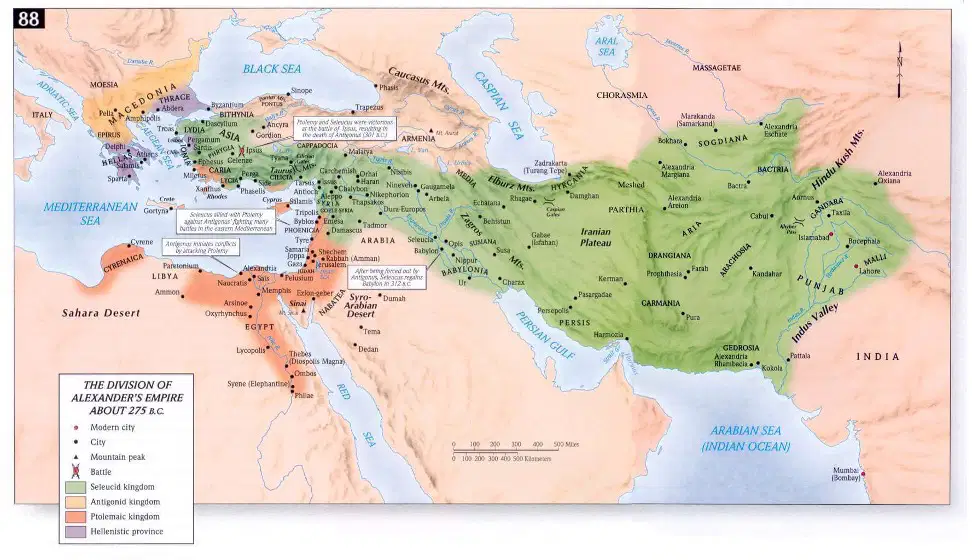
What color on the map represents the Seleucid kingdom around 275 B.C.?
Green
Orange
Blue
Purple
What color on the map represents the Ptolemaic kingdom around 275 B.C.?
Green
Orange
Blue
Purple
What type of religious belief system was Hellenism known for?
Monotheistic
Atheistic
Polytheistic
Animistic
What was a key characteristic of the gods and goddesses in Hellenism?
Invisible and formless
Animal forms
Human form
Shape-shifting abilities
Who adopted Hellenism in Judah?
Common people and slaves
Leaders and upper class Jews
Foreign invaders only
Artisans and craftsmen
What was the religious affiliation of Jews in Judah under Hellenistic influence?
Babylonian Hellenists
Roman Hellenists
Ptolemaic Hellenists
Spartan Hellenists
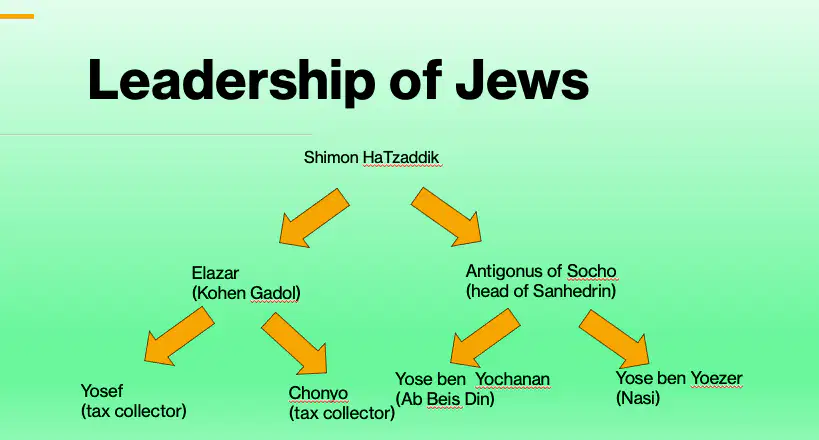
Who was Shimon HaTzaddik in the leadership structure of Jews?
A) A tax collector
B) Head of Sanhedrin
C) Kohen Gadol
D) Nasi
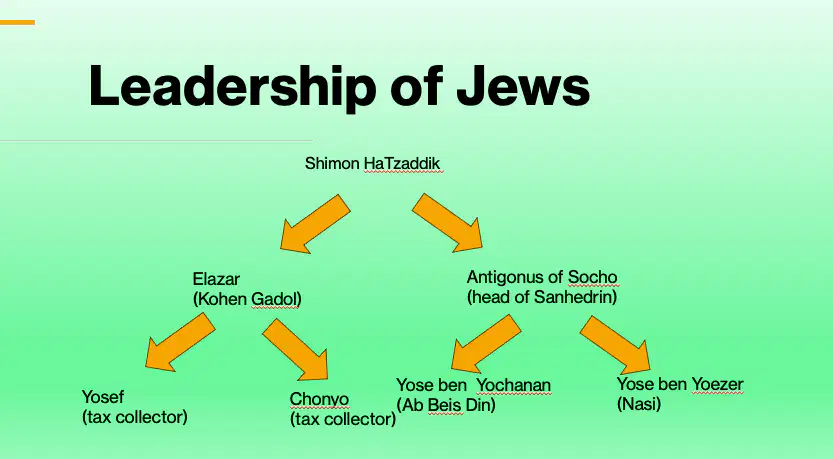
What role did Antigonus of Socho hold?
A) Ab Beis Din
B) Nasi
C) Head of Sanhedrin
D) Tax collector
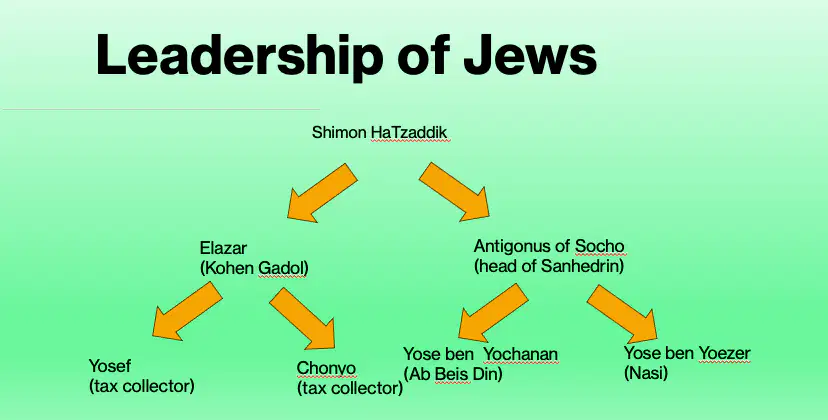
Which position was held by Yose ben Yoezer according to the diagram?
A) Kohen Gadol
B) Nasi
C) Tax collector
D) Ab Beis Din
Who succeeded Ptolemy IV as the ruler after his death in 205 BCE?
Seleucus IV
Antiochus III
Ptolemy V
Antiochus IV
In what year did the Seleucids under Antiochus III gain control of Judah?
198 BCE
205 BCE
187 BCE
185 BCE
What nickname was given to Antiochus IV by those who opposed him?
The Illustrious
The Great
The Madman
The Harsh
What significant event happened in 174 BCE related to the high priesthood in the story of Chanukah?
Menelaus became the high priest
Jason was deposed by his brother Chonyo
Chonyo was deposed and Jason became high priest
Antiochus became the high priest
What did Jason do to appease Antiochus and influence the Jewish people?
He promoted Jewish laws
He discouraged any interaction with the Greeks
He offered to pay large tribute and encouraged Greek sports and competitions
He removed Greek influences from the temple
Who replaced Jason as the high priest in 171 BCE and was noted for being more assimilated than Jason?
Chonyo
Menelaus
Antiochus
Simon
What did Menelaus do to finance Antiochus's needs?
He taxed the Jewish people heavily
He sold many vessels of Beit HaMikdash
He increased trade with neighboring countries
He wrote religious texts
What significant action did Antiochus take in 167 BCE during the Hasmonean Dynasty?
He allowed freedom of religion
He imposed restrictions on Jewish practices
He expanded the empire
He signed a peace treaty
In which year did Mattiyahu fight back in Modiin?
165 BCE
166 BCE
167 BCE
169 BCE
Who defeated the Greek/Syrian army in 165 BCE?
Antiochus
Mattiyahu
Yehuda HaMaccabee
None of the above
Who took over Jerusalem in 63 BCE and installed Hyrcanus as Kohen Gadol?
Julius Caesar
Mark Antony
Pompey
Augustus
In what year did Antipater's son Herod become the ruler?
44 BCE
34 BCE
53 BCE
23 BCE
What was Herod known for besides being a fierce ruler?
Writing religious texts
Building many palaces and fortresses
Establishing peace treaties
Promoting arts and culture
Who was put in charge after Herod's death in 4 BCE?
Pontius Pilate
Archelaus
Agrippa
Claudius
What significant event happened in 6 CE regarding the governance of Judah?
Nero became emperor
Felix was appointed over Judah
Romans took charge without the Herodian family
Augustus died in Rome
Who became the Roman ruler of Judah in 25 CE and was known as a harsh ruler?
Gaius
Claudius
Pontius Pilate
Felix
In 37 CE, which Roman emperor appointed Herod's grandson as ruler over Judah?
Nero
Claudius
Gaius
Augustus
Who became the emperor of Rome in 54 CE?
Claudius
Gaius
Nero
Felix

