
 Worksheets
Sun-Earth-Moon System Unit Summative Spring, '24
Total questions: 55
Worksheet time: 5hrs 35mins

As the Earth rotates counterclockwise, in which direction do the Sun, Moon, and other planets and stars rise?
north
south
east
west

because sometimes the Earth is closer to the sun and farther away from the Sun
because the temperature of the Sun changes

When the southern hemisphere is tilted toward the sun, what will they experience?
More direct sun rays
More indirect sun rays
An equal amount of direct and indirect rays
Winter at the opposite time as the northern hemisphere

gravitational pull of the Sun
gravitational pull of the Moon

Why does the same side of the Moon always face the Earth?
the Moon doesn't rotate
the Moon doesn't revolve
the Earth's gravity keeps the Moon facing it
the Moon's rotation and revolution takes the same amount of time

What determines which phase of the Moon you see?
your longitude on Earth
how much of the Moon is lit by the Sun
how much of the Moon is in the sky

What if the Earth was not tilted on its axis?

During what Moon phases do spring tides occur?


What moon phase would you see at number 8?
waning gibbous


During an equinox, sunlight strikes the Earth most directly at the equator.

Which number represents perihelion?
1
2
3
4

What blocks most of the solar particles from the Sun on Earth?
Earth's magnetic field

When the northern hemisphere (where we live) is tilted toward the Sun, what season are we in?
winter
spring
summer
fall

First and last (third) quarter moons

What is the source of energy for all processes on Earth?
gravity
density
the Earth
the Moon
the Sun

The darkest part of the shadow in an eclipse is the __________.
Earth
Moon
Penumbra
Umbra

The lighter part of the shadow in an eclipse is the __________.
Earth
Moon
Penumbra
Umbra

Which type of eclipse occurs at a full moon when Earth is directly between the Moon and the Sun?
Earth eclipse
Lunar eclipse
Jovian eclipse
Solar eclipse

The imaginary plane that connects Earth's orbit with the celestial sphere is the ______________________.
celestial plane
eclilpse
plane of the ecliptic
vernal equinox

What word means relating to the stars?
day
sidereal
solar
rotation

What is a sidereal year?
The time required for Earth to complete exactly one orbit around the Sun, relative to the stars
The time it takes Earth to rotate one time completely
The time it takes the Sun to complete one orbit in our solar system
The time it takes the Sun to orbit one time through the Milky Way

The average period of revolution of the Moon around the Earth in reference to a fixed star, equal to 27 days, 7 hours, 43 minutes in units of mean solar time is a _________________.
sidereal month
sidereal year
synodic month
synodic year

What is the main difference between the terms sidereal and synodic?
Sidereal is the difference between a month and a year.
Synodic is always relative to the stars.
Sidereal is always relative to the Sun.
Synodic is always relative to the Sun.

READ CAREFULLY!
Which is the correct order of the lunar phases?
Start the new moon.
New moon, waning crescent, first quarter, waning gibbous, full moon, waxing crescent, last quarter, waxing gibbous, new moon
New moon, waxing crescent first quarter, waning crescent, full moon, last quarter, waxing gibbous, waning gibbous
Full moon, waxing gibbous, first quarter, waxing crescent, new moon, waning crescent, waning gibbous
New moon, waxing crescent, first quarter, waxing gibbous, full moon, waning gibbous, last quarter, waning crescent

When the Sun reaches its zenith, approximately what time is it?
12:00 am-2:00 am
11:00 am-12:00 am
12:00 pm-2:00 pm
5:00 pm-7:00 pm

What is a zenith?
altitude
meridian
lowest point
highest point

The two days of the year on which the Sun reaches its greatest distance north or south of the equator are the ___________.
Look at the picture! This causes days with the longest and shortest number of daylight hours in our calendar.
equinox
nadir
solstice
zenith

The point in a moon's orbit where it is nearest to the Earth is ____________.
apogee
Moon
perigee
perihelion

Any apparent motion in the sky that repeats on a daily basis, such as the rising and setting of stars is _____________________.
diurnal motion
equinox
aphelion
solstice

A __________________ occurs when the Moon passes directly between the Sun and Earth and casts a shadow over part of Earth.
equinox
full moon
solar eclipse
lunar eclipse

To get the best view of a solar eclipse event, where do you need to be?
line of totality
meridian
penumbra
umbra

What does the root word gee refer to?
Earth
Moon
Sun
Terrestrial

What does the root word geo refer to?
Earth
Moon
Sun
Terrestrial

What does the root word helio refer to?
Earth
Moon
Sun
Terrestrial

Which type of movement is shown here?
ellipse
revolution
rotation
round

Which location shows the Earth at aphelion?
1
2
3
4

If the Earth had no Moon, what changes would be immediately noticeable? Choose ALL the correct answers!
Without Earth's tilted axis from the collision that created the Moon, we would not have seasons on Earth.
Without the Moon's gravity to stabilize Earth's tilt, our axis would shift.
Nights would be absolutely black with darkness.
Tides would be lower overall because the Moon's gravity would not pull on the oceans.

How are eclipses named?
Eclipses are named for what is casting the shadow.
Eclipses are named for whatever is covered in shadow, whatever is blocked.
Eclipses are named for astronomers who discovered them.
Eclipses are named after constellations in which they occur.

The reason that most solar winds do not disrupt electricity on the Earth is due to the Earth’s ______.
poles
magnetic field
stratosphere
auroras

Which layer of the Sun can be seen here?
We can only photograph it on Earth during a total solar eclipse.


Why do we have tides here on Earth?
We have tides because of how the Moon's gravity pulls on different parts of the Earth.

The Sun has more mass than Earth. Why doesn't the Moon orbit the Sun instead of Earth?
The moon is closer to Earth than the Sun so its gravitational pull is more.
It does orbit the Sun because of Earth's orbit around the Sun.
The Earth has a greater mass than the Sun.
Earth's magnetic field is so strong it pulls the Moon close.


In which area of the sun does gas rise as it heats up, then fall back down as it cools?
the core
the radiative zone
the convective zone
the corona


Over 99% of the solar system's total mass is in the Sun.
Critical Thinking Question: How did this contribute to the development of our solar system?
Mark more than one correct answer!
The Sun's gravity caused
As the object with the greatest mass, all of the planets orbit the Sun.

When drawing a "flat Earth" model to show Earth's tilted axis, which tools and steps must you use to be sure that your model is accurate?
You must mark THREE correct answers.

Use a protractor to mark the degrees.

Use a compass to draw a perfect circle.

Mark the the circle at 0 degrees at the top and 23.5 degrees at the bottom.

Draw a line connecting 0 & 23.5 degrees

Draw a straight line through the circle's center, connecting your marks for 23.5 degrees.
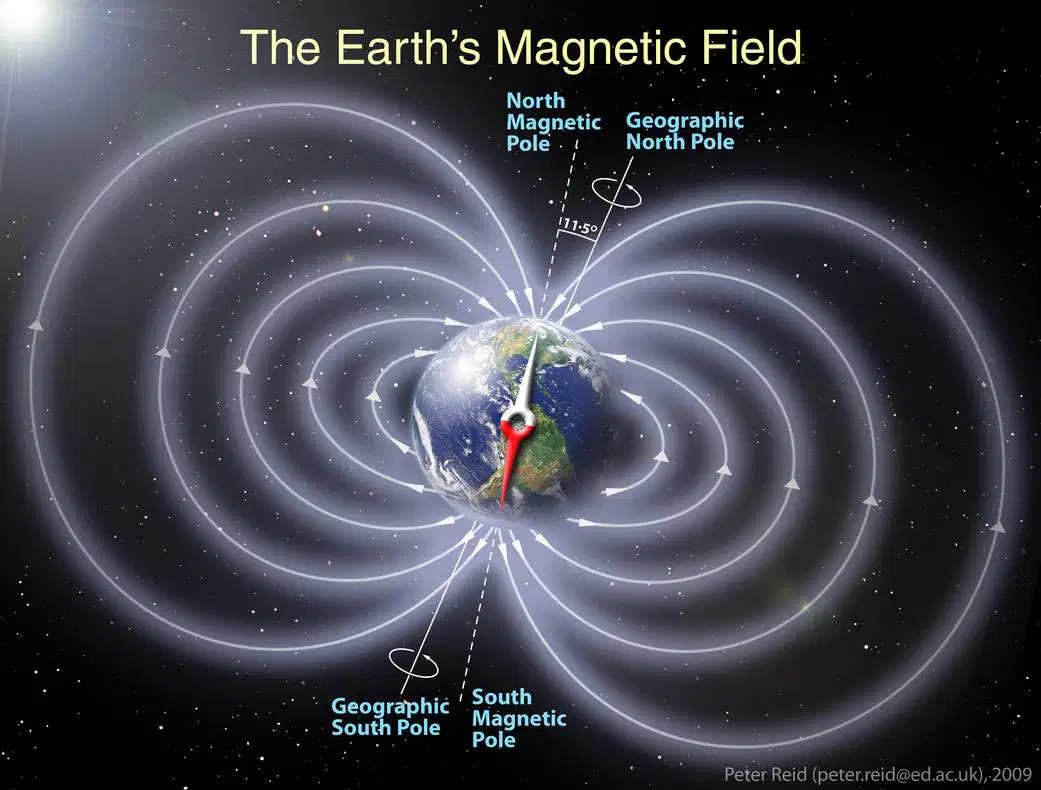
Why does Earth have a magnetic field?
Earth is surrounded by magnetic chunks from asteroids.
Earth's crust is ALL metallic ores. As tectonic plates move, they have a magnetic effect.
It is a solid, metallic inner core, surrounded by a liquid, metallic outer core that moves.
Earth pulls in the Sun's energy and uses it to make magnets in space.

