
Font size
 Worksheets
Quiz 1
Total questions: 15
Worksheet time: 11mins
Who described light as a propagating wave made up of electric and magnetic fields?
James Clark Maxwell
Nikola Tesla
Michael Faraday
________ is a transverse wave produced by a vibrating electric charge.
magnetic waves
longitudinal waves
transverse waves
A wave with the energy moving parallel to the movement of the particle of the wave.
longitudinal waves
magnetic waves
transverse waves
electromagnetic waves
A wave in which the movement of the energy is perpendicular to the movement of the particle of the wave.
transverse waves
magnetic waves
longitudinal waves
electromagnetic waves
Which law states that “The angle of incidence is equal to the angle of reflection. Furthermore, the incident ray, the reflected ray, and the normal to the surface all lie on the same plane”?
Law of Refraction
Law of Reflection
Law of Absorption
________ is the bending of light as it enters a different optical medium.
Refraction
Reflection
Absorption
Which is the light ray that approaches the reflecting surface and forms an angle with the line that is normal or perpendicular to the surface?
Incident Ray
Reflected Ray
Gamma Ray
Ultraviolet Ray
Which is the light ray that bounces off the reflecting surface?
incident ray
reflected ray
gamma ray
ultraviolet ray
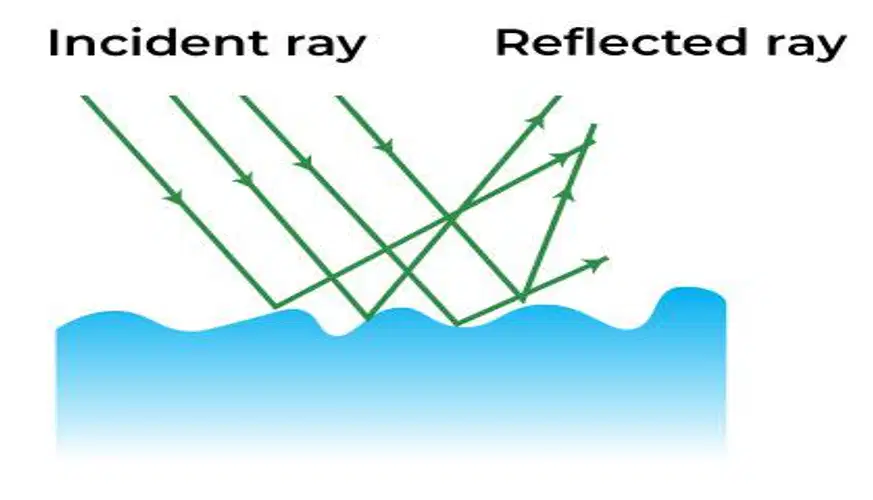
What type of reflection is shown?
regular
specular
diffused
multiple
The separation of white light into various colors is referred to as _______
Retention
Convergence
Dispersion
Separation
(a) a branch of physics that is particularly devoted to the study of light.
(a) is the number of waves that propagate in a unit of time, which is usually in seconds
When light is incident on a smooth surface, it produces (a)
A light being incident to rough surfaces wherein the reflected rays have varying directions produces (a)
What is the speed of light in vacuum? (a) x 108 sm

