
 Worksheets
Human Body Quiz
Total questions: 19
Worksheet time: 10mins
Although vaccines cannot be used to treat a person who is sick, they can help to prevent infections. Vaccinations tell the body to create 'memory cells', which will function later to create antibodies against certain pathogens. When a person is vaccinated, what are they injected with?
live, inactive viruses
weakened viruses or antigens from the virus
blood from a person who has had the disease
Many species of bacteria have become resistant to antibiotics because antibiotics have been so widely used. Now, bacteria that used to be killed by antibiotics are more difficult to treat. What is the best way to proceed in dealing with this public health problem?
Antibiotics should no longer be used.
Antibiotics should be made available to anyone without a prescription.
Antibiotics should only be prescribed to people with bacterial infections.
Anti-viral medications should now be used instead of antibiotics.
The drinking of alcoholic beverages by a pregnant woman is harmful to the development of her fetus. This is most damaging early in a pregnancy because during this time
the lungs of the fetus become functional.
alcohol can easily enter the mouth of the fetus.
many of the essential organs of the fetus are forming.
Which of the following describes fertilization?
cell differentiation to form a blastula
formation of germ layers in a deuterostome
a sperm joining an egg to form a zygote
sperm and egg production
What is the human embryo called after the eighth week of development?
a zygote
infant
morula
How do human diseases caused by bacteria and diseases caused by viruses react to antibiotics?
Neither responds to antibiotics.
Both respond to antibiotics.
Viral diseases respond to antibiotics; bacterial diseases do not.
Bacterial diseases respond to antibiotics; viral diseases do not.
What is immunity?
The body's ability to produce cells that inactivate foreign cells or substances.
The body's ability to regulate homeostasis through feedback loops.
The body's ability to produce the 'fight or flight' response.
The body's ability to use the endocrine system to fight disease.
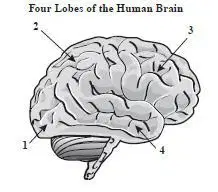
What lobe is designated by label 2?
temporal
parietal
occipital
frontal
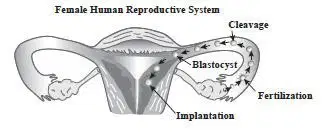
A fertilized egg undergoes several stages before it is successfully implanted. The diagram below shows these stages as the fertilized egg travels through the female reproductive system. In which of the following structures of the female human reproductive system is the blastocyst implanted during normal human development?
ovary
uterus
vagina
amniotic sac
Which of the following best describes the connection between cardiovascular disease and age?
As people age, their blood vessels become more elastic leading to less cardiovascular disease.
As people age, the heart becomes more efficient with each pump, increasing cardiac output.
As people age, blood pressure decreases leading to more cardiovascular disease.
As people age, plaque builds up in the arteries increasing vessel resistance, which leads to disease.
After an initial infection, B-cells recognize the measles virus. How is this helpful in human immune response?
The B-cells use this recognition to defend the body against other pathogens, such as bacteria.
The B-cells more quickly recognize and respond to any other virus that invades the body.
The B-cells produce antibodies more quickly if the measles virus is encountered again.
The B-cells transfer this recognition to T-cells, which will then devour the viruses.
The rate at which blood flows through the human body changes in response to many factors. Which statement describes one of these factors and its effect on blood flow?
A high viscosity of blood causes an increased resistance in the blood vessels and leads to slow blood flow.
A low blood pH decreases the rate of diffusion through the blood vessels and leads to slow blood flow.
The changing of the shape of red blood cells to a crescent shape decreases resistance and lead to a faster blood flow.
The narrowing of blood vessels increases pressure and leads to a faster blood flow.
Which of the following factors would most directly affect blood flow through the circulatory system?
blood pressure
blood sugar
respiratory rate
outside temperature
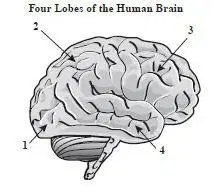
Which lobe of the brain is designated by number 4?
occipital lobe
parietal lobe
frontal lobe
temporal lobe
What is the body's first line of defense against infection by foreign organisms?
antibodies
lymph nodes
white blood cells
the skin
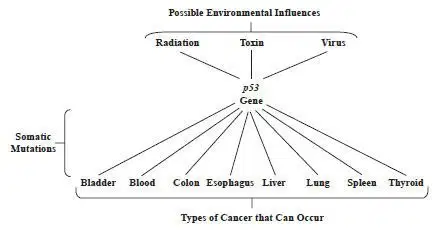
The p53 gene codes for the p53 protein that locates DNA errors for cellular repair. The diagram below shows the relationship among possible environmental influences, the p53 gene, and cancer. Which of the following statements best describes the relationships among possible environmental influences, the p53 gene, and cancer?
Environmental influences can lead to mutations in the p53 gene, which can cause certain cancers.
Increased levels of p53 protein, rather than environmental influences, can cause certain cancers.
Mutations in the p53 gene increase environmental influences that can cause certain cancers.
Genes such as p53 are less casual than environmental influences in stimulating certain cancers.
White blood cells are an important part of the human immune response. Two types of white blood cells, neutrophils and macrophages, act as phagocytes. Phagocytes perform which of the following functions in the human body?
They produce antibodies.
They bind to antigens and develop into plasma cells.
They form a barrier against pathogens.
They engulf and destroy bacteria.
What causes blood pressure?
cholesterol in the blood
stress that exercise puts on heart muscle
contraction of the ventricles in the heart
removal of oxygen from the blood

Which line in the graph best illustrates an effect of the carbon dioxide level in the blood on breathing rate before, during, and after a period of exercise?
A
B
C
D

