
 Worksheets
Post Test Review
Total questions: 151
Worksheet time: 2hrs 6mins
Which amendment gives reserved powers to the states?
1st
7th
10th
12th
This says that Federal law is to be followed if there is a conflict between a state law and federal law.
reserved powers
Supremacy Clause
denied powers

A federal system of government in which power is shared between the national and state governments.
Federalism
Communism
Socialism
Which of the following is a power held only by the national government?
making treaties with foreign countries
taxes
True or False: State governments are allowed to have the power to control schools and marriages.
True
False
True/False:
The national and state governments both have the power to tax and to maintain roads.
True
False
Maria is a member of the mayor's council. She is preparing to present these charts of information to her fellow council members at the next meeting. These charts compare the public and private trash collection services in their area.
Which level of government would be involved in making decisions about trash pick-up services?
International
State
Federal
Local
What is the purpose of government?
limits individual freedoms and liberties of citizens
protects individual freedoms and liberties of citizens
provides a framework for government
allows separation of powers in government
Who establishes public schools?
Federal
State
Shared
Who has the power to declare war?
Federal
State
Shared
The branch of government that enforces laws and is in charge of the military
executive
legislative
judicial
This branch of government makes decisions on how money is spent, as well as printing money and can declare war
executive
legislative
judicial
This branch of government interprets laws and decides if presidential actions and legislative laws are constitutional.
executive
legislative
judicial
What is the highest law in the United States?
Articles of Confederation
U.S Constitution
Declaration of Independence
Treaty of Paris
What does ratify mean?
Weak
Approve
Deny
Ally
What is the role of the Legislative Branch?
Carry out the laws
Make the laws
Vetoes the laws
What is the role of the Executive Branch
Carries out the laws
Makes the laws
Interpret the laws
What is the role of the Judicial Branch?
Breaks the laws
Interpret the laws
Makes the laws
What is the U.S Constitution?
A declaration of war
A document that says how the U.S government runs. It is the highest law of the land.
A peace deal
Is a document that says how mayors and governors should act.
What is an amendment?
An amendment is a change in the Constitution. It takes a lot for Congress to make a change or add to the constitution.
An amendment declares war.
It is a peace deal.
The Constitution can never be changed.
What are the three branches of government?
Legislative, Law Enforcement, Executive
Legislative, Judicial, Executive
Judicial, Exemplary, Legislative
Judges, lawyers, cops
Why did the founders of the Constitution create a separation of powers between the three branches?
So that one branch of government would not have too much power.
So that everyone could be equal.
So that people could vote.
So that the president could have all the power
What are the first 10 amendments to the U.S Constitution called?
Declaration of Independence
Bill of Rights
The First 10 Amendments
Preamble
What is the job of the Supreme Court
To decided if laws or court case decisions are unconstitutional
To decide who should be president
To decide who is elected in Congress
To make new laws
What Principle: Government's power is limited to protect the people's rights.
Limited Government
Popular Sovereignty
Federalism
What Principle: People in government have to obey the Constitution, including the President.
Individual Rights
Checks & Balances
Limited Government
What Principle: The government's power is divided between 3 branches.
Individual Rights
Checks & Balances
Separation of Powers
What Principle: National and State governments share power.
Republicanism
Checks and Balances
Federalism
What Principle: The people have the power in government.
Popular Sovereignity
Republicanism
Federalism
The idea that the people hold the power in the government. They exercise this power by voting.
Popular Sovereignty
Republicanism
Checks and Balances
Individual Rights
The Bill of Rights, Personal freedoms, and protection under the law.
Federalism
Individual Rights
Popular Sovereignty
Limited Government
The central government is separated into three branches. Each have Different Jobs but equal power. Legislative (Lawmakers)Executive (Enforcers of the Law)Judicial (Judges of the Law)
Separation of Powers
Checks and Balances
Federalism
Republicanism
"Nobody is above the law." Which term best describes this definition?
rule of law
minority rights
separation of powers
constitution
Which of the following word best applies to "consent of the governed?"
constitution
separation of powers
voting
minority rights
What principle means that even small and unpopular groups are treated fairly?
rule of law
consent of the governed
minority rights
separation of powers
This happens when citizens use their votes to choose their representatives in government.
rule of law
separation of powers
consent of the governed
minority rights
Which of the following is TRUE about a federalist system of government?
power is shared between the state governments
power is shared among the central, state, and local governments
The central government has all the power
The state governments have all the power
True or Not True: If you are born in Florida, you are a citizen of the United States.
True! Anyone born in any of the 50 states is automatically a citizen
Not True! You have to also take and pass a test to become a citizen, no matter where you live.
You can become a U.S. citizen even if you are not born in the United States
yes
no
Check all the things you need to become a naturalized citizen
18 or older
read, write, and speak English
pass a test about American history and government
have a good-paying job
The citizen obligation or duty of 18 year old males registering with the Selective Service System reflects on which of the following obligations?
defending the nation
serving on juries
performing community services duties
paying taxes
If someone is born on U.S. soil or land anywhere in the world they are automatically a citizen at birth because of ...
Law of Blood
Law of Soil
naturalization
citizen obligations and responsibilities
If someone is born to a U.S. citizen, mother or father, anywhere in the world they are automatically a U.S. citizen at birth through ...
Law of Soil
naturalization
taking a test to prove citizenship
Law of Blood
Someone who is a legal member of a country with certain rights, obligations, and responsibilities is a(n)...
immigrant
citizen
representative
alien
Attending civic meetings, petitioning the government, staying informed, running for office, community service, and voting are examples of citizen...
obligations
requirements
rights
responsibilities
Which is considered a citizen obligation rather than a responsibility?
pay taxes
voting
sigh a petition
attend civic meetings
Below is a quote from an individual about their place of birth.
“My Mother is from Canada and my father is a United States Citizen who lived in the United States for over twenty-five years and is a U.S. Marine. I was born in Canada”
By which means would this person be a U.S. citizen?
Law of Blood
Law of Soil
Immigration
Naturalization

Which of the following is a citizenship responsibility?
Supporting your family
Attending jury duty
Going to school everyday
Doing your homework

To be a naturalized citizen, a person must--
be 18 years or older
be a resident of the U.S. at least 5 years
all of these
pass a citizenship test
Which of the following is a picture of a jury?


Respecting and obeying federal, state, and local laws is a ________________ responsibility.
personal
right
citzenship
optional
Which statement describes the law of demand?
As prices rise, quantity demanded decreases
As prices rise, demand decreases.
As prices fall, quantity demanded decreases.
As prices fall, demand decreases.
Which explains why a supply line is upward sloping?
the Law of Demand states there is an indirect relationship between price and quantity
the Law of Supply states there is a direct relationship between price and quantity
the Law of Supply compares marginal costs and marginal benefits in a constant rate
the Law of Demand shows a positive relationship between two goods, creating the slope
What causes a shift in the demand curve?
A decrease in price
An increase in price
A change in an area other than price
A change in price and availability
The amount of a good or service that producers are willing and able to sell at all possible prices during a given period of time.
Supply
Demand
Factor of Production
Production
The market equilibrium price is the price at which
surpluses depress the number of goods supplied
shortages and surpluses will have no effect on the market
the government will not intervene in the market
the quantity demanded is the same as the quantity supplied
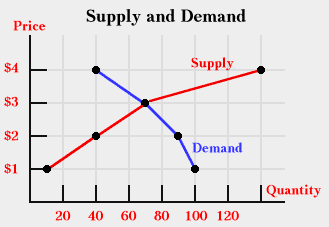
What is the Equilibrium Price?
1
2
3
4

When there is a shortage the price will usually?
rise
fall
remain the same
equilibrium

The diagram represents a(n)
increase in supply
decrease in supply
change in quantity supplied
none of the above
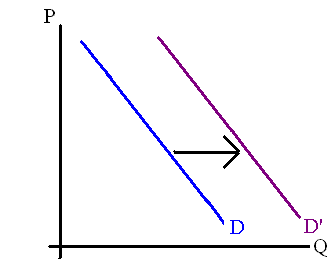
The diagram represents a
increase in demand
decrease in demand
change in quantity demand
none of the above
When the supply of something is high, the price for it is
high
low
not affected
A hurricane caused a shortage at the store of water bottles. There is not enough for everyone to buy. The store changed the price. What do you think happened to the price?
The price went higher.
The price went lower
What is SUPPLY?
the amount of goods or services available.
the amount of goods or services people want and can buy.


When the demand curve shifts to the left, this suggests demand has
increased
decreased
Quantity demanded has increased
Quantity demanded has decreased
When the demand curve has shifted to the right, this suggests demand has
increased
decreased
quantity demanded has increased
quantity demanded has increased

This curve demonstrates what idea?
As price increases, quantity demanded goes up
As price decreases, quantity supplied goes up
As price increases, quantity supplied goes up
As price decreases, quantity demanded goes down

This curve demonstrates what idea?
As price increases, quantity demanded goes up
As price decreases, quantity supplied goes up
As price increases, quantity supplied goes up
As price decreases, quantity demanded goes up
A point ON the curve could change if....?
Price changes
People's tastes or preferences change
There is an increase in demand
There is a change in tax structure

What could cause the shift from D1 to D2?
A change in preferences
A change in price
A change in quantity demanded
A change in quantity supplied

What coin is this?
penny
nickel
dime
quarter

How much is this coin worth?
1c
5c
10c
25c

How many of these are in a dollar?
100
20
10
4

Put money into a bank account.
withdraw
deposit
an institution that receives deposits and makes loans
bank
loans
savings account
checking accounts
deposit
an account to use for daily spending
banks
loans
savings account
checking account
deposit
a safe account to store money
banks
loans
deposit
checking accounts
savings account
money that is borrowed, then paid back with interest
banks
loans
checking accounts
saving accounts
deposit

Something that is worth a lot of money is _________________.
valuable
sick
healthy
How do banks make a profit?
interest
Customer Service
Selling toys
Buying cars and houses
Which is the best description of a loan?
Borrowing money without repaying it
borrowing money and keeping it
Borrowing money and repaying it with interest
None of the above
Banks make it possible for people and businesses to purchase what they need without having all of the money by offering loans.
True
False
Roads, police, schools, governmental agencies, fire and emergency services are funded by taxes.
True
False
Louis's dad pays a tax to the federal government each year based off the money he earns from his business. What type of tax is Louis' dad paying?
Payroll tax
Sales tax
Property tax
Income tax
Your parents pay $3500 in taxes each year based off of the value of your home. Which type of tax is this?
Payroll tax
Property tax
Sales tax
Income tax
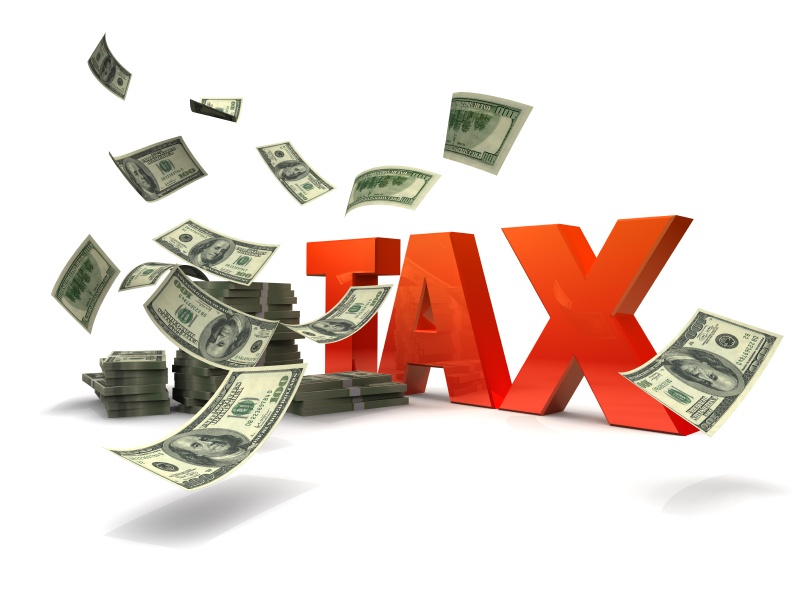
Who primarily uses our tax money? (hint: choose 2 correct answers)
Your employer
Large corporations
Federal and state government
Local Businesses
Our tax money is spent on all of the following EXCEPT:
Social Security
The Military
Private School Education
National Parks
Which of the following is NOT a category in the Federal government's spending?
Mandatory spending
Discretionary spending
Interest on loans issued
Interest on national debt
Jake wants to purchase a video game for $10. Jake hands the cashier a $10 bill plus two $1 bills for tax. What tax is Jake paying?
Payroll Tax
Income Tax
Sales Tax
Property Tax

Which of the following is the single largest federal expenditure?
national defense
Social Security
interest
Medicare
Elementary schools, police departments, and electrical service are typically paid for by
the federal government
state governments
local government
natural monopolies
What is a Economic system?
An Economic system is a system of games in a country.
An economic system describes how a country’s economy is organized.
An economic system describes how much weapons a country has.
Click the four type of Economic systems?
Market
Mixed
Command
Traditional
marcommand.
What would be an example of a Traditional economy?
Germany in the 1920s
A village in South America
The U.K during world war II.
What are the three basic questions that every economic system must answer?
What's produced?
How's it produced?
Who sells it?
Who consumes it?
Which economic system allows for the most individual freedom?
Mixed
Market
Command
Traditional
In which economic system does the government have the most control?
Traditional
Command
Mixed
Market
In which economic system do individuals do things based on customs & beliefs?
Command
Market
Mixed
Traditional
A new tax is added to pharmaceutical imports from the United Kingdom.
tariff
quota
embargo
Germany places a block on all imports from Sri Lanka
tariff
quota
embargo
Spain restricts all imports of automobiles from Germany
tariff
quota
embargo
The United Kingdom adds a tax on all fabric imported from Italy.
tariff
quota
embargo
France imposes a limit on Avocado imports from Mexico.
tariff
quota
embargo
A tax on imports
tariff
import tax
supply
embargo
A limit to the number of imports that may enter a country
tariff
embargo
demand
quota
A government order stopping trade with another country
tariff
embargo
quota
Which is an example of a quota?
The U.S. stops trade with China.
The U.S. limits the amount of foreign cars brought into our country.
The U.S. pays a high tax on BMW cars brought into the country.
Government payments to exporters. This payment helps reduce an exporter’s cost of production.
Subsidies
Quotas
Tariffs
Standards
Safety, environmental health, or other technical requirements set by a government. Imports must meet these requirements before they are allowed to come into the country.
Standards
Quotas
Tariffs
Subsidies
Goods and services a country produces and sells to other countries
imports
exports
demand
supply
Goods and services brought in from other countries
supply
exports
imports
tariff

What is the purpose of a trade barrier?
to raise prices in another country
to make money from another country
to restrict trade with another country and boost domestic production
to make another country do something illegal

What is the purpose of an embargo?
The purpose of an embargo is to exert economic pressure or to punish a country for political reasons.
The purpose of an embargo is to prevent the spread of infectious diseases.
The purpose of an embargo is to establish diplomatic relations with other countries.
The purpose of an embargo is to promote economic growth and trade between countries.

What are the advantages and disadvantages of quotas?
Quotas have advantages such as protecting domestic industries and promoting economic growth, but they also have disadvantages such as higher prices for consumers and limited competition.
Quotas have advantages such as lower prices for consumers and increased competition.
Quotas only have disadvantages such as job losses and reduced consumer choices.
Quotas have no advantages or disadvantages.

How does a quota affect the quantity of imported goods?
A quota increases the quantity of imported goods.
A quota has no effect on the quantity of imported goods.
A quota only affects the quality of imported goods.
A quota reduces the quantity of imported goods.

What is a tariff?
A tariff is a subsidy given to domestic producers.
A tariff is a fee charged for using public transportation.
A tariff is a discount offered to customers for purchasing a product.
A tariff is a tax or duty imposed on imported or exported goods.

What is the purpose of a tariff?
The purpose of a tariff is to lower consumer prices.
The purpose of a tariff is to protect domestic industries.
The purpose of a tariff is to promote economic growth.
The purpose of a tariff is to increase international trade.

How does a tariff affect the price of imported goods?
The price of imported goods decreases.
The price of imported goods remains the same.
The price of imported goods fluctuates.
The price of imported goods increases.

What is a quota?
A quota is a predetermined or fixed amount or limit that is set for something.
A quota is a type of clothing.
A quota is a unit of measurement.
A quota is a type of fish.

What is the purpose of a quota?
The purpose of a quota is to encourage competition and increase market efficiency.
The purpose of a quota is to limit consumer choices and restrict freedom.
The purpose of a quota is to promote unfair trade practices and hinder economic growth.
The purpose of a quota is to control or regulate the quantity or quality of something.
How does a quota affect the quantity of imported goods?
A quota increases the quantity of imported goods.
A quota has no effect on the quantity of imported goods.
A quota only affects the quality of imported goods.
A quota reduces the quantity of imported goods.
What are the advantages and disadvantages of quotas?
Quotas have advantages such as protecting domestic industries and promoting economic growth, but they also have disadvantages such as higher prices for consumers and limited competition.
Quotas have advantages such as lower prices for consumers and increased competition.
Quotas only have disadvantages such as job losses and reduced consumer choices.
Quotas have no advantages or disadvantages.

What is an embargo?
A term used in sports to describe a tie game
A type of dance move
A popular brand of clothing
A government-imposed restriction on trade or other commercial activity with a particular country or group of countries.
What is the purpose of an embargo?
The purpose of an embargo is to exert economic pressure or to punish a country for political reasons.
The purpose of an embargo is to prevent the spread of infectious diseases.
The purpose of an embargo is to establish diplomatic relations with other countries.
The purpose of an embargo is to promote economic growth and trade between countries.

What is a trade barrier?
A wall built so people on either side cannot trade with each other.
A government imposed restriction on the flow of international goods or services.
The prevention of people trading with each other outside of their city or state.
A bunch of rules invented by the government to make trade more difficult for everyday citizens.

