
 Worksheets
To Engineer Is Human
Total questions: 17
Worksheet time: 4hrs 1mins
What was the status of the Great Pyramid in terms of its height historically?
It was the tallest structure for about 500 years.
It was never considered tall.
It was the tallest man-made structure for almost four thousand years.
It was moderately tall for its time.
According to the text, what is a fundamental aspect of engineering?
Creating systems that deliver basic needs like water and electricity.
Building aesthetically pleasing structures only.
Focusing solely on technological advancements.
Engineering is only about historical innovations.
What does the design aspect of engineering involve, as mentioned in the text?
Following strict historical guidelines.
Creating something that has not existed before.
Replicating designs from other civilizations.
Ignoring practical utility.
What is one of the primary needs met by engineering according to the text?
Entertainment and leisure.
Basic needs such as water, food, and shelter.
Luxury travel and tourism.
Advanced computing technologies.
What is the primary focus of the National Academy of Engineering as identified in the top twenty engineering achievements of the twentieth century?
Development of digital technologies
Advancements in medical science
Achievements that have transformed human lives
Innovations in space exploration
According to the text, why is water considered a critical engineering challenge?
It is essential for cooking and cleaning only
It is not easily accessible in all regions
It is used for basic survival and other crucial purposes
It is inexpensive to distribute

What does the image in the document primarily depict?
A broken pipe leaking water
Water being wasted
Clean water flowing from a faucet
A person drinking water
By what year is the Earth's human population predicted to be around 9 billion according to the projections mentioned in the text?
2050
2100
2030
2000
What is the main challenge for the future as described in the text regarding the increase in human population?
Reducing technological advancements
Alleviating poverty and raising the standard of living while sustaining natural resources
Increasing the use of non-renewable energy sources
Decreasing global temperatures
According to the National Resource Council (NRC, 1999), what is the most recent conceptual focus for sustainable development?
Economic growth
Technological innovation
Reconciliation of society’s developmental goals with environmental limits
Expansion of urban areas
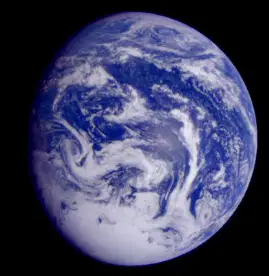
What percentage of the Earth's surface is covered by water as shown in the image?
71%
65%
80%
50%
What percentage of the Earth's surface is covered by water?
51%
71%
81%
91%
Which state of water is the least dense?
Solid (ice)
Liquid (water)
Gas (water vapor)
Plasma
What does the term 'precipitation' refer to in the context of water?
The process of water evaporating from the surface
The process of water freezing into ice
The process of water dissolving substances from soil and rocks
The process of water being purified
What effect does heating and cooling water have?
Changes the chemical composition of water
Affects the density of water
Creates water vapor instantly
None of the above
Why might bottled water contain chemicals besides H2O?
Due to contamination during bottling
Because it dissolves substances such as magnesium and calcium
Because it is artificially flavored
Because it is carbonated


