
 Worksheets
DNA Replication Quiz
Total questions: 172
Worksheet time: 4hrs 26mins
What is the role of Helicase in DNA replication?
Seals the two new DNA strands
Opens the DNA at the replication fork
Synthesizes RNA primers
Removes the RNA primers
Which enzyme is responsible for relieving tension on the DNA strand while it is being unwound?
Topoisomerase
Gyrase
DNA Ligase
Primase
What is the function of DNA polymerase III in DNA replication?
Removes RNA primers
Extends the primers, adding on in the 5’-3’ direction
Seals the DNA strands
Coats the DNA to prevent rewinding
Which of the following best describes the role of Okazaki Fragments?
They are synthesized on the lagging strand
They are the fragments of DNA on the leading strand
They signal for DNA Polymerase III to add bases
They prevent supercoiling of DNA
What does the enzyme DNA Ligase do during DNA replication?
Opens the DNA at the replication fork
Extends the primers
Synthesizes RNA primers
Seals the two new DNA strands
The enzyme _____ unzips the DNA strand during Replication
Topoisomerase
Polymerase
Ligase
Helicase
The enzyme ________ adds on the free nucleotides to the leading strand during DNA Replication
Topoisomerase
Polymerase
Helicase
Ligase
If you have a DNA strand TAT, what is the complementary strand?
ATA
TAT
AAA
TTT
When does DNA Replication occur?
G1
G2
S phase
M phase
The small fragments on the lagging strand are called?
Topoisomerase fragments
Polymerase fragments
Okazaki fragments
Lagging fragments
Which scientist(s) established the double helix structure?
James Watson & Francis Crick
Rosalind Franklin & Alfred Hershey
Martha Chase & James Watson
Francis Crick & Alfred Hershey
What does Chargaff's rule state?
A pairs with T and C pairs with U
A pairs with G and T pairs with C
A pairs with T and C pairs with G
A pairs with C and G pairs with U
What does Chargaff's rule state?
A pairs with T and C pairs with U
A pairs with G and T pairs with C
A pairs with T and C pairs with G
A pairs with C and G pairs with U
What type of bond holds the nitrogen bases together?
covalent
ionic
hydrogen

This image is of what?
lipid
nucleotide
amino acid
DNA
What is the macromolecule that DNA belongs to?
lipid
protein
carbohydrate
nucleic acid

The picture below shows an enzyme unwinding and unzipping DNA.
What is the name of this enzyme?
DNA Helicase
DNA Ligase
DNA polyermase
RNA Polymerase
The picture below shows an enzyme unwinding and unzipping DNA.
What is the name of this enzyme?
DNA Helicase
DNA Ligase
DNA polyermase
RNA Polymerase
DNA replication takes place in eukaryotic cells during which phase?
G1
S
M
G0

The picture below shows the steps of DNA replication beginning with step one and ending with step three.
Because you are reusing the old, or parent, DNA strand DNA replication is said to be
Semi- Conservative
Semi-discontinuous
Continuous
Fully-Conserveative
Match he nucleotide with its complementary nucleotide. (DNA to DNA).
Adenine -
Thymine
Guanine
Cytosine
Match he nucleotide with its complementary nucleotide. (DNA to DNA).
Cytosine-
Thymine
Guanine
Adenine
Which enzyme is responsible for adding the free nucleotides to the replicating DNA?
DNA Helicase
DNA Ligase
DNA polyermase
RNA Polymerase
CAT TCA CTG
CAT TCA CTG
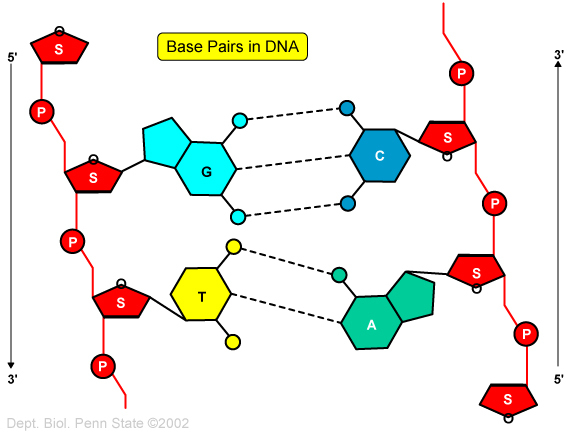
Enzymes: Enzyme that connects the DNA to the backbone (glues)
Ligase
Polymerase
Helicase
Primase
Phases: Which is the first step?
DNA Helicase unwinds original DNA strand
RNA Primase lays down RNA primer for new nucleotide bases.
DNA polymerase builds new strands by bring in new nucleotide bases.
Ligase knits together fragments on lagging strand
Phases: Which is the second step?
DNA Helicase unwinds original DNA strand
RNA Primase lays down RNA primer for new nucleotide bases.
DNA polymerase builds new strands by bring in new nucleotide bases.
Ligase knits together fragments on lagging strand
Phases: Which is the third step?
DNA Helicase unwinds original DNA strand
RNA Primase lays down RNA primer for new nucleotide bases.
DNA polymerase builds new strands by bring in new nucleotide bases.
Ligase knits together fragments on lagging strand
Phases: Which is the fourth step?
DNA Helicase unwinds original DNA strand
RNA Primase lays down RNA primer for new nucleotide bases.
DNA polymerase builds new strands by bring in new nucleotide bases.
Ligase knits together fragments on lagging strand


Direction that DNA is READ?
3' to 5'
5' to 3'
Each DNA molecule created contain one NEW strand and one OLD strand
True
False
Which of the following is a reason for DNA replication in skin cells?
to produce identical daughter skin cells
to enable the skin cells to make more proteins
to allow the skin cells to adapt to a changing environment
to ensure daughter skin cells will have higher genetic diversity
For a new liver cell to form, DNA replication is necessary because it ensures that the newly formed cell has which of the following?
two copies of the original cell’s DNA
an identical copy of the original cell’s DNA
a rearranged copy of the original cell’s DNA
only the best parts of the original cell’s DNA
The small fragments on the lagging strand are called?
Topoisomerase fragments
Polymerase fragments
Okazaki fragments
Lagging fragments
The enzyme ________ adds on the free nucleotides to the leading strand during DNA Replication
Topoisomerase
Polymerase
Helicase
Ligase
What does DNA determine?
traits of living things
traits of nonliving things
organization of living things
Did Not Attempt
How many parts make up a nucleotide?
One
Two
Three
Four
What are the parts of a nucleotide?
sugar
nucleotide
nitrogenous base
phosphate group
What are the names of the nitrogenous bases?
adenine
cytosine
thymine
guanine
Adenine always pairs with...
thymine
cytosine
guanine
adenine
Cytosine always pairs with...
thymine
cytosine
guanine
adenine
Thymine always pairs with...
thymine
cytosine
guanine
adenine
Guanine always pairs with...
thymine
cytosine
guanine
adenine
What is the shape of DNA?
double helix
single helix
squiggle
twisty step looking thing
The first step of protein synthesis is.....
replication
mitosis
translation
transcription
Which Nucleic Acids can be found in the nucleus?
DNA only
DNA & RNA
RNA only
enzymes only
The first step of protein synthesis is.....
replication
mitosis
translation
transcription
Which Nucleic Acids can be found in the nucleus?
DNA only
DNA & RNA
RNA only
enzymes only
During transcription a specific (a) is copied into mRNA.
An enzyme is
a protein that makes chemical reactions go faster
a term that ends in "ase"
RNA polymerase
The molecule that synthesizes the mRNA inside the nucleus
DNA polymerase
Nucleotides
RNA polymerase
helicase
True or False:
Transcription makes a copy of the FULL chromosome at one time.
true
false
Ms. Mo I wasn't listening when you were teaching
DO YOU REMEMBER?!
What is the nitrogen base ONLY found in DNA?
adenine
uracil
guanine
cytosine
thymine
What is a chromosome?
a piece of DNA
DNA wrapped around protein
the complete genome of an organism
Adenine pairs with
uracil
thymine
cytosine
adenine
The DNA strands are held together
with covalent bonds
with sugar molecules
with hydrogen bonds between bases
What does NOT describe DNA?
Contains the sugar Deoxyribose
Is single stranded
Contains Thymine
Only found in the Nucleus
What does NOT describe RNA?
Found in both the Nucleus and Cytoplasm
Single Stranded
Contains Thymine
Contains the sugar Ribose
What determines the sequence of amino acids to build a protein?
DNA
Glucose
Fatty Acids
Enyzme

What is the sequence of events that occurs in your cells to make a trait, also known as the Central Dogma?
Transcription > Translation > Expression
Translation > Expression > Transcription
Expression > Transcription > Translation
Translation > Transcription > Expression

Where does Transcription occur?
Nucleus
Ribosome
Cytoplasm
Mitochondria

What is the purpose of transcription?
To copy DNA into a molecule of mRNA.
To read a copy of mRNA to build a protien.
What molecules are involved in transcription? (pick 3)
mRNA
DNA
RNA Polymerase
Amino acids
What does the "m" in mRNA stand for?
(a)
What is the enzyme that copies DNA into mRNA?
DNA Polymerase
RNA Polymerase
Reverse Transcriptase
Protease
What was the complementary mRNA sequence from the example in your notes?
ACG TGC GTA
ACG UGC GUA
TGC ACG CAT
ACG TCG CUA
Where can mRNA be found in the cell?
Nucleus
Cytoplasm
Both Nucleus and Cytoplasm
Neither the Nucleus or the Cytoplasm
Transcription converts a gene into a double stranded molecule.
True
False
What is the correct order to make a protein?
Protein, DNA, RNA
RNA, DNA, Protein
DNA, RNA, Protein
Protein, RNA, DNA
Where is DNA and RNA made?
nucleus
cytoplasm
mitochondria
ER
Where are proteins made?
ER
nucleus
cytoplasm
mitochondria
DNA contains the template to make RNA
True
False
RNA contains which sugar?
deoxyribose
Ribose
glucose
fructose
RNA has what base that is instead of thymine?
guanine
adenine
thymine
uracil
What enzyme does transcription use?
DNA polymerase
ligase
RNA polymerase
helicase
Which RNA brings amino acids?
rRNA
tRNA
mRNA
Which RNA forms part of the ribosomes?
tRNA
mRNA
rRNA
Which RNA carries the message?
mRNA
rRNA
tRNA
Transcription and DNA replication both involve complex enzymes and complementary base paring.
True
False
Replication makes one copy and transcription makes many.
True
False
The goal of transcription is to make RNA.
True
False


What is the correct order to make a protein?
Protein, DNA, RNA
RNA, DNA, Protein
DNA, RNA, Protein
Protein, RNA, DNA
RNA has what base that is instead of thymine?
guanine
adenine
thymine
uracil
What enzyme does transcription use?
DNA polymerase
ligase
RNA polymerase
helicase
Which RNA carries the message?
mRNA
rRNA
tRNA
Which process is used to make mRNA from the DNA in the nucleus?
transcription
translation
replication
Where does transcription take place in EUKARYOTIC cells?
nucleus
cytoplasm
ribosome
ATG GGA ACT CCA

Transcribe the following DNA sequence into RNA:
AAT TAG GGC TCG
AAT TAG GGC TCG
TTA ATC CCG AGC
UUA AUC CCG AGC
TTU UTC CCG UGC
Which RNA carries the message from the DNA molecule out of the nucleus?
mRNA
rRNA
tRNA
Where does TRANSCRIPTION occur in EUKARYOTIC cells?
Nucleus
Ribosome
Cytoplasm
Mitochondria
How many nucleotides equal make up a codon?
1
2
3
4
TRANSCRIBE this DNA sequence into RNA: TAC GTT ACT
AUG CAA UGA
ATG CAA TGA
AUG GAT UGA
TAC GTT ACT
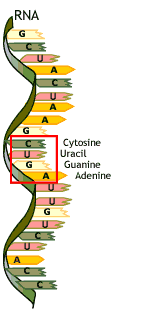
Nucleic acids are the building blocks of...
DNA
RNA
Atoms
Nucleotides
Where does transcription take place in PROKARYOTIC cells?
nucleus
cytoplasm
ribosome
TRANSCRIBE this DNA sequence into RNA: AUG CGC TCT
AUG CAA UGA
ATG CAA TGA
UAC GCG AGA
TAC GTT ACT
What is the difference between the sugar in DNA and RNA?
In DNA, the sugar is Deoxyribose while in RNA the sugar is Ribose
In DNA, the sugar is Ribose while in RNA the sugar is Deoxyribose
In DNA, it is a 5 carbon sugar while in RNA it is only a 4 carbon sugar.
There is no difference between the sugars
Where does RNA polymerase know where to start copying down instructions in the DNA molecule?
By looking for Promotors in the code to signal to start copying
By looking for Stop Codes in the code to signal to start copying
It doesn't matter where it starts, it will find it.
mRNA signals to the RNA polymerase where to start
Which process is used to make mRNA from the DNA in the nucleus?
transcription
translation
replication
Where does transcription take place in EUKARYOTIC cells?
nucleus
cytoplasm
ribosome
ATG GGA ACT CCA
Transcribe the following DNA sequence into RNA:
AAT TAG GGC TCG
AAT TAG GGC TCG
TTA ATC CCG AGC
UUA AUC CCG AGC
TTU UTC CCG UGC
Which RNA carries the message from the DNA molecule out of the nucleus?
mRNA
rRNA
tRNA
Where does TRANSCRIPTION occur in EUKARYOTIC cells?
Nucleus
Ribosome
Cytoplasm
Mitochondria
How many nucleotides equal make up a codon?
1
2
3
4
TRANSCRIBE this DNA sequence into RNA: TAC GTT ACT
AUG CAA UGA
ATG CAA TGA
AUG GAT UGA
TAC GTT ACT
Nucleic acids are the building blocks of...
DNA
RNA
Atoms
Nucleotides
Where does transcription take place in PROKARYOTIC cells?
nucleus
cytoplasm
ribosome
TRANSCRIBE this DNA sequence into RNA: AUG CGC TCT
AUG CAA UGA
ATG CAA TGA
UAC GCG AGA
TAC GTT ACT
What is the difference between the sugar in DNA and RNA?
In DNA, the sugar is Deoxyribose while in RNA the sugar is Ribose
In DNA, the sugar is Ribose while in RNA the sugar is Deoxyribose
In DNA, it is a 5 carbon sugar while in RNA it is only a 4 carbon sugar.
There is no difference between the sugars
Where does RNA polymerase know where to start copying down instructions in the DNA molecule?
By looking for Promotors in the code to signal to start copying
By looking for Stop Codes in the code to signal to start copying
It doesn't matter where it starts, it will find it.
mRNA signals to the RNA polymerase where to start
In what process is mRNA synthesized?
Transcription
Translation
DNA Replication
Mitosis
Where does TRANSCRIPTION occur?
Nucleus
Ribosome
Cytoplasm
Mitochondria
Why must transcription occur where DNA can be found?
because DNA can't leave
because ribosomes are in the nucleus
because DNA polymerase is found there
because helicase unzips the DNA
How many nucleotides equal 1 amino acid?
1
2
3
4

A polypeptide is a sequence of ____________________ held together by a ______________ bond.
amino acids; peptide
fatty acids; ionic
proteins; hydrogen
fatty acids; covalent
TRANSCRIBE this DNA sequence: TACGTTACT
AUGCAAUGA
ATGCAATGA
AUGGATUGA
TACGTTACT
TRANSLATE this RNA sequence: AUGCAAUGA
Met-Glu-Stop
Met-His-Stop
Thr-Glu-Stop
Thr-Pro-Stop
GTAGTCA
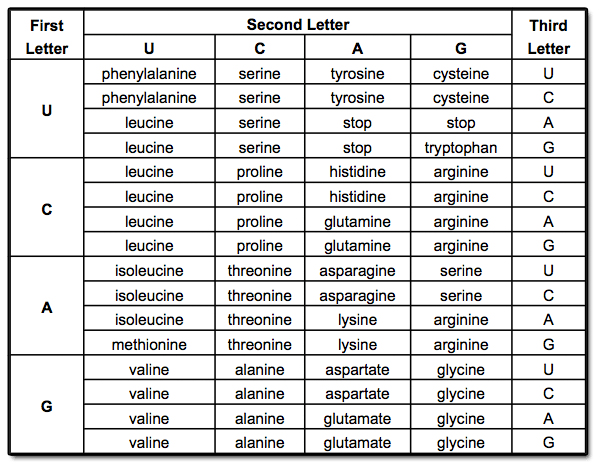
TGGCAAGTACGT
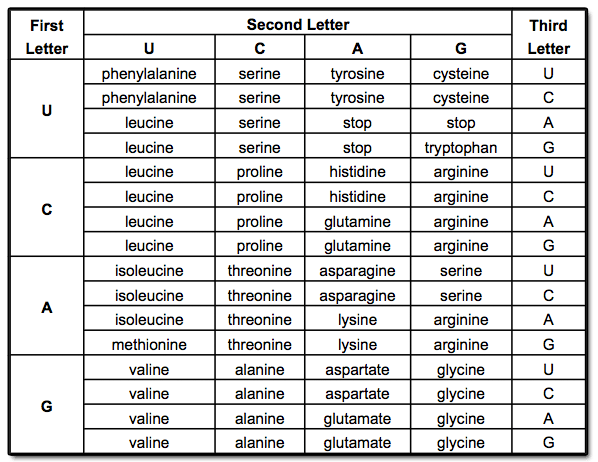
Through the process of transcription, DNA makes a complimentary strand of
DNA
RNA
CNA
PLB
After transcription mRNA goes from the nucleus to the _________.
Ribosome
Mitochondria
Endoplasmic Reticulum
Vacuoles
If the mRNA codon is AUG, what would the matching tRNA anticodon be?
UAC
AUG
TAC
GUA

If the mRNA codon is AUG, what amino acid would the tRNA bring?
Met
GLu
Ala
Phe

