
 Worksheets
EOY REVIEW
Total questions: 222
Worksheet time: 6hrs 33mins

Euclidean Geometry is an axiomatic system made up of a collection of statements, i.e. definitions and axioms, from which we expand the system by proving theorems based on the definitions, axioms and previously proved theorems.
True
False

If you were to rotate ABCD 90° clockwise about the origin, what would be the coordinate of A'?
(-5, 3)
(3, -5)
(5, -3)
(-3, -5)


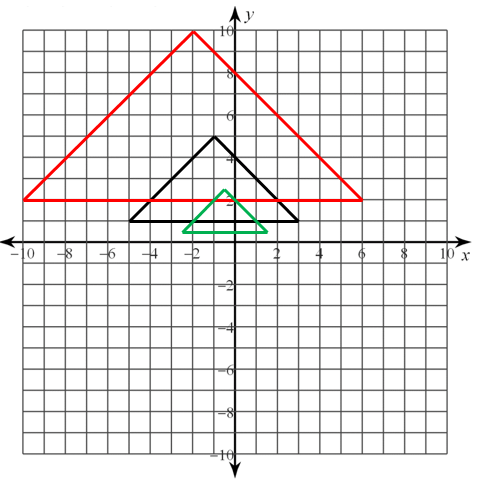


Which of the following describes the sequence of transformations shown?
Reflect across the x-axis and then rotate 90 degrees counterclockwise around the origin
Rotate 90 degrees clockwise around the origin and then translate down 8.
Reflect across the x-axis and then reflect across the y-axis.
Translate up 8 and then rotate 90 degrees counterclockwise about the origin.

Triangle ABC is rotated 180 degrees counterclockwise around vertex C. Find the coordinates of B'.
B' (-4, -4)
B' (2, -2)
B' (6, 0)
B' (5, -1)

Triangle ABC is rotated 90 degrees clockwise around vertex B. Find the coordinates of C'.
C' (-3, 6)
C' (-3, 2)
C' (-2, 1)
C' (2, 7)
C' (2, -3)

The triangle is reflected over the line y=x and then rotated 90 clockwise around the origin. Find the final coordinates for K''.
(1,3)
(-1,-3)
(1,-3)
(-3,-1)
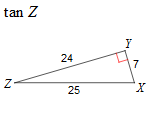
The triangle is reflected over the line y=x and then rotated 90 clockwise around the origin. Find the final coordinates for L''.
(1,-2)
(1,2)
(-1,-2)
(-2,-1)

Two lines in the same plane that will never intersect
Parallel Lines
Skew Lines
Perpendicular Lines
Line Segment

Find x.
14.3
7.3
31.4
35.2

Find x.
42.9
21
33.3
21.9

Find x.
41.8
48.2
33.7


Find x.
28.9
61.1
64.2
25.8

Find x.
12.8
77.2
12.5
77.5

Find x.
18.6
21.3
9.2
12.2

Find x.
8.5
31.9
8.8
34.2

Find x.
15.8
12.3
25.6
15.6

Find x.
38.7
32
58
51.3

Find x.
27
63
24.4
65.6

Find x.
54.9
35.1
50.7
39.3

Find x.
2.3
5.6
9.8
11

Find the length of the ramp.
5.7
44.6
41.7
17.1

Find angle CDB.
68.7
21.3
19.3
22
What is the ratio for Tangent
Opp/Adj
Adj/Opp
Opp/Hyp
Hyp/Opp
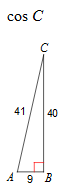
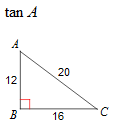


(x-4)2+(y+2)2=25
If the Implication (conditional statement) is p→q , then find the converse statement.
q→p
∼p→∼q
∼q→∼p
p→∼q

Two angles that sum to 90 degrees.
Complimentary Angles
Supplementary Angles
Right Angle
Obtuse Angle
If it rains today, then I will stay at home
Find the converse of this statement
If it doesn't rain today, then I won't stay at home
If I will stay at home, then it rains today
If I will not stay at home, then it does not rain today
If it rains today, then I will not stay at home
If it rains today, then I will stay at home
Find the inverse of this statement
If it doesn't rain today, then I won't stay at home
If I will stay at home, then it rains today
If I will not stay at home, then it does not rain today
If it rains today, then I will not stay at home
If you receive A grade in math, then you will be awarded a scholarship.
Find the contrapositive of this statement
If you won't be awarded a scholarship, then you don't receive A grade in math
If you don't receive A grade in math, then you will not be awarded a scholarship
If you will be awarded a scholarship, then you receive A grade in math
If you receive A grade in math, then you will not be awarded a scholarship
If you receive A grade in math, then you will be awarded a scholarship.
Find the inverse of this statement
If you won't be awarded a scholarship, then you don't receive A grade in math
If you don't receive A grade in math, then you will not be awarded a scholarship
If you will be awarded a scholarship, then you receive A grade in math
If you receive A grade in math, then you will not be awarded a scholarship
If I am tiger, then I am a mammal.
Conclusion - I am a mammal
Conclusion - I am a tiger
Conclusion - then I am a tiger
Conclusion - I am a national champion
Write this statement as a conditional statement.
"Thanksgiving in the United States falls on the fourth Thursday of November."
If it is a Thursday, then it is November.
If it is the fourth Thursday of November, then it is Thanksgiving in the United States.
If it is Thanksgiving, then it is in the United States.
If it is a Thursday, then it is Thanksgiving in the United States.
Write the following as a conditional statement.
"A counterexample shows that a conjecture is false."
If a conjecture is false, then a counterexample is shown.
If a counterexample is shown, then a conjecture is false.
If you have a conjecture, then the conditional statement is false.
If you are sitting in Geometry, then you are crying.

Which of the following is true about the conditional statement below?
If a man is 7 feet tall, then he plays basketball.
Hypothesis: a man is 7 feet tall
Conclusion: he plays basketball
Hypothesis: IF a man is 7 feet tall
Conclusion: THEN he plays basketball
Hypothesis: THEN he plays basketball
Conclusion: IF a man is 7 feet tall
Hypothesis: he plays basketball
Conclusion: a man is 7 feet tall
“If x is 22, then x - 10 = 12”
The conclusion is ________
X is 22
If x is 22
X - 10 = 12
Then x - 10 = 12
“If two angles are supplementary angles, then the sum of the measure of the angles is 180.”
Identify the hypothesis
If two angles are supplementary angles
Then the sum of the measure of the angles is 180
Two angles are supplementary angles
The sum of the measure of the angles is 180
P: A square has 3 sides.
Q: A square has 4 right angles.
What is the truth value of the compound statement P and Q
True
False
None of the above
They are neither true or false

Complete the truth table


Is statement 2 the inverse, converse, or contrapositive of statement 1?
Statement 1: If two lines are perpendicular, then they form right angles.
Statement 2: If two lines form right angles, then they are perpendicular.
Inverse
Converse
Conditional
Contrapositive

Complete the truth table
If you give me twenty dollars, then I will be your best friend.
Conclusion: you give me twenty dollars
Conclusion: I will be your best friend
Conclusion: then you probably should reevaluate your life
Conclusion: if you have lots of friends
To name a plane, you must use _________ points.
1
2
3
4
The three undefined terms in Geometry are...
Point, Ray, Segment
Line, Plane, Triangle
Point, Line, Plane
Peanut, Butter, Jelly
Two lines that intersect and form 90 degree angles are known as...
Parallel lines
Intersecting lines
Right lines
Perpendicular lines
The measure of one angle is 30 degrees. The measure of another angle is 59 degrees. Are these angles complimentary?
No
Yes

A triangle with one 90 degree right angle.
Acute Triangle
Right Triangle
Obtuse Triangle
Equilateral Triangle

Two or more lines that share a common point of intersection.
Parallel Lines
Intersecting Lines
Ray
Line Segment

Two lines that intersect at 90 degree angles.
Parallel Lines
Skew Lines
Perpendicular Lines
Line Segment

A triangle with three congruent sides
Equilateral Triangle
Isosceles Triangle
Scalene Triangle
Right Triangle

A triangle with two congruent sides
Equilateral Triangle
Isosceles Triangle
Scalene Triangle
Right Triangle

A triangle with no congruent sides
Equilateral Triangle
Isosceles Triangle
Scalene Triangle
Right Triangle

Two angles that sum to 180 degrees.
Complimentary Angles
Supplementary Angles
Right Angles
Obtuse Angles

An angle that measures greater than 90 degrees.
Complimentary Angles
Straight Angle
Right Angle
Obtuse Angle

An angle that measures less than 90 degrees.
Acute Angle
Straight Angle
Right Angle
Obtuse Angle
Formed by negating and switching the hypothesis and conclusion.
If ~q, then ~p.
Biconditional
Converse
Contrapositive
Inverse
A part of the circumference of the circle is mathematically known as...
an arc.
a curved line.
a piece of the perimeter.

Part of a line beginning from an endpoint and then continuing forever.
Ray
Line
Line Segment
Straight Angle

Part of a line consisting of two endpoints and all points in between them.
Ray
Line
Line Segment
Straight Angle

A flat surface with no thickness that extends in all directions forever.
Ray
Line
Plane
Parallelogram

A straight path that has no thickness and extends forever.
Ray
Line
Plane
Line Segment

A location that has no size.
Ray
Point
Plane
Dot

In a geometric system, which would best describe how postulates differ from theorems?
Postulates do not require a proof and are presumed true, while theorems are statements requiring proof.
Postulates are statements that require proof, while theorems cannot be proven.
Both postulates and theorems do not require proof and are assumed to be true.
There is no difference between postulates and theorems.
Which of the following statements is true?
A theorem is not possible to prove.
A theorem is a statement accepted to be true without proof.
A postulate is a statement accepted to be true without proof.
A conjecture is a statement accepted to be true without proof.
These are statements that are accepted as true without proof.
Definitions
Postulates
Undefined Terms
Theorems
Complete the Line Postulate:
"For every two points, there is exactly _____ line that contains both points."
one
two
three
four
An axiom is...
a statement of the meaning of a word or term.
a self-evident statement accepted as true for the purpose of reasoning. A fundamental building block of the system.
a statement proved from other statements.
the reverse of a statement.
A theorem is...
a statement of the meaning of a word or term.
the reverse of a statement.
a statement proved from definitions, axioms and other statements. A proven rule.
a statement of lesser importance.
"If A then B" represents a theorem. This implies that "if B then" A represents...
a theorem as well.
a proof.
a corollary.
the converse which may or may not be necessarily true.
Which of the statements below represents the converse of the following statement: If two sides of a triangle are equal in length then the angles facing those sides are equal in size.
If two angles of a triangle are equal in size then the two sides of the triangle facing those angles are equal in length.
If two angles of a triangle are equal in size then that triangle is an isosceles triangle.
If two angles of a triangle are equal in size then the two sides of the triangle facing those angles are different lengths.
The statement does not have a converse.
A corollary is...
an important theorem.
the same as the converse of a theorem.
the reverse statement.
a theorem in its own right but of lesser importance which follows immediately from another theorem.
A mathematical statement which is apparently true, but has not yet been proven is...
a theory or idea.
a theorem.
a proposition or conjecture.
an invalid argument.
The logical progression of statements based on definitions, axioms and other theorems to demonstrate the truth of a conjecture or proposition is known as a...
definition.
rider.
solution.
deductive proof.
What is used to disprove a statement?
An idea.
A proof.
A counter-example.
A theorem.
"Every prime number is odd" is a proposition. Which of the following represents a counter-example to this statement?
2
4
6
-2
A geometry rider is a conjecture, proposition or problem in geometry to be proved or solved using definitions, theorems and/or converses of theorems and which is of sufficient importance to be made a theorem in its own right.
True
False
Fill in the blank: A circle can be defined as the set of all points __________________ from a given point called the centre.
different distances
equidistant
opposite
What is the measure of an angle formed by two intersecting chords in a circle?
Equal to the measure of the arc intercepted by the angle
Half the difference of the measures of the arcs intercepted by the angle and its vertical angle
Twice the measure of the arc intercepted by the angle
Half the sum of the measures of the arcs intercepted by the angle and its vertical angle

In the image, AB represents a
sector.
segment.
chord.
diameter.
True or false: A diameter is a special type of chord that passes through the centre of the circle.
True
False
If a diameter is 48 cm then the length of the radius is...
96 cm.
48 cm.
24 cm.
12 cm.

In the diagram, if M is the centre of the circle then triangle MBX is, at the very least, ...
Equilateral
Scalene
Isosceles
Right-angled

In the diagram, line LP touches the circle once at point P. This line is a...
secant.
chord.
tangent.
diameter.
A sector of a circle is identical to a segment of a circle.
True
False
A line passing through a circle at two points and extending beyond the circle is known as a....
tangent.
chord.
diameter.
secant.
points that lie in the same line
coplanar points
concurrent lines
collinear points
parallel lines
lines whose intersection is a single point
concurrent lines
skew lines
coplanar lines
line
points contained in the same plane
collinear points
point
non coplanar points
coplanar points
lines contained in the same plane
concurrent lines
coplanar lines
skew lines
parallel lines
an undefined term in euclidean geometry that can be thought of as a straight set of points extending infinitely in one dimension with no width or thickness
skew lines
plane
line
point
not in the same plane
plane
coplanar lines
non coplanar points
non collinear points
points that do not lie on the same line
collinear points
point
non coplanar points
non collinear points
coplanar lines that do not intercept
line
parallel lines
skew lines
coplanar points
an undefined term in euclidean geometry that can be thought of as a flat surface made of points extending infinitely in 2 dimensions with no thickness
skew line
plane
point
line
an undefined term in euclidean geometry that can be thought of as a dot or location in space with no length, width, or thickness
collinear lines
line
plane
point
lines that are not coplanar
coplanar lines
skew lines
concurrent lines
parallel lines
Making a conclusion based on observation or patterns
Negation
Disjunction
Inductive Reasoning
Conjecture
A concluding statement reached using inductive reasoning.
Conclusion
Biconditional
Hypothesis
Conjecture
An example that shows a conjecture is false
Disjunction
Counterexample
Negation
Conclusion
The statement that has the opposite meaning.
Negation
Inverse
Converse
Contrapositive
A compound statement joined by the word AND.
Disjunction
Conjunction
Conclusion
Biconditional
A compound statement joined by the word OR.
Conjecture
Inverse
Disjunction
Conjunction
Two or more statements joined by the words AND or OR.
Compound Statement
Counter Example
Biconditional
Conclusion
A statement that can be written in the form "if-then."
Compound Statement
Conjuction
Converse
Conditional Statement
The IF part of a conditional statement.
Conclusion
Hypothesis
Negation
Converse
The THEN part of a conditional statement.
Hypothesis
Compound Statement
Conclusion
Inverse
Formed by negating the hypothesis and conclusion.
if ~p, then ~q
Inverse
Contrapositive
Converse
Biconditional

Formed by switching the hypothesis and conclusion.
if q, then p
Contrapositive
Inverse
Biconditional
Converse
The conjunction of a conditional and its converse.
Uses the phrase IF AND ONLY IF.
Biconditional
Conditional Statement
Compound Statement
Contrapositive
Which of the following transformations will map a figure onto itself?
Translation
Rotation of 180 degrees
Dilation with a scale factor of 2
Reflection over a line of symmetry
What is the measure of angle A in a right triangle if angle B is 35 degrees?
90 degrees
65 degrees
55 degrees
45 degrees
Find the area of a circle with a radius of 7 units.
77 square units
44 square units
49 square units
154 square units
What is the length of the hypotenuse in a right triangle with legs of 6 and 8 units?
14 units
15 units
12 units
10 units
What is the measure of an angle that is supplementary to a 65-degree angle?
125 degrees
135 degrees
145 degrees
115 degrees
Which of the following is a property of an isosceles triangle?
All sides are equal
Two sides are equal
No sides are equal
All angles are different
What is the measure of angle ACB in triangle ABC if angle BAC is 45° and angle ABC is 60°?
75°
45°
60°
90°
Find the length of the hypotenuse in a right triangle with legs measuring 9 and 12.
14
13
16
15
What is the area of a circle with a radius of 7 units?
154 square units
49 square units
98 square units
44 square units

Which statement must also be true?
If a quadrilateral has 4 congruent sides, then it is a square.
If a quadrilateral does not have 4 congruent sides, then it is not a square.
If a quadrilateral is not a square, then it does not have four congruent sides.
If a quadrilateral does not have 4 congruent sides, then it is a square.
All of these are true

What is the probability that the point is in the white square region?
227
4415
2915
4429

Which value is closest to the maximum volume of water this cup can hold?
159 cm3
32 cm3
127 cm3
40 cm3
Which equation represents a circle with a radius of 8 centered at (-3, 4)?
(x−3)2+(y+4)2 = 8
(x+3)2+(y−4)2 = 64
(x−3)2+(y+4)2 = 16
(x−8)2+(y+4)2 = −3

What is the total area of the banner in square centimeters?
(a)

Which of the following is closest to the lateral surface area of the pyramid?
16,330 ft2
20,930 ft2
10,465 ft2
34,155 ft2
The curved surface of the Earth compares to which undefined term in Euclidean geometry?
plane
line
point
space

Based on this information, which statement can be proved true?
∠ACB≅∠ABC
CAB is an acute triangle
∠DCB≅∠BCA
CAB is a right triangle

Based on this construction, which statement is not true?
∠AWC is complementary to ∠CWB
CWB is a right triangle
ACB is isosceles
m∠CAB=m∠CBA

Which measure is closest to the value of y?
5.5 ft
3.1 ft
4.3 ft
7.5 ft

Which rule describes the transformation that ws used to form parallelogram A'B'C'D'?
(x, -y)
(-x, y)
(x+6, -y)
(-x, y-3)

Based on the information provided in the diagram, what is m∠P in degrees?
(a)
A triangle is enlarged by multiplying each of its dimensions by 4. Based on this information, which of the following statements is true?
The perimeter of the new triangle is 12 times the perimeter of the original triangle.
The perimeter of the new triangle is 16 times the perimeter of the original triangle.
The perimeter of the new triangle is 18 times the perimeter of the original triangle.
The perimeter of the new triangle is 4 times the perimeter of the original triangle.
A civil engineer is drawing a plan for the location and length of a new underground sewer pipe on a coordinate grid. The pipe on the plan will run from point N (a, -2) to point P (1, b) on the coordinate grid. Which expression represents the shortest distance between N and P in units?
(a+2)2+(1−b)2
(1−a)2+(b+2)2
(a+2)2+(1−b)2
(1−a)2+(b+2)2

If the arrow is spun once, what is the probability that the arrow will land in Sector 1?
31
41
61
32

Which value is closest to the area of the shaded regions?
7.7 units2
4.3 units2
17.2 units2
64.3 units2

Which statement describes the relationships between the sides of the quadrilateral?
AD is parallel to BC , but AB is not parallel to CD
AB is parallel to CD , but AD is not parallel to BC
AB is parallel to CD , and AD is parallel to BC
AD is not parallel to BC , and AB is not parallel to CD
Two motorcycles start at the same point. One motorcycle travels 15 km due north and stops. The second motorcycle travels 32 km due west and stops. Which value is closest to the distance between the motorcycles when they stop?
28.3 km
47.0 km
35.3 km
21.9 km

Other layouts are also being considered. Which layout is the result of a 90° counterclockwise rotation of the original layout using D as the center of rotation?


If AC = 28.5 cm, what is the length of AB ?
14.4 cm
22.5 cm
36.1 cm
23.7 cm


The measure of the interior angles of four regular polygons are shown below. Which expression best represents the measure in degrees of the sum of the interior angles of a regular polygon having n sides?
n180(n−2)
180(n - 2)
n360
n180


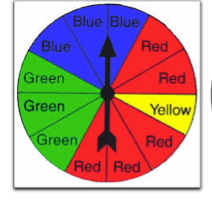
A spinner is spun twice. What is the probability of spinning green both times?
1/16
1/4
1/2
1/8

5 green
6 yellow
8 blue
7 brown
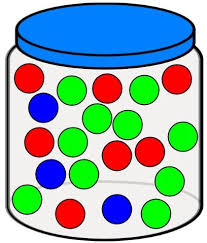
out of a jar of marbles that have 10 green marbles, 7 red marbles and 3 blue marbles?

What is the probability of getting an odd number?
1/6
1/2
1/3
1/4
There are 14 tiles with one letter from the word MATHEMATICIANS on each. Find the probability of randomly choosing the letter "M".
1/2
1/7
1/14
2/7

If you flip a coin two times, is it independent or dependent probability?
Independent
Dependent

If you draw out a red marble, keep it, then draw out a blue marble, is it independent or dependent probability?
Independent
Dependent

What is the probability of flipping a coin twice and landing on tails both times? (leave answer in fraction form in lowest terms)
1/2
2/2
4/1
1/4

What is the probability of picking a green marble, keeping it, then picking another green marble? (leave answer in fraction form in lowest terms)
9/49
1/7
3/14
6/42

If you spin two times, what is the probability of landing on green both times? (leave answer in fraction form in lowest terms)
1/6
1/9
1/36
1/30

You roll a 6-sided number cube. What is the probability of rolling an even number three times in a row? (leave answer in fraction form in lowest terms)
3/100
1/8
1/6
1/2

A coin and a number cube with the numbers 1 through 6 are tossed. What is the probability of the coin showing tails and the number cube showing the number 3? (leave answer in fraction form in lowest terms)
1/12
1/4
1/8
1/2

The spinner is divided equally. Find P(A).
*Remember to simplify.*
6/8
3/4
2/8
1/4

You spin this spinner 3 times.
Find the probability of these 3 events.
P(red, odd, 3)
1/216
1/72
1/12
1/36


The letters that form the word ALGEBRA are placed in a bowl.
What is the probability of choosing a letter that is NOT “A”?
72
495
75
4910

What is the probability of selecting a brown M&M from this bowl?
4 yellow, 6 orange, 2 brown, 3 green, 5 blue
182
91
202
101

0%
41 or 25%
21 or 50%
100%

What is the probability of spinning a number less than 5?
1632 %
33 31 %
66 32 %
83 31 %
What is the probability of spinning green?
0
41
21
43
A ten sided die is rolled.
P (3 or 5)
3/10
1/5
1/10
25%
A box has 3 limes, 5 grapes, and 2 oranges.
P (NOT lime)
3/10
30%
7/10
Answer Not Here
A box has 6 red pens, 8 black pens, 2 blue pens, and 4 purple pens.
P(NOT red or blue)
3/5
2/5
3/10
7/10

What is the probability of flipping tails two times in a row?
3/8
1/4
5/8
Answer Not Here

