
 Worksheets
7.8 Chemical reactions - Mega Quizizz
Total questions: 25
Worksheet time: 13mins
Which of the following observations indicates that a chemical reaction has occurred?
Change in state
Formation of a precipitate
No colour change
Change in size
Why does a precipitate form in a chemical reaction?
Because the reactants become lighter
Because the reaction absorbs heat
Because at least one product is insoluble
Because the reaction speeds up
What is a neutralisation reaction?
Which tests can be used to identify hydrogen?
squeaky pop test
limewater test
relights glowing splint
smells bad
How can the formation of a precipitate indicate a chemical reaction? (indicate means show)
It indicates the formation of a gas
It indicates the loss of reactants
It indicates the formation of a new substance
It indicates a decrease in temperature
According to the particle model, what happens to particles during a chemical reaction?
They disappear
They change color
They rearrange to form new substances
They increase in size
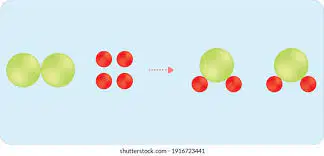
How do we know the picture is showing a chemical reaction? Choose two.
Particles have rearranged
The size of particles changed
A new substance was formed
A gas was released
Which gas test involves passing the gas through lime water?
Hydrogen test
Carbon dioxide test
Oxygen test
Nitrogen test
What is the result of passing carbon dioxide through lime water?
Limewater remains unchanged
Limewater turns milky
Limewater turns blue
Limewater turns yellow
Which gas test involves relighting a glowing splint?
Hydrogen test
Carbon dioxide test
Oxygen test
Nitrogen test

What are the reactants in the given chemical reaction?
NaCl and H₂O
HCl and NaOH
NaOH and NaCl
H₂O and NaOH
What is the chemical formula of one of the products formed in the reaction?
HCl
NaOH
NaCl
How many different elements are present among the reactants and products?
2
3
4
5
Which of the following is a chemical change?
Melting ice into water
Boiling water into steam
Burning wood to produce ash and smoke
Dissolving sugar in water
Which of the following best defines a solution?
solute + solvent
sugar + salt
solute + solution
soluble + insoluble
What is an insoluble substance?
A substance that cannot be dissolved in a particular solvent
A substance that can be easily dissolved in any solvent
A precipitate is ...
an insoluble product of a reaction
a soluble product of a reaction
a soluble reactant in a reaction
an insoluble reactant in a reaction

We can tell a chemical reaction is happening in the photo because...
a gas is being produced (bubbles)
there is a colour change
the hydrochloric acid disappears
carbon dioxide is being formed
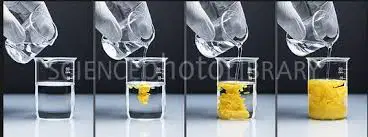
In this reaction a ..... ...... is made.
yellow gas
yellow solution
yellow precipitate
new liquid
The formation of a precipitate shows that ...
a new product has been made
this is a physical change
this is a chemical change
the reactants are both liquids
An acid has a pH of...
7
above 7
below 7
14
An alkali has a pH of...
7
above 7
below 7

Universal indicator turns .... with an acid
red
purple
green
blue
Universal indicator turns .... with an alkali
red
purple/blue
green
yellow

The photo shows the result for the test for ...
hydrogen gas
carbon dioxide gas
nitrogen gas
oxygen gas

