
 Worksheets
6th Grade Mega-Ultra Review Day 1
Total questions: 124
Worksheet time: 1hrs 2mins
What unique challenge does the study of prehistoric history present?
written records that cannot be read
conflicting views in ancient diaries
lack of evidence from the period
huge amounts of artifacts to analyze
How did the Leakeys discover the Homo habilis (Handy Man) hominin group?
They found remains in Africa.
They found ancient documents
They found a complete male skeleton
They found cave paintings
How did people in the Paleolithic Age get their food?
by hunting and gathering
by planting and harvesting
by herding goats and cattle
by trading over land and sea
Social scientists are scholars who study
animal behavior
dinosaur skeletons
human society
astronomy
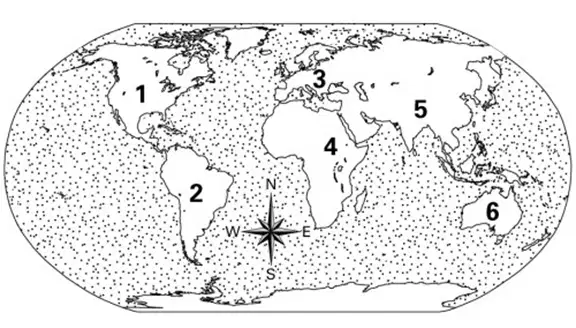
Where were Homo habilis (Handy Man) bones first found?
continent 2
continent 4
continent 5
continent 6
Communities and civilizations began to emerge after humans discovered
Agriculture
the wheel
writing
stone tools
Which of these helped Homo habilis survive against animal attacks?
building shelters
burying their dead
using bows and arrows
living together in groups
One animal that was domesticated mainly for meat and milk was the
goat
mule
camel
chicken
Modern humans belong to which hominin group?
Homo sapiens
Homo Erectus
Homo Neanderthalensis
Denisovans
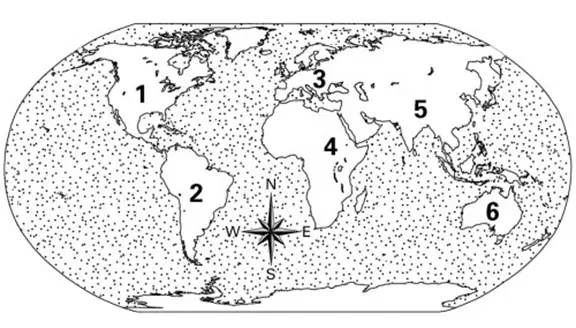
Which group is believed to be the first to live on continent 3?
Homo habilis (Handy Man)
Homo erectus (Upright Man)
Homo neanderthalensis
Homo sapiens (Wise Man)
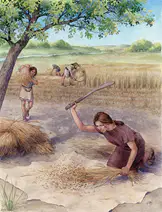
What was the greatest benefit to people when early farmers began to raise plants and animals?
They kept pets for company.
They could travel more easily.
They shared most of the work.
They had a stable food supply.
The Neolithic Age ended about 3000 B.C.E., with the discovery of how to
make metal tools
weave linen cloth
tame wild animals
build brick houses
People who study the past are most like
artists
builders
detectives
teachers
If ancient paintings were found in a cave, which of these questions would be the hardest to answer?
Why did people paint in caves?
What type of paint did people use?
What did people paint pictures of?
What did people use for paintbrushes?
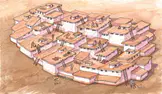
Archaeologists have found houses in which the doorways were built high up on the walls. What was the most likely reason for this?
People grew taller because they had more to eat.
The land around the houses has sunk over the years.
People wanted to be safe from wild animals or enemies.
The lower parts of the walls were covered with paintings.
As cities continued to grow, a new form of state developed, called
tribes
empires
villages
kingdoms
Why do historians read diaries and letters from the past?
to agree on plans for the future
to compare their ideas of history
to learn to speak an ancient language
to find out what happened and why
Why was the Fertile Crescent the site of many early settlements?
The hills were rich in gold.
The soil was good for crops.
The forest was full of animals.
The caves were deep and warm.
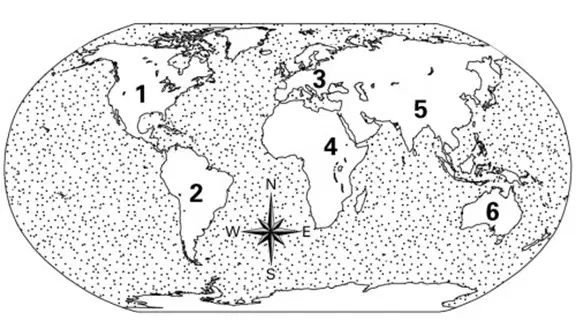
Which new capability enabled hominins to survive in the colder climate of continent 3?
building fire and shelters
drawing art on cave walls
gathering food from plants
making tools out of bones
A paleoanthropologist specializes in the study of the
kings and queens of the earliest modern humans.
development and culture of the earliest hominins.
communication and social systems of early apes.
trade and barter systems among modern humans.
Between 4000 and 1000 B.C.E., many smaller tribes were combined into
larger city-states.
small empires.
two governments.
fallen civilizations.
Why did people in the Neolithic Age live together in larger groups, compared with earlier times?
They were nomads who moved faster in larger groups.
They made special goods like baskets and pottery.
They needed more people for hunting and gathering.
They could grow enough food to support more people.
Throughout ancient history, human settlement has depended on
climate
geography
physical features
all of the above
The creation of _____ helped interactions among ancient peoples.
writing
the calendar
the wheel
metal money
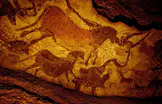
How did prehistoric artists deal with the uneven surfaces of the caves?
They only painted animals on the uneven surfaces.
They did not paint in caves with uneven surfaces.
They included uneven surfaces as part of their composition.
They were forced to paint around any cracks in the caves.
The Akkadians used steles to
attack enemy forces
get water for farming
record important events
make objects from metal
What enabled the Olmec population to grow and, thus, their civilization to expand?
social stratification
large-scale agriculture
expansive trade networks
government by consensus
What was a problem caused by Sumerian city-states’ independence from one another?
They were unable to trade crops with one another
They did not cooperate to build irrigation systems
They had very few different natural resources available
They could not defend themselves against stronger groups
What did ancient Persians do with light and mirrors?
light fires for slash-and-burn farming
show devo on to Ahura Mazda
communicate critical messages
redirect invading armies
One factor that made farming difficult in the area of Sumer was
rocky soil
steep hillsides
lack of rainfall
growth of weeds
If you were in ancient Sumer, you might see a levee beside a river. Why was the levee built?
to load barges
to irrigate crops
to prevent floods
to control workers
Which statement about the royal road system of ancient Persia is correct?
It connected the empire’s cities and countries and extended to other countries
It was built initially during the Achaemenid Empire to carry chariots
It aimed to avoid interfering with wildlife that could interfere with safe passage
It was moved and rebuilt during multiple empires
How did the Akkadians get the resources to build up their capital city?
mined precious stones in the mountains
collected tribute from conquered peoples
expanded irrigation to grow bigger crops
printed paper money to buy what it needed
A society has a stable food supply if
it gives food to the king
it has enough food for its people
it buys food from other groups
it gets food by hunting and fishing
In the ancient Persian empires, women were banned from
being a witness to a contract
owning property
asking for a divorce
earning more money than men
The name of Mesopotamia comes from its location, which was
between two rivers
in mountain foothills
near a region of many conflicts
at the site of the earliest cities
The Sumerian civilization had a social structure with different social levels and jobs. A social structure is
the way a civilization is organized
how much in taxes a king collects from each class
the way scribes record social events
how the government treats the lower classes
Which one of these inventions most affected the food supply in Sumer?
the arch
the plow
the wheel
the chariot
What was one of the effects of ancient Persia being tolerant of different people and their ideas?
This ensured religious diversity across each empire
This limited Persia’s need to engage in military conflicts
This led leaders to embrace and preserve learning
This made Persian the language of trade across Central Asia
How was the legal system of Babylon more advanced than that of other societies at that me?
It put an end to slavery
It used mild punishments
It gave women some rights
It treated all classes the same
What do the ancient Persian empires founded by Alexander the Great and by Seleukid Nicator I have in common?
They are considered extensions of the Achaemenid Empire
They lasted for over several hundred years
They conquered most of the Arabian Peninsula
They are considered Greco-Macedonian empires
Much of our knowledge of ancient Persia has come from the works of outsiders, mostly Greeks. Why might these works not be entirely reliable?
The writers had little first-hand knowledge of ancient Persia
The writers aimed to entertain rather than educate
The writers recounted history only through poetry
The writers were biased against Persians
A problem that all four Mesopotamian empires had was difficulty in
choosing strong leaders
trading with other empires
controlling such a large area
keeping track of their history
How did the Sasanian Empire differ from earlier Persian-led empires?
It lacked tolerance toward people who did not practice Zoroastrianism
It enforced Middle Persian as the only language of government
It limited Greek cultural influences by banning the use of the Greek language
It replaced the satrap system by making the king’s relatives governors
Which Sumerian belief about the king helped strengthen the social order?
He was supported by the gods
He cared most about poor people
He consulted with wise advisers
He wanted everyone to be happy
Why did the rivers of Mesopotamia flood in the spring?
Heavy rain fell throughout the area
Strong winds blew from the Persian Gulf
Ice that had formed on the rivers broke into bits
Snow melted in the mountains where the rivers began
What is one reason there is limited access to written records about ancient Persia?
Ancient Persia relied largely on oral history
Scholars have been unable to translate ancient Persian texts
Later conquerors of Persia worked to destroy most records
Written records have been lost mainly to natural disasters
How did people in climates that prevented the development of agricultural settlements survive?
They depended on the sea for food
They migrated to find food
They migrated to different climates over me
They traded with groups to obtain goods
In which present-day country or region did the Olmec civilization flourish?
Mexico
Central America
Peru
the United States
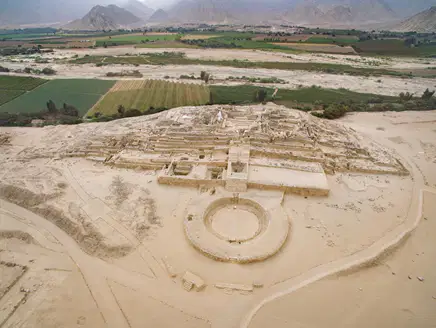
Why do historians believe that the Caral civilization was built in the desert?
to be far from the stormy coastal region
to limit attacks from outsiders
to serve as a trading center
to farm foods that grew in dry regions
Why was Jerusalem considered a holy city?
David built his first palace there.
Religious ceremonies were held there.
The Ark of the Covenant was kept there.
The Israelites believed God told them to live there.
What technology enabled Assyria to defeat Kush?
fire
charcoal
iron weapons
wooden wheels
Useful vegetation along the Nile River included
ducks and geese.
barges and boats.
reeds and papyrus.
canals and ditches.
How did the desert help the people of Egypt and Kush?
It had fertile land for crops.
It made trade and travel easy.
It was grassy for grazing sheep.
It gave protection from invaders.
Hatshepsut was one of the first pharaohs who was
a god
a child
a priest
a woman
It was built from more than 2 million stone blocks. It had tunnels inside. What was it?
the Sphinx
the White Chapel
the temple at Abu Simbel
the Great Pyramid at Giza
Which sentence best describes the role of Ancient Egyptian women in religion?
They were worshiped as gods.
They could become priestesses.
They ran all religious ceremonies.
They were not allowed in temples.
What is one characteristic for which Egypt's Middle Kingdom is especially famous?
reunification
great pharaohs
widespread wars
military conquests
Which of these activities was permitted only to Ancient Egyptian men?
owning land
running a business
working as a scribe
asking for a divorce
What was one of the few ways that a boy from a peasant family could rise to a higher social class in Ancient Egypt?
store a lot of grain
attend scribe school
help build a pyramid
take care of a temple
An important way historians learn about ancient Kush is through
Syrian trade agreements.
Sumerian cuneiform tablets.
Egyptian tomb wall paintings.
Nubian books printed on paper.
Why did the ancient Egyptians make mummies?
to decorate palaces of the pharaohs
to preserve dead bodies of the pharaohs
to transport goods up and down the Nile
to educate and protect the royal children
The festival of Passover celebrates the
Jewish Diaspora.
Exodus from Egypt.
rededication of the Temple.
end of the Babylonian Exile.
The word exodus means "departure." In the history of the Israelites, the Exodus was the departure from
Ur.
Egypt.
Canaan.
Babylon.
Which of these is the best example of a question of ethics?
What shall I eat for dinner?
When should I brush my teeth?
Should I help a child who is lost?
Which color shall I paint my room?
Which of these was part of the topography of ancient Egypt?
a river valley
a mountain range
a hot, dry climate
a long growing season
In the life of an Ancient Egyptian peasant, which season came next after the flooding season?
the festival season
the harvest season
the planting season
the building season
What place did the Jewish people believe was the promised land?
Ur
Egypt
Canaan
Babylon
For what achievement is King Piye of Kush remembered?
conquering Egypt
introducing iron tools
building dams on the Nile
trading with India and China
Which common feature of most ancient religions did the Jews reject?
ritual
morality
tradition
polytheism
Why do Jews consider the Western Wall in Jerusalem a sacred place?
It was built by King Solomon.
It was part of the Second Temple.
It was where many Jews died in rebellion against Rome.
It was constructed with the stones that held the Ten Commandments.
When people read from the Torah, they are reading from
the Prophets and the Writings.
the first five books of the Hebrew Bible.
an ancient Egyptian book about the Hebrew people.
a collection of prayers and poems used by the early Jews.
Who built the giant temples of the pharaohs?
scribes who kept poor records
government officials out of favor
peasant farmers during the flood season
priests hoping to get jobs at the temples
Which of these events led to Kushites adopting Egyptian ways of life?
Kush allied with the Assyrians.
Scribes traveled to Kush to teach.
Both armies burned a Roman fort.
Egyptian pharaohs conquered Kush.
The festival of Diwali, which begins the Hindu New Year, celebrates
the changing of the seasons.
the victory of good over evil.
the food from a good harvest.
the long life of the wise elders.
Which of these sentences is true of most Hindu temples?
They contain elaborate sculptures.
They face west toward the setting sun.
They are placed as far from cities as possible.
They are small so as not to distract worshipers.
Which feature of Mohenjodaro was quite different from other settlements of that time?
high wall
dirt roads
brick homes
sewer system
Harappan civilization, which included ancient Mohenjodaro, developed in the
Western Ghats.
Deccan Plateau.
Indus River valley.
Ganges River valley.
How did modern scholars learn that Mohenjodaro had ever existed?
Astronauts saw it from space.
Historians read ancient scrolls.
Archaeologists found its ruins.
Geographers studied old maps.
The discovery of a scale, stone weights, and a marked rod suggests that the people of Mohenjodaro
had uniform ways to measure.
knew how to make tools of iron.
traded with people from far away.
started a new kind of mathematics.
Which of Ashoka's actions best expressed his Buddhist values?
allowing slavery
keeping a strong army
putting criminals to death
treating all of his servants well
How are the Indus and Ganges rivers similar to the Nile River in Egypt?
They begin in the same general area.
They carry silt that enriches the soil.
They flow in the same general direction.
They have big floods that prevented early settlement.
Farmers in the Deccan Plateau use the iron-rich black soil principally to raise
tea.
sheep.
cotton.
oranges.
Which of the following groups of people made it possible to construct complex buildings like this one?
historians
monks
astrologers
mathematicians
Which goal did Buddhism teach people to move toward?
converting everybody
reaching enlightenment
making elaborate sacrifices
completing a big pilgrimage
Why were Untouchables excluded from other Indians?
They wanted to stay pure.
They shared all their goods.
They had to eat a special diet.
They did work others considered lowly.
How has the location of the Himalaya Mountains benefited India?
roads for trade routes
consistent water supply
protection from enemies
prevention of earthquakes
How did Chandragupta Maurya begin building his empire?
He sent ships to far-off islands.
He conquered neighboring kingdoms.
He sponsored settlements by colonists.
He persuaded other rulers to unite with him.
Why did the Buddha decide to follow a "middle way"?
Neither riches nor being an ascetic led to nirvana.
Neither struggle nor acceptance summed up all of life.
Neither life on Earth nor life after death seemed most important.
Neither the Four Truths nor the Eightfold Path worked without the other.
Because of its large size and its position in relation to large masses of land and water, India is called
a plateau.
an isthmus.
an ecosystem.
a subcontinent.
What happened on the Indian subcontinent in the time period between the Mauryan and Gupta empires?
It went through a golden age.
It experienced a great famine.
It was filled with small kingdoms.
It was conquered by the Sumerians.
Which of these is the best reason for someone in India to study Sanskrit?
to read the ancient texts
to understand road signs
to run for political office
to talk to ordinary people
Why was Chandragupta Maurya poor in his later years?
He put a stop to foreign trade.
He was overthrown by his son.
He decided to live as an ascetic.
He lost the conquered territories.
Which of these finds by an archaeologist would be evidence of a golden age?
walled cities
fine sculptures
metal weapons
animal skeletons
Ashoka expanded the Mauryan Empire until he
moved to China.
gave up violence.
reached the mountains.
surrendered to his cousin.
What troubled the Buddha on his first few trips out into the world?
inequality of wealth
aging, sickness, and death
prejudice against lower castes
cruelty, evil, and lack of caring
Why did the Buddha decide not to escape into enlightenment right away?
He preferred to follow a middle way.
He forgot his dream when he woke up.
He wanted to teach people the path he had found.
He did not want to leave his wife and child behind.
The name "Buddha" meant one who was
sorrowful.
awakened.
everlasting.
all-powerful.
Why were wells constructed along trade routes?
so deities would be pleased
so roads would not get muddy
so travelers could cook and drink
so merchants could pay for water
Ancient Chinese healers used the technique of acupuncture to
satisfy the gods
achieve immortality
teach people to live with pain
rebalance the forces of yin and yang
What happened during the Warring States period?
Dozens of clan leaders set up military states.
The Zhou army won control of the state by force.
Six or seven large Chinese states fought for power.
China fought to protect the state from invaders from the north.
What protected Inner China from invasion from the northwest?
wide rivers
grassy plains
barren deserts
high mountains
For what purpose would a Shang leader most likely use an oracle bone made from a turtle shell?
to serve a ceremonial meal
to make music for his family
to send messages to the nobles
to ask advice from his ancestors
To a large extent, the Great Wall was built by
forced labor.
foreign workers.
skilled stonemasons.
close friends of the emperor.
Why is Zhang Qian often called the Father of the Silk Road?
This teacher encouraged the exchange of ideas.
This explorer opened the way for trade with western cultures.
This emperor forced peasants to work on construction.
This military leader made the highway safe for traders.
Shang weapons were especially strong because skilled artisans made these objects from
iron.
stone.
bones.
bronze.
If you were a laborer, what would Confucius say that you should do?
plan to rise to a higher status
behave properly for your role
try to outwit those around you
relax and stop working so hard
What change made silk production more efficient?
a kind of tree that was better for silkworms
an invention that wound fibers onto a large reel
a road on which trade goods could be carried safely
a law that all farmers must weave for one month a year
In the Shang civilization, Anyang was an important city because
it was home to many skilled artisans.
it was where the king lived.
many royal tombs are located there.
all of the above
Which of these Shang people had the lowest social status?
merchants
jade carvers
stonemasons
grain farmers
Under Qin rule, what would happen if a rich person and a poor person committed the same crime?
The rich person would pay a larger fine.
The two would have to exchange places.
The two would suffer the same punishment.
Only the poor person would be punished.
The Silk Road split into a northern route and a southern route. What was one advantage of taking the northern route?
Oases were closer together.
Road surfaces were smoother.
Scenery was more attractive.
Travelers were safer from bandits.
Why did ancient people on the Tibet-Qinghai Plateau herd yaks rather than grow crops?
Yaks found food in thick forests.
The region was too wet for crops.
The region was too cold for crops.
Yaks could be sold in the markets.
Why did fewer people settle in Outer China than in Inner China?
The land was in smaller estates in Outer China.
The climate was more extreme in Outer China.
The roads were more dangerous in Inner China.
The invasions drove farmers away in Inner China.
Which of these men would most likely be hired for the Han bureaucracy?
one who did well on an exam
one who was born in the capital
one who had an important family
one who inherited a lot of money
If the white portion of the yin and yang symbol shown here represents pleasure, what would the black portion represent?
pain.
reward.
afterlife.
enjoyment.
What is the likely reason why the Roman emperor told Romans not to wear silk?
He worried that buying silk was taking too much of the empire's gold.
He believed that cotton was softer and more comfortable than silk.
He was afraid the silkworms would eat too many leaves off the trees.
He wanted to save as much silk as possible to make army banners.
How did the natural vegetation of the Northeastern Plain affect the lives of ancient settlers there?
Fruit trees attracted settlement around oases.
Varieties of plant life encouraged raising crops.
Dense woods supported hunting and gathering.
Prairie grass provided food for horses and sheep.
According to belief in the Mandate of Heaven, earthquakes and floods might be signs that
the king did not govern well.
the end of the world was near.
the people did not obey the laws.
the natural world ignored humans.
Where did archaeologists find a life-sized army made of terra-cotta, a kind of clay?
in the Great Wall
next to the royal palace
along the southern border
inside the emperor's tomb
What made silk valuable in the West?
The Syrians thought wool was too itchy.
The Indians found cotton to be too expensive.
The Romans wanted to use it to praise their Christian God.
The Chinese were the only ones who knew how to make it.
What new technology most helped the Han in warfare?
invention of the wheel
advances in working iron
steam-powered riverboats
improvements in gunpowder
What was one difference between feudalism and the Emperor of Qin's system of government?
Under feudalism, power was held locally; the Emperor of Qin held all the power.
Under feudalism, lords met with the king; the Emperor of Qin did not have meetings.
Under feudalism, leadership came from a few men; the Emperor of Qin had many leaders.
Under feudalism, peasants chose their lords; the Emperor of Qin chose their lords for them.
Why did people in China want horses from Central Asia?
The horses were scarce in China.
The horses gave the Chinese a way to sell their silk.
The horses were larger and more powerful than Chinese horses.
The horses were considered prettier than the ones in China.

