
Font size
 Worksheets
Human Geography Final Exam Master Review
Total questions: 48
Worksheet time: 32mins
Human Geography is the study of...
The physical processes of the Earth
Who lives where, why they live there, and how they live
The psychology of the human race, using maps
The culture of the human race, without environmental influences
How humans evolved through time
What are the 5 themes of Geography
movement, region, human-environment interaction, location, place
movement, region, human-environment interaction, address, place
movement, area, human-environment interaction, location, place
movement, region, human-environment interaction, location, oceans
Physical and Human are both characteristics of which of the 5 themes of geography?
Region
Place
Movement
Location

Which of the five themes of geography is BEST depicted in the image below?
location
region
place
movement
The development of agriculture allowed for people to leave the nomadic lifestyle and begin building permanent settlements. Farming and agriculture are examples of which of the five themes of geography?
place
region
movement
human/environment interaction
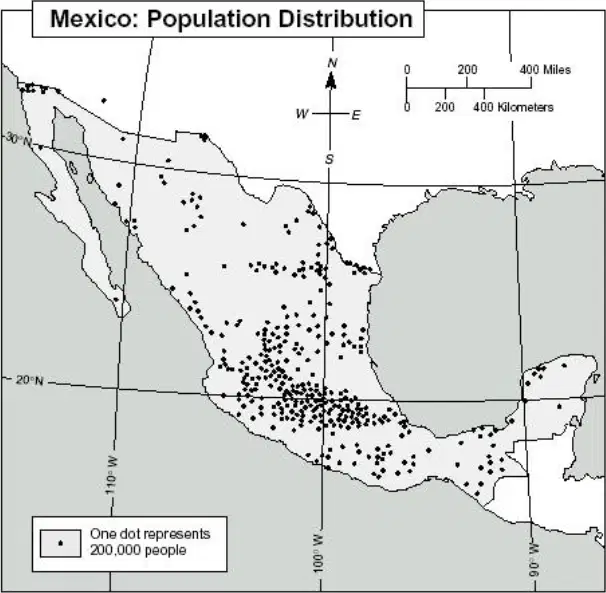
What does each dot on the map represent?
A) 200 people
B) 2,000 people
C) 20,000 people
D) 200,000 people
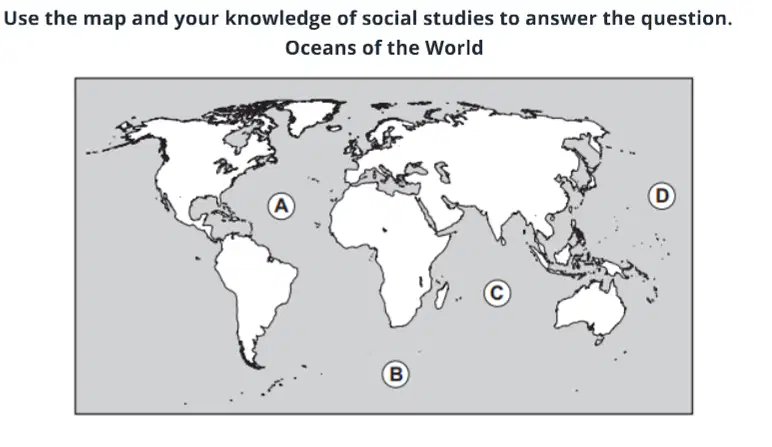
Use the map and your knowledge of social studies to answer the question. Which letter on the map shows the location of the Indian Ocean?
letter A
letter B
letter C
letter D

Use the following map to answer the question below:
Australia
Africa
Antarctica
South America
Every map projection has some degree of distortion because:
a curved surface cannot be represented on a flat surface without distortion
parallels and meridians never cross at right angles on a globe
the grid system is two-dimensional, while the real world is three-dimensional
Earth is not a perfect sphere
latitude lines are shorter than meridian lines

Use the following map to answer the question below.
North
West
East
South

Which ocean is located at 0°, 120°W and also located at 0°, 150°E?
Arctic Ocean
Indian Ocean
Atlantic Ocean
Pacific Ocean

Based on the map of New York City, 1910, which statement below is true?
Immigrants swarmed to the US during the Gilded Age.
Most immigrants settled in rural areas to work temporary farming jobs.
Immigrant groups of the same background gathered and lived together.
Immigrants were met with racism, nativism, and xenophobia.
A political map shows boundaries.
True
False
What are "push" factors and why do they cause people to leave a place?
What are "pull" factors and why do they attract people to a new location?
Which of the following is not a category of reasons why people move due to push and pull factors?
Political
Environmental
Social
Recreational
What does the term "emigrate" mean?
To leave your native country to live somewhere else temporarily
To leave your native country to live somewhere else permanently
To enter another country to live there temporarily
To enter another country to live there permanently
What does the term "immigrate" mean?
To leave your native country to live somewhere else temporarily
To leave your native country to live somewhere else permanently
To enter another country to live there temporarily
To enter another country to live there permanently
Explain the difference between push factors and pull factors.
A) Push factors make you want to leave an area and pull factors make you want to go to an area
B) Pull factors make you want to leave an area and Push factors make you want to leave an area
C) Pull factors force you to leave and Pull factors are your choice

Which of the Population Pyramids shown below would best represent a town that has large retirement and nursing home communities?
A
B
C
D
E
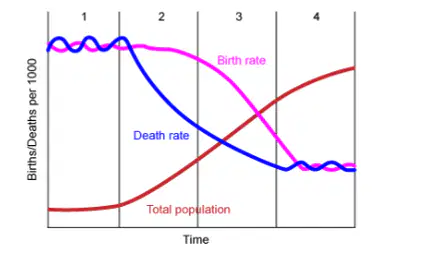
Since the Demographic Transition Model and the Population Pyramids are both population models, they help us to...
Better understand global population issues and trends
Why certain countries may practice population policies
Predict future population issues
All of the Above
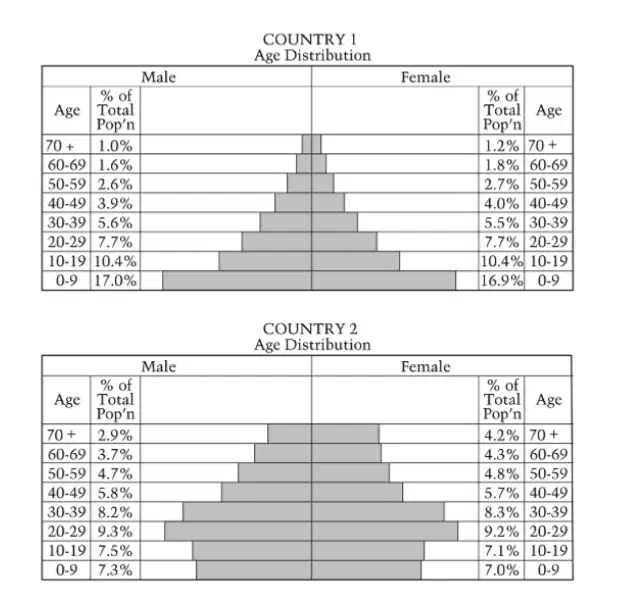
Refer to the two population pyramids provided. What percentage of the total population of Country 1 is age 70 or over?
A) 1.0%
B) 1.2%
C) 2.2%
D) 3.0%
What is the main difference between material culture and non-material culture?
What are the TWO primary languages of Latin America?
English and Dutch
French and Spanish
Portuguese and English
Spanish and Portuguese
Which religion is the most popular in Latin America?
Judaism
Islam
Atheist
Catholicism
The Vikings who invaded Europe in the Middle Ages were from —
Poland
Russia
Turkey
Scandinavia
In contrast to folk/local culture, popular culture is typical of:
Large heterogeneous groups of people.
Indigenous and native groups.
Groups of people that have little interaction with other groups of people.
Small, homogeneous groups.
Groups of people living in isolated areas.
Both religions (Hinduism and Buddhism) believe in reincarnation.
True
False
Hinduism and Buddhism are different religions. In what way are they similar?
Both religions believe in reincarnation.
Both religions recognize the importance of dharma.
Both religions have to do with the concept of moksha.
Both religions use the Vedas.
Which statement explains how early Hinduism first developed?
It developed from the spirituality of the Aryans and the teachings of the Vedas.
It blended the traditions of Mohenjo Daro and the customs of the Gupta Empire.
It incorporated the principles taught in the Two Lessons.
It developed by adopting the teachings of Asoka.
What MAJOR impact did Hinduism have on Indian society?
The creation of a religion that encouraged equality
The spread of the teachings and beliefs of the Buddha
The division of Indian society into a class structure called the caste system
Led to the creation of Islam and the partitioning of India into three countries
In Hinduism, what is the relationship between karma and reincarnation?
an individual's good karma will help end the cycle of reincarnation
Reincarnation will result in the escape from the cycle of karma
Reincarnation will determine a person's future karma
An individual's bad karma will end the cycle of reincarnation
How was Buddhism introduced into ancient China?
Through trade
Through Legalism
Through military conquest
Through Confucianism
Buddhism was founded by an Indian prince named
Mohammed
Jesus
Siddhartha Gautama
Abraham
Which statement best represents the core belief in Buddhism?
Followers should adhere to the Four Noble Truths.
Followers should learn and follow the Ten Commandments.
The Vedas contain all sacred teachings.
Dharma is most important to earning good karma.
In Buddhism, you must give up _________ to rid yourself from suffering.
your job
your money
your house
all worldly desires
What do the teachings of Christianity and Judaism have in common?
a belief in one god
a belief in reincarnation
the value of giving up all worldly possessions
the importance of making a pilgrimage to Mecca
The main divisions or branches of Judaism are:
Orthodox, Conservative and Reform
Sunnis and Shi'ites
Protestants and Roman Catholics
Theravada and Mahayana
Which text is a central document of Judaism?
Analects
Koran (Qur'an)
Torah
Upanishads
Which of the following is a symbol for Judaism?
Star of David
Crescent moon with star
Who is the founder or the "father" of Judaism?
Abraham
Moses
Jesus
Cyrus
Synagogues are to Jewish culture as:
Churches are to Christian culture.
As the capital building is to the American culture.
As restaurants are to American culture.
Believers of Islam are called:
Christians
Torahs
Muslims
Jews
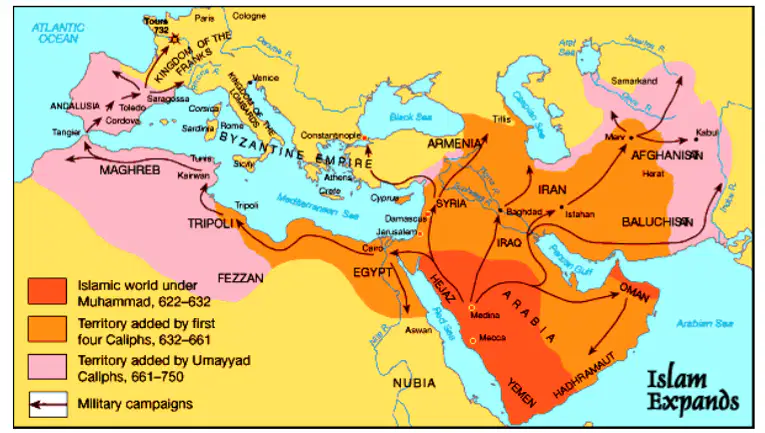
In what area did Islam first begin under Muhammad from 622-632?
Near present day Egypt, Iraq, and Syria
Into Northern Africa
In the land surrounding their holy cities (Medina and Mecca)
None are true
The holy book of Islam is
The Sutras
The Bible
The Qu'ran
The Torah
Islam began in the 7th century with (a) .
Which of the following are part of the 5 Pillars of Islam? (Hint: there are three)
Make a trip to Mecca/Mekkah, their holy site
Never eat meat
Belief in one God
Fast during the holy month
Quit your job and give all possessions to the poor
What of the following are responsibilities of the United Nations? (check all that apply)
Promote world peace
Promote democracy
Create international law
Provide security to non members

