
 Worksheets
Overpopulation Article Quiz
Total questions: 14
Worksheet time: 12mins
The CENTRAL idea of the article is developed by __________
describing what countries have done to ensure that their rising populations do not overuse important natural resources
exploring the regions where the education of women has had a larger than average impact on the rate of population growth
outlining the effects of the relationship between fertility and mortality on countries' populations and economies
contrasting the causes of death that slowed population growth in the past with causes of death in the modern world
Which CENTRAL idea is BEST supported by the following statement?
This year, the number of people worldwide who are over 60 will rise above 1 billion for the first time. By 2050, it is forecast to be 2 billion, which raises the question: 'Who will pay for them'?
Experts are concerned that some rising populations will put a strain on the world's resources.
Countries that plan for changing and aging populations will see gains among all demographics.
Declining fertility rates have led to a period of demographic dividends for some Asian countries.
The level of education that a woman has is one factor that relates to the number of children she has.
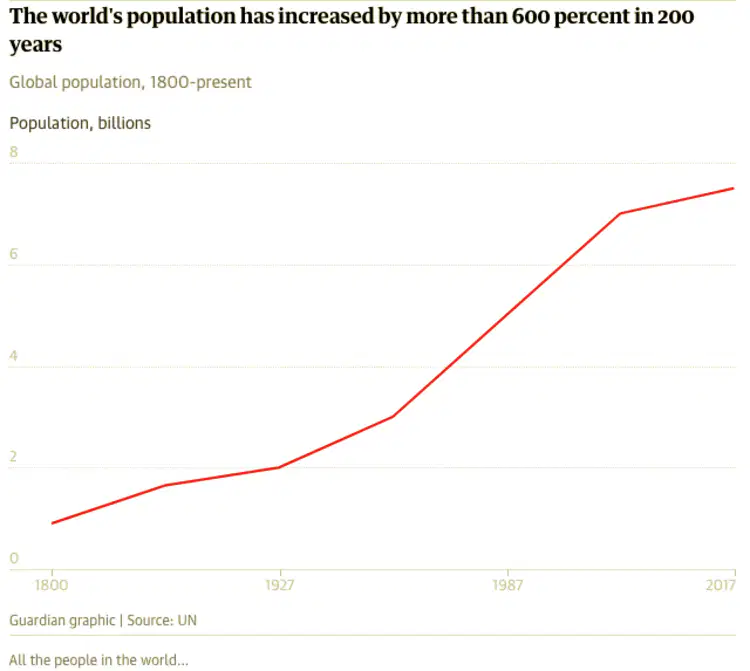
What is an advantage of presenting global population growth this way?
It shows that specific world events have caused the population growth to slow throughout history.
It shows that long-term population growth in the modern age has increased fairly consistently.
It illustrates how much global population rates are likely to increase over the next few decades.
It illustrates how fertility rates are connected to global population changes over time.
Examine Image 3 and read from the section "Where is the Population Rising Fastest - And Slowest?" Which statement accurately compares the chart and the reading selection?
The selection makes a general statement about population growth in two continents, while the chart illustrates the growth of specific countries around the world.
The selection provides background information to support the predictions in the chart, and explains the causes of the rate of population growth outlined in the chart.
Both the selection and the chart emphasize the diversity in the expected rates of population growth in different nations.
Both the selection and the chart outline the rate at which populations in Asia and Africa will grow in the future.
Although developing countries have higher birth rates, populations in richer nations may be more problematic. Why do some scientists worry more about richer nations?
People in developing countries do not produce pollution.
People in developing countries do not use as much healthcare.
People in richer countries have a higher life expectancy.
People in richer countries consume more resources.
Why is the human population growing? (Check all that apply).
People are living longer
Child mortality rate is lower
Suitable habitat is increasing
Fertility rate are increasing
What trend in population leads to a demographic dividend?
longer life span
reduced fertility rate
increased fertility rates
higher infant mortality
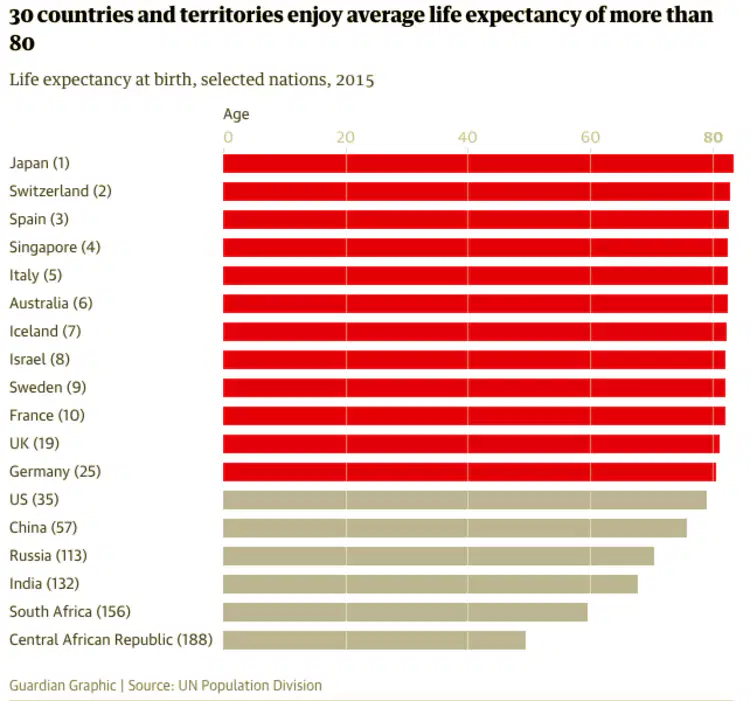
What is the significance of the red bars?
life expectancy of 80 years or above
child mortality rate below the average
countries with the oldest population
countries with the fastest population growth
Answer in a paragraph
Why is the growing population of people problematic for the Earth? Support your claim with evidence from the article. Then, explain why the evidence supports your claim.
Read the following statement.
These scientists use the resultant data to prevent species overpopulation, or conversely, extinction.
Which phrase from the article helps explain what 'overpopulation' means?
factors such as available food, water, cover, prey, and predator species
to include more complex interactions between species
when a species exceeds its niche environment's carrying capacity
steadily and exponentially increasing
What is the meaning of the phrase 'ecological footprint' as used in the following statement.
Humans are in a position where they have to work on their ecological footprint.
management of disease
impact on the environment
expertise on carrying capacity
understanding of unrestrained reproduction
Read the following statement.
Human population growth is expected to continue an upward trend.
Which sentence from the article BEST supports the statement above?
This is a topic of much debate in recent years due to the rapidly expanding human population.
Since the end of the bubonic plague at the turn of the 15th century, the human population has been steadily and exponentially increasing.
The human population of the world as of 2018 was nearly 7.6 billion.
The United Nations Department of Economic and Social Affairs Population Division estimates an additional 3.5 billion population growth by the year 2100.
Read the following selection from the article.
Sometimes, though, a certain species will overpopulate, resulting in the devastation of shared resources. If this animal happens to be a predator, it might overconsume the prey population. That leads to that pre species' local extinction and the unrestrained reproduction of the predator species.
Which idea is BEST supported by this selection?
Predator overpopulation can lead to the demise of a local prey species.
Prey overpopulation can lead to the demise of a local predator species.
Overconsumption of shared resources will undo the global food web.
Overconsumption of shared resources will result in excessive reproduction within a habitat.
Read the following claims and answer in a paragraph.
1. We as humans need to adjust the way we treat the Earth and other organisms to increase Earth's carrying capacity for our species.
2. If the human population continues to grow at its current rate, Earth's carrying capacity for our species will be met.
Which claim is correct? Support your choice with relevant data or evidence from the article. Then, justify why the data or evidence supports your choice.

