
 Worksheets
OAS Test Practice
Total questions: 16
Worksheet time: 8mins

Chengdu is closer to the equator than Harbin. Which location has a colder air temperature and why?
Harbin, because less energy is transferred from the sun directly to the surface, and then from the surface to the air.
Harbin, because less energy is transferred from the sun directly to the air.
Chengdu, because less energy is transferred from the sun directly to the surface, and then from the surface to the air.
Chengdu, because less energy is transferred from the sun directly to the air.

How does the air temperature of Alesund compare to the air temperature of Khatyrka? Why?
the same as Khatyrka. Even though the ocean water at each location is a different temperature, the same amount of energy is transferred to the air at both locations.
the same as Khatyrka. They are both near moving ocean water, so the same amount of energy is transferred to the air at both locations.
warmer than Khatyrka. At Alesund, energy is transferred from the ocean to the air. At Khatyrka, energy is transferred from the air to the ocean.
warmer than Khatyrka. At Alesund, a lot of energy is transferred from the ocean to the air. At Khatyrka, only a little energy is transferred from the ocean to the air.

Delta and Alpha are the same distance from the equator, and they are both near the ocean. Using the information in the map, how does the air temperature of Delta compare to the air temperature of Alpha? Why?
the same as Alpha. Both locations are the same distance from the equator. The winds push the ocean water, and it turns to follow the coast in both locations, so the same amount of energy is transferred to the air.
warmer than Alpha. Moving air with a lot of energy turns and follows the coast toward Delta; moving air with only a little energy turns and follows the coast toward Alpha.
warmer than Alpha. The winds push ocean water that turns and follows the coasts. Energy is transferred from the ocean to the air at Delta and only a little energy is transferred from the air to the ocean at Alpha.
warmer than Alpha. The winds push ocean water that turns and follows the coasts. A lot of energy is transferred from the ocean to the air at Delta, and only a little energy is transferred from the ocean to the air at Alpha.
Harold is using what he knows about cause-and-effect relationships to write a paper explaining cloud shape. How could he describe cause and effect in his paper?
There is only one cause for cloud shape, because each effect has one cause.
There can be more than one cause for the effect of cloud shape.
It is impossible to determine which factors cause cloud shape and which factors are the effects of cloud shape.
Some things, like cloud shape, do not have a cause because they just happen.
Hopetown is farther from the equator than Kamina. Which location has a colder air temperature and why?
Kamina, because less energy is transferred from the sun directly to the air.
Kamina, because less energy is transferred from the sun directly to the surface, and then from the surface to the air.
Hopetown, because less energy is transferred from the sun directly to the air.
Hopetown, because less energy is transferred from the sun directly to the surface, and then from the surface to the air.

Madison and Oxford are the same distance from the equator and they are both near the ocean. Use the information on the map to answer these questions: How does the air temperature of Madison compare to the air temperature of Oxford? Why?
warmer than Oxford. At Madison, a lot of energy is transferred from the ocean to the air. At Oxford, only a little energy is transferred from the ocean to the air.
warmer than Oxford. At Madison, energy is transferred from the ocean to the air. At Oxford, energy is transferred from the air to the ocean.
the same as Oxford. They are both near moving ocean water, so the same amount of energy is transferred to the air at both locations.
the same as Oxford. Even though the ocean water at each location is a different temperature, the same amount of energy is transferred to the air at both locations.

Mowe Bay and Townsville are the same distance from the equator, and they are both near the ocean. Using the information in the map, how does the air temperature of Mowe Bay compare to the air temperature of Townsville? Why?
the same as Townsville. Both locations are the same distance from the equator. The winds push the ocean water, and it turns to follow the coast past both locations, so the same amount of energy is transferred to the air.
colder than Townsville. Moving air with only a little energy turns and follows the coast toward Mowe Bay. Moving air with a lot of energy turns and follows the coast toward Townsville.
colder than Townsville. The winds push ocean water that turns and follows the coasts. Energy is transferred from the air to the ocean at Mowe Bay and energy is transferred from the ocean to the air at Townsville.
colder than Townsville. The winds push ocean water that turns and follows the coasts. Only a little energy is transferred from the ocean to the air at Mowe Bay; more energy is transferred from the ocean to the air at Townsville.
Milltown is 15°C (59°F) in the spring. What is the source for most of the energy that causes this temperature?
the sun
volcanoes
coal and oil
trees
Saskatoon is farther from the equator than Lubbock. Which location has a warmer air temperature and why?
Lubbock, because more energy is transferred from the sun directly to the surface, and then from the surface to the air.
Lubbock, because more energy is transferred from the sun directly to the air.
Saskatoon, because more energy is transferred from the sun directly to the surface, and then from the surface to the air.
Saskatoon, because more energy is transferred from the sun directly to the air.

Rolling Rock and Seaside are the same distance from the equator and they are both near the ocean. Use the information on the map to answer these questions: How does the air temperature of Rolling Rock compare to the air temperature of Seaside? Why?
the same as Seaside. Even though the ocean water at each location is a different temperature, the same amount of energy is transferred to the air at both locations.
the same as Seaside. They are both near moving ocean water, so the same amount of energy is transferred to the air at both locations.
colder than Seaside. At Rolling Rock, only a little energy is transferred from the ocean to the air. At Seaside, a lot of energy is transferred from the ocean to the air.
colder than Seaside. At Rolling Rock, energy is transferred from the air to the ocean. At Seaside, energy is transferred from the ocean to the air.

Penha and Chañaral are the same distance from the equator, and they are both near the ocean. Using the information in the map, how does the air temperature of Penha compare to the air temperature of Chañaral? Why?
warmer than Chañaral. The winds push ocean water that turns and follows the coasts. A lot of energy is transferred from the ocean to the air at Penha. Only a little energy is transferred from the ocean to the air at Chañaral.
warmer than Chañaral. The winds push ocean water that turns and follows the coasts. Energy is transferred from the ocean to the air at Penha and energy is transferred from the air to the ocean at Chañaral.
warmer than Chañaral. Moving air with a lot of energy turns and follows the coast toward Penha. Moving air with only a little energy turns and follows the coast toward Chañaral.
the same as Chañaral. Both locations are the same distance from the equator. The winds push the ocean water, and it turns to follow the coast past both locations, so the same amount of energy is transferred to the air.
Demi is studying the amount of snowfall at the South Pole. She wants to describe it using cause and effect. How could she do that?
She can't. It is impossible to determine which factors cause a particular amount of snow to fall and which factors are the effects.
She can't. Some things, like the amount of snowfall, do not have a cause; they just happen.
She can describe the one cause for amount of snowfall—each effect has one cause.
She can describe more than one cause. There can be more than one cause for the effect—amount of snowfall.
Buchanan is closer to the equator than Menindee. Which location has a warmer air temperature and why?
Buchanan, because more energy is transferred from the sun directly to the surface, and then from the surface to the air.
Buchanan, because more energy is transferred from the sun directly to the air.
Menindee, because more energy is transferred from the sun directly to the surface, and then from the surface to the air.
Menindee, because more energy is transferred from the sun directly to the air.

Monterey and Virginia Beach are the same distance from the equator and they are both near the ocean. Use the information on the map to answer these questions: How does the air temperature of Monterey compare to the air temperature of Virginia Beach? Why?
the same as Virginia Beach. They are both near moving ocean water, so the same amount of energy is transferred to the air at both locations.
the same as Virginia Beach. Even though the ocean water at each location is a different temperature, the same amount of energy is transferred to the air at both locations.
colder than Virginia Beach. At Monterey, energy is transferred from the air to the ocean. At Virginia Beach, energy is transferred from the ocean to the air.
colder than Virginia Beach. At Monterey, only a little energy is transferred from the ocean to the air. At Virginia Beach, a lot of energy is transferred from the ocean to the air.
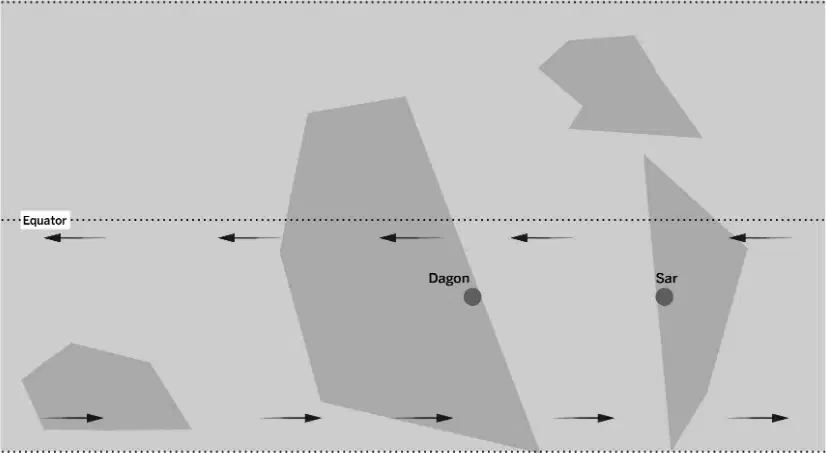
Using the information in the map, how does the air temperature of Sar compare to the air temperature of Dagon? Why?
colder than Dagon. Moving air with only a little energy turns and follows the coast toward Sar. Moving air with a lot of energy turns and follows the coast toward Dagon.
colder than Dagon. The winds push ocean water that turns and follows the coasts. Energy is transferred from the air to the ocean at Sar and energy is transferred from the ocean to the air at Dagon.
colder than Dagon. The winds push ocean water that turns and follows the coasts. A lot of energy is transferred from the ocean to the air at Dagon. Only a little energy is transferred from the ocean to the air at Sar.
the same as Dagon. Both locations are the same distance from the equator. The winds push the ocean water, and it turns to follow the coast past both locations, so the same amount of energy is transferred to the air.
Ferris is 6°C (43°F) in the winter. What is the source for most of the energy that causes this temperature?
trees
coal and oil
volcanoes
the sun

