wayground logo

Free Printable Worksheets

Font size

S
M
L
XL
Worksheets

untitled

Total questions: 138

Worksheet time: 13hrs 30mins

Name
Class
Date
1.

What are the 5 nitrogen bases?

a)

adenine, thymine, cytoplasm, guanine, and uracil

b)

adenine, thymine, cytosine, guanine, and uracil

c)

adenine, thymine, cytosine, glycerol, and uracil

d)

adenine, thymine, cytosine, glucose, and uracil

2.

The monomer for nucleic acids is called a:

(a)  

3.

These biomolecules are composed of repeating units of nucleotides. Its main function is to store and transmit genetic information. DNA and RNA are the most common examples.

4.

Label the nucleotide

5.

Match the following

a)

DNA Bases

1.

A-T

b)

RNA Bases

2.

A-U

c)

DNA Structure

3.

Double Stranded

d)

RNA Structure

4.

Single Stranded

6.

DNA's shape is a (a)   ​. It has these bases: (b)   It is found ​ (c)  

RNA's ​shape is a (d)   . It has these bases: ​ (e)  

Choose from the below words
Double Strand
ATCG
In Nucleus ONLY
Single Strand
AUCG
7.

The three components of a nucleotide are​ (a)   , ​ (b)   group, and ​ (c)   base.

Choose from the below words
sugar
phosphate
nitrogenous

8-17.

Answer the questions below after watching the video

8.

What are the monomers that make up nucleic acids called?

a)

Lipids

b)

Glycoproteins

c)

Nucleotides

d)

Amino acids

9.

Which component is not a part of a nucleotide?

a)

Ribose sugar

b)

Amino group

c)

Nitrogenous base

d)

Phosphate group

10.

How are nucleotides linked together in a DNA molecule?

a)

Hydrogen bonding

b)

Peptide bonding

c)

Ionic bonding

d)

Dehydration synthesis

11.

What type of bond holds the DNA strands together?

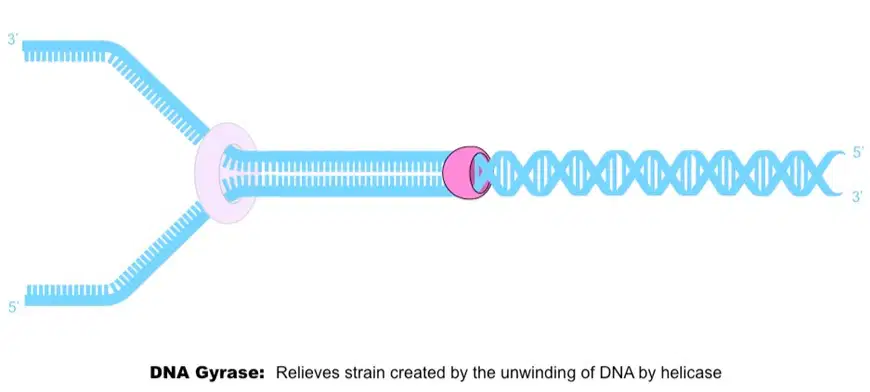
a)

Peptide bonds

b)

Hydrogen bonds

c)

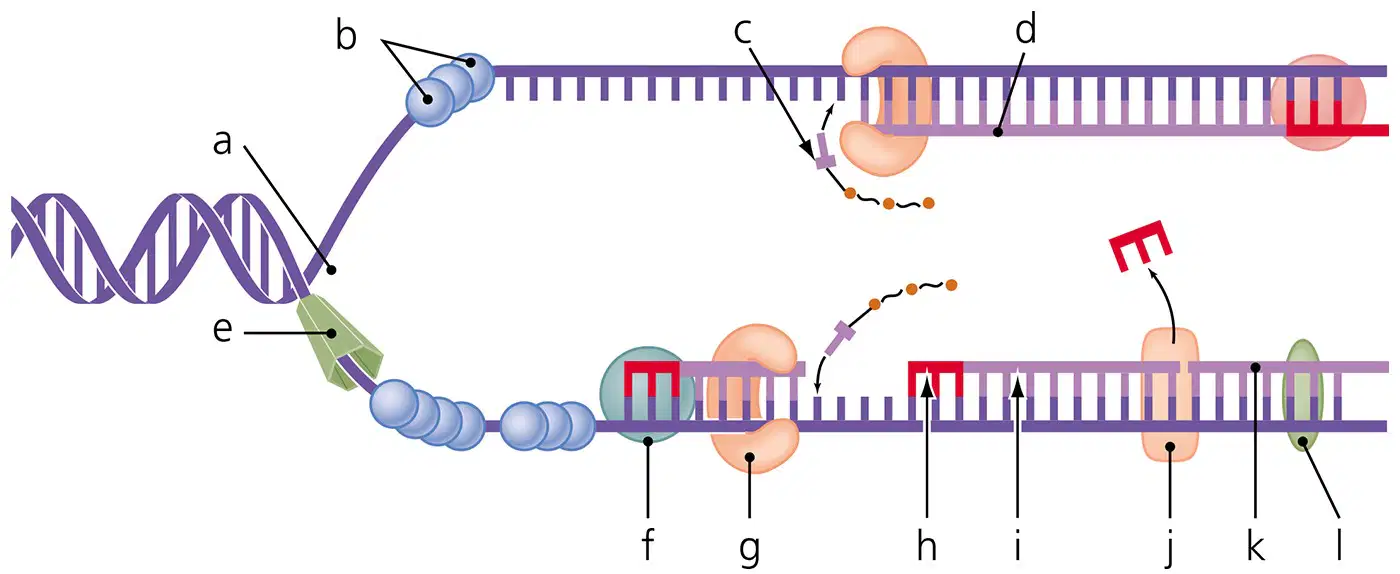
Covalent bonds

d)

Ionic bonds

12.

Which base does adenine pair with in DNA?

a)

Thymine

b)

Uracil

c)

Cytosine

d)

Guanine

13.

Which sugar is found in RNA?

a)

Ribose

b)

Glucose

c)

Deoxyribose

d)

Fructose

14.

Which nitrogenous base is unique to RNA?

a)

Adenine

b)

Uracil

c)

Cytosine

d)

Thymine

15.

What is the main structural difference between DNA and RNA?

a)

DNA is double-stranded, RNA is single-stranded

b)

DNA is single-stranded, RNA is double-stranded

c)

DNA contains uracil, RNA contains thymine

d)

DNA and RNA are both double-stranded

16.

What is the role of ATP in cells?

a)

Cellular movement

b)

Protein synthesis

c)

Energy transfer

d)

Genetic information storage

17.

What happens when ATP is used for energy?

a)

It becomes ADP by losing a phosphate group

b)

It becomes AMP by gaining a phosphate group

c)

It is broken down into nucleotides

d)

It synthesizes new DNA strands

18.
Which of the following best describes a DNA molecule?
a)
double helix
b)
contains ribose
c)
made of amino acids
d)
contains Uracil
19.
Adenine bonds with ______________.
a)
Guanine
b)
Thymine
c)
Cytosine
d)
Adenine
20.
Guanine bonds with ______________.
a)
Adenine
b)
Guanine
c)
Cytosine
d)
Thymine
21.
Why is DNA important?
a)
it is very small and very complicated
b)
it's in everything
c)
it serves as the blueprint for traits of all living things
d)
because we eat it every day for energy
22.
Which 2 molecules forms the sides (backbone) of the DNA ladder?
a)
deoxyribose and adenine
b)
deoxyribose and a hydrogen bond
c)
sugar and the nucleus
d)
deoxyribose (sugar) and phosphate
23.
What bonds the nitrogen bases in the center of the DNA strand?
a)
Covalent Bonds
b)
Ionic Bonds
c)
Hydrogen Bonds
d)
Metallic Bonds
24.
Which shows the correct complementary base pairing for DNA?
a)
C-A, T-G
b)
A-G, C-T
c)
C-G, U-A
d)
T-A, G-C
25.
Which sequence of DNA bases would pair with this partial strand
ATG TGA CAG
a)
ATG TGA CAG
b)
TAC ACT GTC
c)
GTA AGT GAC
d)
CAT TCA CTG
26.
In a sample of DNA, 20 percent is Adenine. What are the percentages of the other bases?
a)
Thymine - 30 percent, Cytosine 25 percent, Guanine 25 percent
b)
Cytosine - 20 percent, Thymine - 30 percent, Guanine 25 percent
c)
Thymine - 20 percent, Cytosine 30 percent, Guanine 30 percent
d)
Thymine - 30 percent, Cytosine 30 percent, Guanine 20 percent
27.
DNA codes for...
a)
cholesterol
b)
proteins
c)
fatty acids
d)
a sandwich
28.
What determines the code, or information, of a DNA molecule?
a)
the shape (structure) of the nitrogen bases
b)
the order (sequence) of the nitrogen bases
c)
the color of the nitrogen bases
d)
the frequency (number) of nitrogen bases
29.
What is the relationship between a protein, the cell, and DNA?
a)
DNA is produced by protein which is produced in the cell
b)
Protein is composed of DNA which is produced in the cell
c)
DNA controls the production of protein in the cell
d)
A cell is composed of DNA and protein
30.
Genes are found on...
a)
chromosomes
b)
alleles
c)
proteins
d)
anthers
31.
A change in the genetic code = ____
a)
trait
b)
genotype
c)
phenotype
d)
mutation
32.
Nucleotides are made up of a sugar, phosphate, and..?
a)
nitrogenous base
b)
nucleic acid
c)
cholesterol
d)
fatty acid
33.
What is the name of the subunit that builds a DNA polymer?
a)
Nucleotide
b)
Nucleic acid
c)
Nitrogenous base
d)
Nucelosome
34.
What does DNA stand for?
a)
Deoxyribonucleic acid
b)
Denitrogenous acid
c)
Deribonucleic acid
d)
Diribonucleic acid
35.
Why is the order of amino acids so important?
a)
The order of amino acids dictates what shape the protein will fold into.
b)
It is not important. The protein folding chamber will force the protein to fold into the correct shape.
36.
This nucleic acid is single stranded
a)
DNA
b)
RNA
c)
Both
37.
DNA and RNA are macromolecules in the category of
a)
Proteins
b)
Lipids
c)
Nucleic Acids
d)
Carbohydrates
38.
Which of the following best describes a DNA molecule?
a)
double helix
b)
contains ribose
c)
made of amino acids
d)
contains Uracil
39.
Adenine bonds with ______________.
a)
Guanine
b)
Thymine
c)
Cytosine
d)
Adenine
40.
Guanine bonds with ______________.
a)
Adenine
b)
Guanine
c)
Cytosine
d)
Thymine
41.
Why is DNA important?
a)
it is very small and very complicated
b)
it's in everything
c)
it serves as the blueprint for traits of all living things
d)
because we eat it every day for energy
42.
Name this structure
a)
double helix
b)
nucelotide
c)
twisted ladder
d)
hydrogen bond
43.
Which 2 molecules forms the sides (backbone) of the DNA ladder?
a)
deoxyribose and adenine
b)
deoxyribose and a hydrogen bond
c)
sugar and the nucleus
d)
deoxyribose (sugar) and phosphate
44.
Which shows the correct complementary base pairing for DNA?
a)
C-A, T-G
b)
A-G, C-T
c)
C-G, U-A
d)
T-A, G-C
45.
What bonds the nitrogen bases in the center of the DNA strand?
a)
Covalent Bonds
b)
Ionic Bonds
c)
Hydrogen Bonds
d)
Metallic Bonds
46.
Which sequence of DNA bases would pair with this partial strand
ATG TGA CAG
a)
ATG TGA CAG
b)
TAC ACT GTC
c)
GTA AGT GAC
d)
CAT TCA CTG
47.
Who realized that A is always equal to T and C is always equal to G?
a)
Franklin
b)
Watson and Crick
c)
Chargaff
d)
Mendel
48.
Which organelle is DNA usually found in?
a)
cell membrane
b)
vacuole
c)
chloroplast
d)
nucleus
49.
What organisms have DNA?
a)
Virus
b)
Plant
c)
Bacteria
d)
All living things
50.
In a molecule of double-stranded DNA, the amount of Adenine present is always equal to the amount of
a)
cytosine
b)
guanine
c)
thymine
d)
uracil
51.
In a sample of DNA, 20 percent is Adenine. What are the percentages of the other bases?
a)
Thymine - 30 percent, Cytosine 25 percent, Guanine 25 percent
b)
Cytosine - 20 percent, Thymine - 30 percent, Guanine 25 percent
c)
Thymine - 20 percent, Cytosine 30 percent, Guanine 30 percent
d)
Thymine - 30 percent, Cytosine 30 percent, Guanine 20 percent
52.
What does DNA stand for?
a)
Deoxyribonucleic acid
b)
Denitrogenous acid
c)
Deribonucleic acid
d)
Diribonucleic acid
53.
DNA codes for...
a)
cholesterol
b)
proteins
c)
fatty acids
d)
a sandwich
54.
Can DNA be transferred between different organisms?
a)
Yes
b)
No
c)
Maybe
d)
I don't know
55.
What determines the code, or information, of a DNA molecule?
a)
the shape (structure) of the nitrogen bases
b)
the order (sequence) of the nitrogen bases
c)
the color of the nitrogen bases
d)
the frequency (number) of nitrogen bases
56.
What is the relationship between a protein, the cell, and DNA?
a)
DNA is produced by protein which is produced in the cell
b)
Protein is composed of DNA which is produced in the cell
c)
DNA controls the production of protein in the cell
d)
A cell is composed of DNA and protein
57.
In DNA replication, which enzyme is responsible for unwinding & unzipping the parent strand of DNA?
a)
helicase
b)
polymerase
c)
ligase
d)
primase
58.

The final proof as DNA as genetic material came from the experiment of

a)

Griffith

b)

Hershey and chase

c)

Avery, Mcleod, & McCarty

d)

Hargovind khorana

59.

Bacteriophages are

a)

Viruses

b)

Bacteria

c)

Prions

d)

Viroids

60.

In Hershey Chase exp.,Protein tagging was done by-

a)

Radioactive Phosphorus P37

b)

Radioactive sulphur S 34

c)

radioactive sulphur 35 S

d)

radioactive Phosphorus 32 P

61.

In Blender exp.,DNA tagging was done by-

a)

Radioactive phosphorus P 37

b)

Radioactive sulphur S 34

c)

Radioactive sulphur S 35

d)

Radioactive Phosphorus 32 P

62.

Hershey-Chase exp.confirms that-

a)

DNA is always formed from DNA in semiconservative manner.

b)

Sulphur and Protein both enter in bacterial cell progeny.

c)

DNA is genetic material,not protein.

d)

Radioactive Phosphorus was only found in surrounding.

63.

The Bacteria used for confirmation of DNA was-

a)

Staphylococci

b)

E.coli

c)

Salmonella typhimurium

d)

Clostridium tetani

64.

In the DNA of a panda, there is 30% adenine. Determine the percent of guanine.

a)

15%

b)

40%

c)

10%

d)

20%

65.

In organism #1 there is 13% thymine in a molecule of DNA, Determine the percent (%) _____ cytosine.

a)

13%

b)

26%

c)

37%

d)

74%

66.
Chargaff's experiments showed that the amount of A, T, G and C is the same from species to species
a)
True
b)
False
67.

Based upon the data in the table provided complete letter F (22.8% of Guanine), determine the percentage of Thymine present in DNA of Maize.

a)

37.9% Thymine

b)

32.8% Thymine

c)

27.2% Thymine

d)

22.6% Thymine

68.
Which two radioactive isotopes were used to label the DNA and protein components of viruses called bacteriophages?
a)
Nitrogen and Phosphorus
b)
Phosphorus and Sulfur
c)
Nitrogen and Sulfur
69.
Which scientist discovered that in any sample of DNA the amounts of adenine and thymine were always equal and the amounts of guanine and cytosine were always equal?
a)
Chargaff
b)
Avery
c)
Griffith
d)
Franklin
70.
Which scientist used a technique called X-ray diffraction to study the structure of the DNA molecule?
a)
Watson and Crick
b)
Hershey and Chase
c)
Franklin
d)
Chargaff
71.
Which scientists built a 3-D model of the DNA double helix?
a)
Hershey and Chase
b)
Watson and Crick
c)
Chargaff and Franklin
d)
Griffith and Avery
72.

Tag the base that is bonded to Thymine.

73.

Match the following Scientist to their credited Discoveries.

a)

1.

Took the now infamous Photo 51.

b)

2.

Won the Nobel Prize for solving DNA.

c)

3.

Traced viral DNA into Bacteria.

d)

4.

Proved Bacteria can share DNA.

74.

Rosalind Franklin used what to obtain this photo?

[Select all that apply]

a)

X-ray Diffraction

b)

Protein Synthesis

c)

X-ray Crystallography

d)

Photosynthesis

75.

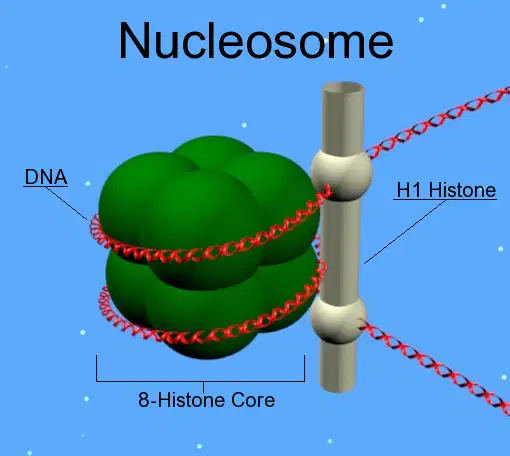
A nucleosome is best described as

a)

nucleosomes coiled around each other

b)

a DNA strand wrapped around histone proteins

c)

one fully-packaged DNA molecule

d)

one strand of DNA double-helix

76.

Chromatin is best described as

a)

nucleosomes super-coiled around each other

b)

a DNA strand wrapped around histone proteins

c)

one fully-packaged DNA molecule

d)

one strand of DNA double-helix

77.

DNA replication results in

a)

three identical copies of each chromosome

b)

23 different copies of each chromosome

c)

46 identical copies of each chromosome

d)

two identical copies of each chromosome

78.

The familiar X-shaped structure shown can be described as..... (Choose all that apply.)

a)

one chromosome

b)

one replicated chromosome

c)

two sister chromatids

d)

two different chromosomes stuck together

79.

Sister chromatids are joined together at a constriction called a

a)

chromatid

b)

centromere

c)

nucleosome

d)

spindle apparatus

80.

Chromosomes are made of... (Choose all that apply.)

a)

DNA

b)

proteins

c)

carbohydrates

d)

lipids

81.

The length of DNA molecule greatly exceeds the dimensions of the nucleus in eukaryotic cells. How is this DNA accommodated?

a)

Deletion of non-essential genes

b)

Super-coiling in nucleosomes

c)

DNAse digestion

d)

Through elimination of repetitive DNA

82.

Label the nucleotide

83.

Match the Base Pairs

a)

Adenine

1.

Thymine

b)

Cytosine

2.

Guanine

c)

Guanine

3.

Cytosine

d)

Thymine

4.

Adenine

84.

How many hydrogen bonds connect adenine and thymine?

a)

1

b)

2

c)

3

d)

4

85.

How many hydrogen bonds connect guanine and cytosine?

a)

1

b)

2

c)

3

d)

4

86.

Which of the labelled structures shows the correct directionality of the DNA molecule?

a)

b)

c)

d)

87.

Click on Adenine

88.

Click on Cytosine

89.

Click on Guanine

90.

Click on Thymine

91.

What elements do we find in Nucleic Acids (DNA) and Protein?

Categorize the following

Phosphorus

Sometimes Sometimes Sulfur

Carbon

Hydrogen

Oxygen

Nitorgen

DNA
Protein
Both

92-95.

Answer the questions below after watching the video

92.

What organism did Hershey and Chase use for their experiments?

a)

Pea plants

b)

Bacteriophages

c)

Mice

d)

Fruit flies

93.

What did Hershey and Chase use to label DNA and protein?

a)

Magnetic beads

b)

Fluorescent tags

c)

Radioactive carbon and nitrogen

d)

Radioactive phosphate and sulfur

94.

What was the key finding of Hershey and Chase's experiment?

a)

RNA is the hereditary material

b)

Protein is the hereditary material

c)

Lipids are the hereditary material

d)

DNA is the hereditary material

95.

What model did Watson and Crick propose?

a)

The protein structure model

b)

The double helix model of DNA

c)

The triple helix model of DNA

d)

The RNA world hypothesis

96.

DNA is organized into nucleosomes. A nucleosome contains eight histone proteins at the core (octamer). DNA is wrapped ~2 times around the octamer. Another protein (H1 Histone) holds the DNA in place around the octamer. You should be able to draw a nucleosome on your IB test.

Which of the following best describes the purpose of nucleosomes?

a)
To increase the speed of DNA replication
b)
To store excess nucleotides
c)
To regulate protein synthesis
d)
To compact DNA and regulate gene expression
97.

Match the processes with the correct description and location:

Categorize the following

1 DNA to 2 DNA

DNA to mRNA

mRNA to Protein (amino acids)

Happens in the Nucleus of Eukaryotes when a new cell needs to be made

Constantly happening in the Nucleus of Eukaryotes

Ribosome
Replication
Transcription
Translation
98.

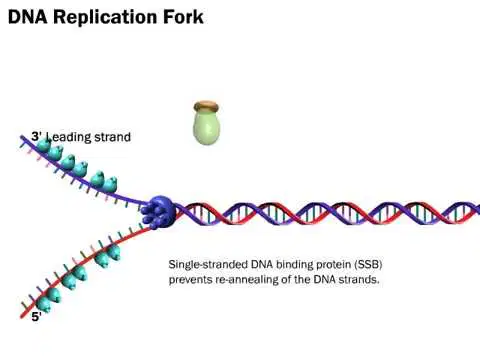
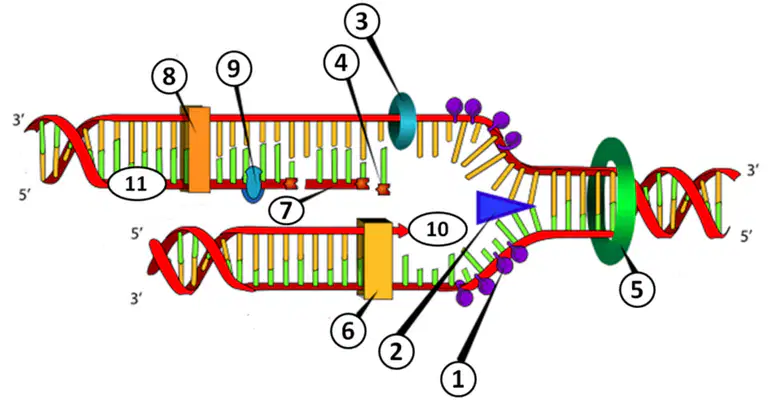
For DNA to be copied, it must first be split apart. The enzyme HELICASE (light pink) opens up the replication fork by breaking the hydrogen bonds between the nitrogenous bases. The enzyme GYRASE (dark pink) relieves the strain this unwinding causes upstream.

a)

I read this.

b)

I did not read this.

99.

After HELICASE separates the two parental strands, SINGLE STRANDED BINDING PROTEINS (SSBs) attach to each strand. These proteins prevent the parental strands from reannealing (reattaching).

a)

I read this.

b)

I did not read this.

100.

Which number represents Gyrase?

(a)  

101.

Which number represents Helicase?

(a)  

102.

Which number represents the single stranded binding proteins?

(a)  

103.

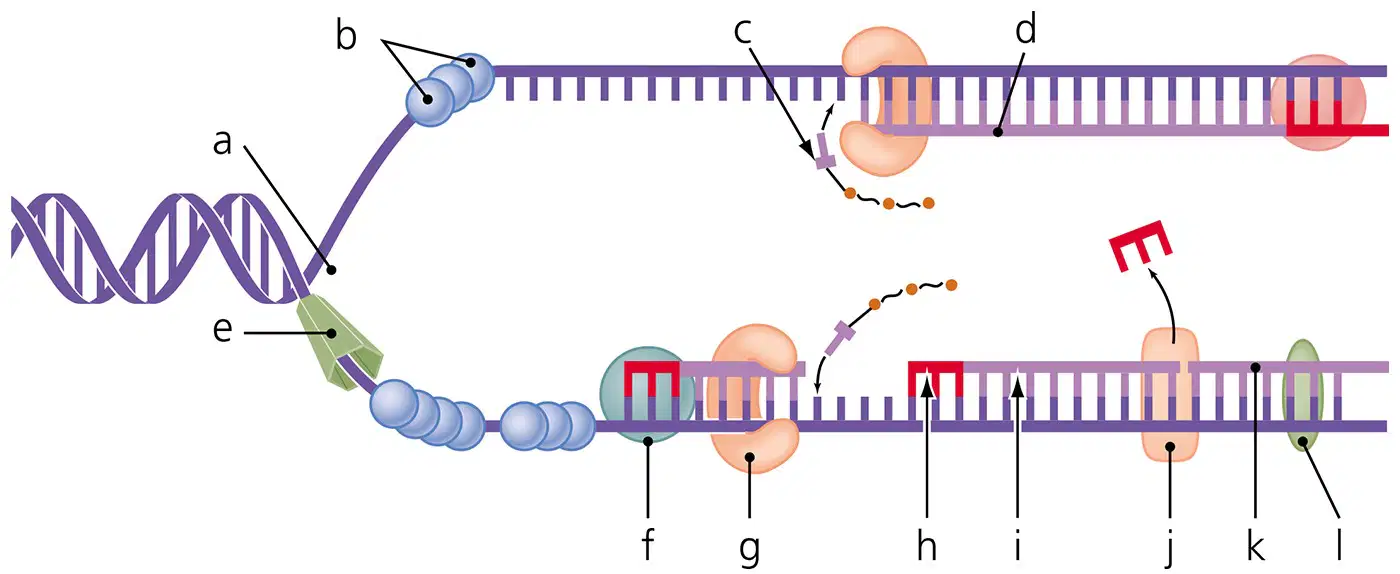
Once the parental strands are separated, the DNA can officially be replicated. This accomplished by the PRIMASE, DNA POLYMERASE III, DNA POLYMERASE I, and LIGASE. Watch the video as a refresher.

a)

I watched the video.

b)

I did not watch the video.

104.

G can be seen on both strands. It is making the complementary base strands. What is G?

a)

DNA polymerase I

b)

DNA polymerase III

c)

Primase

d)

Ligase

105.

What type of primer does primase make?

a)

DNA

b)

RNA

106.

Enzyme j is removing the RNA primers and replacing them with DNA. What is enzyme j?

a)

DNA polymerase I

b)

DNA polymerase III

c)

Ligase

d)

Primase

107.

Enzyme l joins (links) all of the Okazaki fragments together on the lagging strand. What is enzyme l?

a)

DNA polymerase I

b)

DNA polymerase III

c)

Ligase

d)

Primase

108.

What direction does polymerase build new DNA?

a)

3' - 5'

b)

5' - 3'

109.

On the leading strand, which way does polymerase move?

a)

Away from the replication fork (helicase)

b)

Toward the replication fork (helicase)

110.

On the lagging strand, which way does polymerase move?

a)

Away from the replication fork (helicase)

b)

Toward the replication fork (helicase)

111.

There is only 1 enzyme involved in transcription - RNA Polymerase. What the video to get a refresher on how this process works and how it is regulated.

a)

I watched the video.

b)

I did not watch the video.

112.

What is the promoter?

a)
A structure that helps maintain the shape of DNA
b)
A region of DNA that codes for a specific protein
c)
A type of protein involved in DNA replication
d)
Region of DNA where RNA polymerase binds to initiate transcription
113.

What is the terminator sequence?

a)
A sequence that determines the beginning of DNA replication in bacteria.
b)
A specific DNA sequence that signals the start of translation in eukaryotes.
c)
A region of DNA that promotes gene expression in prokaryotes.
d)
A specific DNA sequence that signals the end of transcription in prokaryotes.
114.

How often a gene is transcribed (gene expression) is controlled by transcription factors (proteins). The proteins can either help or prevent RNA polymerase from binding to the promoter. Check all that are true:

a)

Activator transcription factors increase gene expression

b)

Activator transcription factors decrease gene expression

c)

Repressor transcription factors decrease gene expression

d)

Repressor transcription factors increase gene expression

115.

Gene expression is also controlled by chemical groups that determine how tightly packed DNA is in a nucleosome. Check all that are true:

a)
  • Acetylation makes DNA less tightly packed, and therefore increases gene expression.

b)
  • Acetylation makes DNA less tightly packed, and therefore decrease gene expression.

c)
  • Methylation makes DNA more tightly packed, , and therefore decrease gene expression.

d)
  • Methylation makes DNA more tightly packed, , and therefore increases gene expression.

116.

Before the mRNA can leave the nucleus, it must be modified. Select all that are done to make mature mRNA.

a)

Exons are removed

b)

A 3' methyl cap is added

c)

A 5' poly A tail is added

d)

Introns are removed

117.

Which base is not found in mRNA?

a)

Thymine

b)

Adenine

c)

Guanine

d)

Uracile

e)

Cytosine

118.

Match the RNA with the correct description.

a)

Carries the message of DNA

1.

mRNA

b)

Carries amino acids to the ribosome

2.

tRNA

c)

Forms the ribosome (along with proteins)

3.

rRNA

119.

Last video! Please watch to review Translation.

a)

I watched the video.

b)

I did not watch the video.

120.

Match the following descriptions the correct sites within the ribosome:

a)

The exit site (where the tRNA leaves the ribosome after dropping off its amino acid)

1.

E site

b)

Holds the growing polypeptide chain.

2.

P site

c)

Where the tRNA enters the ribosome and its anticodon binds to the codon on the mRNA.

3.

A site

121.

If the codon is UCG, what is the anticodon?

a)
GCU
b)
AGC
c)
CGU
d)
ACG
122.

What are telomeres?

a)
Telomeres are proteins that protect the nucleus.
b)
Telomeres are repetitive sequences of DNA at the end of chromosomes.
c)
Telomeres are only present in plant cells.
d)
Telomeres are found in the cytoplasm of cells.
123.

What is PCR?

a)
Polymerase Chain Replication
b)
Polymerase Chain Reaction
c)
Protein Chain Reaction
d)
Polymerase Chain Rejection
124.
Which is NOT a property of water that helps or bodies function properly?
a)
Water is a natural antibiotic substance
b)
Water dissolves many substances
c)
Water cools when it evaporates
d)
Water can hold heat (maintain temperature)
125.
Water dissolves ionic compounds, like NaCl, because water molecules...
a)
are non polar
b)
have a pH value of 14
c)
Have partially charged ends that interact with ions
d)
do not contain atoms
126.
Which statement best describes an effect of the low density of frozen water on a lake?
a)
When water freezes it contracts, decreasing the water level in the lake.
b)
Water in a lake freezes from the bottom up
c)
Water removes thermal energy from the land, causing the lake to freeze
d)
When water in a lake freezes, it floats and provides insulation for the organisms below
127.
Which combination when referring to salt water is correct in terms of solutes/solvents?
a)
solute: table salt solvent: saltwater
b)
solute: table salt solvent: water
c)
solute: water solvent: table salt
d)
solute: saltwater solvent: water
128.
How many hydrogen bonds can one water molecule make?
a)
6
b)
3
c)
4
d)
2
129.
Water is cohesive, the molecules are attracted to one another because of hydrogen bonds. This attraction helps create...
a)
surface action
b)
surface tension
c)
ice
d)
solvents
130.
When water travels up the stem of a plant, this is a result of
a)
surface tension
b)
capillary action and adhesion
c)
capillary action and cohesion
d)
capillary action, cohesion and adhesion
131.
Water helps maintain homeostasis in an organism, which of the following hold true to that?
a)
Its high specific heat
b)
Its ability to dissolve substances
c)
Its ability to be a polar molecules and have a pH of 7
d)
all of these
132.
What property of water is being shown?
a)
polarity
b)
freezing point
c)
hydrogen bonds
d)
solution/universal solvent
133.
What property of water is being shown?
a)
cohesion
b)
adhesion
c)
polarity
d)
freezing point
134.
What property of water is being shown?
a)
solution
b)
adhesion
c)
freezing point
d)
specific heat
135.
What property of water is being shown?
a)
cohesion
b)
hydrogen bonds
c)
adhesion
d)
polarity
136.
What property of water is being shown?
a)
polarity
b)
hydrogen bonds
c)
surface tension
d)
capillary action
137.
What property of water is being shown?
a)
cohesion
b)
adhesion
c)
freezing point
d)
capillary action
138.
What property of water is being shown?
a)
specific heat
b)
surface tension
c)
polarity
d)
solution
139.
What property of water is being shown?
a)
cohesion
b)
specific heat
c)
capillary action
d)
hydrogen bonds
140.

What is the measure of how likely water is to move from one location to another?

a)

Water concentration

b)

Water potential

c)

Water pressure

d)

Water equilibrium

141.

What is the effect of solutes on a solution's overall water potential?

a)

Increases water potential

b)

Decreases water potential

c)

Has no effect on water potential

d)

Creates equilibrium

142.

What is the physical pressure that increases water potential in plant cells called?

a)

Turgor pressure

b)

Solute pressure

c)

Equilibrium pressure

d)

Osmotic pressure

143.

What is the total water potential equation?

a)

Y = Ys + Yp

b)

Y = Ys - Yp

c)

Y = Ys * Yp

d)

Y = Ys / Yp

144.

What is the pressure potential for pure water in an open container?

a)

0

b)

1

c)

-1

d)

2

145.

If a cell's ψp = 3 bars\psi_p\ =\ 3\ bars bars and its ψs = 4.5 bars\psi_s\ =\ -4.5\ bars what is the resulting ψ\psi ?

Round to the nearest tenth and do not include units.

146.

What is the movement of solutes from an area of high concentration to an area of low concentration called?

a)

Osmosis

b)

Diffusion

c)

Active transport

d)

Facilitated diffusion

147.

What is the term used to describe a solution with a higher solute concentration and lower water potential compared to another solution?

a)

Hypotonic

b)

Hypertonic

c)

Isotonic

d)

Osmotic

148.

Which of the following processes is an "umbrella" term for the others?

a)

Osmosis.

b)

Facilitated diffusion.

c)

Passive transport.

d)

Transport of an ion down its electrochemical gradient.

149.

Which of the following would likely diffuse through the lipid bilayer of a plasma membrane most rapidly?

a)

sucrose.

b)

an amino acid.

c)

O2.

d)

Na+.

150.

Assuming that the purple molecules are too large to pass through the membrane, what would happen to the water level as a result of osmosis?

a)

The water level would rise on the A side

b)

The water level would rise on the B side

c)

The water level would remain constant

d)

The water level would drop on the A side.