
 Worksheets
Mirrors Lab Quizizz
Total questions: 13
Worksheet time: 19mins

Type of mirror used in a convenience store to provide a wide angle view...
Plane
Convex
Concave

Type of mirror used by a dentist to get magnified view of a patient's teeth...
Plane
Convex
Concave

Type of mirror found in a bathroom...
Plane
Convex
Concave

Type of mirror used as a side mirror on a vehicle to provide a wide angle view...
Plane
Convex
Concave

Type of mirror that can produce an inverted (upside-down) image...
Plane
Convex
Concave

Type of mirror that provides a wide angle view...
Plane
Convex
Concave

Name the mirror that curves inwards
plane mirror
convex mirror
concave mirror
spherical mirror

Convex mirror
Concave mirror
A flat mirror is an example of a ___.
plane mirror
concave mirror
convex mirror
spherical mirror
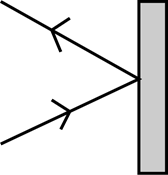
In the illustration, the light ray striking the object is-
11-16.
Answer the questions below after watching the video
What allows us to see objects in a mirror?
Light travels from the object to our eyes after reflecting off the mirror
Because our eyes emit light towards the object
The mirror generates a copy of the object for our eyes to see
Due to the object emitting light directly into our eyes
What is the name of the ray that hits the mirror first?
Normal ray
Incident ray
Direct ray
Reflected ray
How does the angle of incidence compare to the angle of reflection?
It is larger than the angle of reflection
It is smaller than the angle of reflection
It is equal to the angle of reflection
There is no relationship
Why don't all flat surfaces act like mirrors?
Some surfaces absorb all the light
Not all surfaces reflect light
Only mirrors have the special property to reflect light
Light rays scatter in different directions on rough surfaces
What happens to light rays when they hit a rough surface?
They scatter in multiple directions
They reflect at the same angle but in a single direction
They stop moving
They are absorbed by the surface
Does the law of reflection apply to all surfaces?
No, it's a myth
Yes, but only in theory
No, it only applies to mirrors
Yes, but the outcome depends on the surface's smoothness

According to the law of reflection the angle of incidence is ____________ the angle of reflection.
less than
greater than
equal to
What is something you didn't know about mirrors and learned from the lesson?

