
Font size
 Worksheets
Sam's Last Exam
Total questions: 150
Worksheet time: 6hrs 59mins
The weather layer of the atmosphere is ________.
mesosphere
stratosphere
thermosphere
troposphere
The most abundant gas in the atmosphere is ________.
carbon dioxide
argon
nitrogen
oxygen
In which layer of the atmosphere do cloud formation and precipitation occur?
mesosphere
stratosphere
thermosphere
troposphere
In which layer of the atmosphere do airplanes fly to avoid turbulence?
mesosphere
stratosphere
thermosphere
troposphere
________ is a region of highly ionized, or electrically charged, gases.
mesosphere
thermosphere
troposphere
stratosphere
It is the lowest layer of the atmosphere.
stratosphere
mesosphere
thermosphere
troposphere
In which atmospheric layer is the ozone formed?
mesosphere
stratosphere
thermosphere
troposphere
It is essential to maintain the ozone layer in the atmosphere because it ________.
prevent heat loss from the Earth
mixes the gases in the atmosphere
reflect sun's rays back to the atmosphere
absorb most of the ultraviolet radiation that enters the atmosphere
The layer of the atmosphere from top to down are ________.
stratosphere, mesosphere, thermosphere, ionosphere
thermosphere, mesosphere, stratosphere, troposphere
thermosphere, stratosphere, mesosphere, troposphere
troposphere, mesosphere, thermosphere, stratosphere,
Why is the troposhere called the weather sphere?
The troposhere has the densest air.
There is a high concentration of ozone in this layer.
Clouds, precipitation, and storms forms in the troposphere.
Temperature decreases as altitude increases in the troposhere.
The atmosphere is divided into layers based on ________.
density
weather
temperature
altitude
The atmosphere becomes less dense as altitude increases.
True
False
It is layer of the atmosphere where meteors burn up.
thermosphere
mesosphere
troposphere
stratosphere
It is layer of the atmosphere where aurora borealis is formed.
mesosphere
thermosphere
stratosphere
troposphere
It separates the stratosphere from the mesosphere.
mesopause
tropopause
stratopause
none of the above
It serves as a boundary between the troposphere and the stratosphere.
stratopause
tropopause
mesopause
none of the above
In the thermosphere, temperature increases as altitude increases.
True
False
The temperature in the troposphere increases as altitude increases.
True
False
In which layer do you live?
stratosphere
troposphere
mesosphere
thermosphere
What is the composition of the atmosphere?
70% nitrogen and 30% oxygen
78% oxygen, 21% nitrogen, and 1% other gases
78% nitrogen, 21% oxygen, 0.93% argon, 0.04% carbon dioxide, 0.03 other gases
none of the above
What happens to the temperature as you go higher in the troposphere?
A. It increases.
B. It decreases.
C. It stays the same.
D. It increases then decreases.
Which of the following is considered to be as the coldest layer?
A. Ionosphere
B. Mesosphere
C. Stratosphere
D. Thermosphere

Contains molecules that absorb harmful ultraviolet rays.
Troposphere
Stratosphere
Mesosphere
Thermosphere
All of the above.
In the troposphere, the temperature _____ as altitude increases.
Increases
Decreases
Stays the same
Goes up and down


1. Denser air exerts greater pressure against Earth's surface.
true
false
2. As you go up the atmosphere there is less air above you to push you down and exert pressure on you. We can say that air pressure is high at a higher altitude.
true
false

5. Air with low density has greater pressure while air with high density has low pressure.
true
false
Changes in air pressure, temperature, humidity, and wind over a long period of time is...
weather
climate
Changes in air pressure, temperature, humidity, and wind over a short time is...
weather
climate

What represent this image?
weather
weather forecast
weather map
front
A weather _____________________ is a prediction about the future weather conditions of a place.
maps
symbols
forecast
data
PAGASA has just raised typhoon signal number two in Cavite and nearby
provinces. What does this mean? Winds____
Winds up to 60 kph may be expected in the locality.
Winds from 61 to 120 kph may be expected within the next 24 hours.
Winds with a speed greater than 121-170 kph are expected in 12 hours.
Winds with a speed of more than 220kph are expected in at least 18
hours.
Which is a description given by PAGASA during public storm signal no.1?
A. There is widespread damage to high-risk structures.
B. Wind speed of 30-60 km/hour may be expected in at least 36 hours.
C. Classes in the elementary and high school level are automatically suspended.
D. Moderate to heavy damage may be experienced particularly in the agricultural and industrial sector.
Which of the following is the effect of very strong winds of public storm warning signal # 4 on the transportation system?
A. Travels by air and sea are cancelled.
B. Travel by sea is allowed but not on the air.
C. Travel by air is allowed but not on the sea.
D. It is safe to travel both by air and on the sea.
Typhoons which are under PSWS # ___ are known to be deadly and destructive.
PSWS #1
PSWS #2
PSWS #3
PSWS #5
Which of the following weather events can have wind speeds exceeding 74 mph (119 km/h)?
Thunderstorm
Tornado
Tropical cyclone
PAGASA has just raised PSWS No. 3 in Metro Manila and neighboring provinces. What does this mean?
Winds up to 60 kph may be expected in the locality.
Winds from 60 – 100 kph may be expected within the next 24 hours.
Winds with a speed of 100 – 185 kph are expected in the area in at least 18 hours.
Winds with a speed greater than 185kph are expected to hit the area in at least 12 hours.
A Typhoon winds with 171—220kph expected within 12 hours. Everyone is advice to be in the evacuation area for those who are in the high-risk area.
Signal No. 1
Signal No. 2
Signal No. 3
Signal No. 4
Why does warm air rise?
Because it's less dense than cold air.
Because it's more massive than cold air.
Because it has a smaller volume than cold air.
Because it has more energy than cold air.
What is the name of the weather instrument that measures the direction of the wind?
Wind Vane
Anemometer
Thermometer
Barometer


Relative Humidity
Mixing Ratio
Dew Point Temperature
Wet-bulb Temperature
colder air = higher humidty
warmer air = higher humidity
What is absolute humidity ?
This phrase means "rain."
Cumulo
Cirrus
Strato
Nimbo
This phrase is referred to as "puffy" or "fluffy."
Cumulo
Cirrus
Strato
Nimbo
How are air masses form into clouds? Clouds are form when
cold moist air rises and then cools
warm moist rises, expands and then cools
cold air reaches the lifted condensation level

How does an Cirrus cloud look?
featureless sheets of clouds
low, gray rain clouds
wispy, stringy clouds
puffy, lumpy looking clouds

altocumulus
cumulonimbus
cirrus

stratocumulus
nimbostratus
cumulonimbus

stratus
cumulus
cirrus

What is the direction of the cool sea breeze during a land breeze?
From the land towards the sea
From the sea towards the land
From the sea upwards
From the land downwards

During a land breeze, what causes the air to rise?
The cool air from the sea
The warm land surface
The sun heating the sea
The moon's gravitational pull

What time of day does a land breeze typically occur?
Noon
Evening
Morning
Night
What are the two pronounced monsoons in the Philippines?
Luntian and Habagat
Amihan and Habagat
Amihan and Amaya
Alupihan and Bahaghar
We have two wind systems, amihan, and habagat. Which of the following DOES NOT describe amihan?
It brings lots of rain.
It brings cold weather
It comes around July to September.
It comes from the northeast and moves southward.
Which of the following statement is TRUE about habagat?
Amihan is known as the southwest monsoon.
Habagat is known as the northeast monsoon.
From July to October, the habagat comes from the southwest and moves
From October to March the amihan comes from the northeast and moves towards the south.
Why do amihan and habagat bring a lot of rain to the Philippines?
Due to the rotation of the earth.
It is due to the prayers made by farmers.
This is because of the large piece of land near the Philippines.
This is because the wind passes over bodies of water which supply a lot of moisture.
is a belt of low pressure which circles the Earth generally near the equator
PAR
ITZY
ITCZ
Typhoon
It is a device that uses a laser or other light source to determine the height of a cloud ceiling or cloud
base.
Ceilometer
Hygrometer
Anemometer
Barometer
This instrument measure the temperature of the air using graphing paper.
An instrument that records the atmospheric pressure in which pen is attached to aneroid cells that will move vertically are there are changes in the atmospheric pressure.
Barograph
This measures both humidity and air temperatures.
Hygrothermograph
An instrument used to measure the height of the base of the clouds.
Ceiling Light projector
Ceiling Balloon
Why do you think weather forecasts are useful?
Weather forecasts are made by meteorologists.
Weather forecasts do not keep people prepared because they are not correct.
Weather forecasts can help predict weather and keep people prepared by knowing what to wear.
Weather forecasts use technology like radar.
A weather _____________________ is a prediction about the future weather conditions of a place.
maps
symbols
forecast
data
What causes damage in a hurricane/typhoon
Winds
Flooding
Strom Surge
all of the above
PAR stands for?
Philippine Area of Restriction
Philippine Autonomy and Responsibility
Philippine Area of Responsibility
Philippine Authority for Responsibility
SHOW ANSWER
PAGASA stands for?
Philippine Atmospheric, Geographical and Astronomical Services Administration
Philippine Atmospheric, Geophysical and Astronomical Services Administration
Philippine Atmospheric, Geophysical and Astrological Services Administration
Philippine Atmospheric, Geophysical and Astronomical Services Authority
Every year, the Philippines experiences at least how many typhoons?
18
20
25
23
Refer to last question, rearrange the tropical cyclones in ascending order.
A. Super typhoon
B. Severe typhoon
C. Typhoon
D. Tropical depression
E. Tropical Storm
F. Severe tropical storm
A > B > C > F > E > D
D < E < F < C < B < A
E > F > D> C > B > A
C > B > A > D > E > F
Government agency that is tasked to monitor and assess any weather disturbances that enter PAR
PAGASA
PHIVOLCS
DEPED
DOH
Typhoon is locally known as ________________________
baha
ulan
bagyo
buhawi
Tropical cyclones in Northwest Pacific Ocean are called ____________.
Typhoon
Hurricane
Cyclone
Tropical cyclones in North Atlantic Ocean and Northeast Pacific are called ____________.
Typhoon
Hurricane
Cyclone
Tropical cyclones in South Pacific and Indian Ocean are called ____________.
Typhoon
Hurricane
Cyclone
Tropical Cyclone with Maximum Speed kph of 118kph are considered ____________.
Tropical Storm
Typhoon
Super Typhoon
Tropical Cyclone with Maximum Speed kph of 220kph
are considered ____________.
Tropical Storm
Typhoon
Super Typhoon
PSWS #2 has a wind speed of ____________ kph.
30 to 60
62 to 120
121 t o170
Public storm warning signal number 3 is raised in Metro Manila. What does it mean?
Cyclone is coming within the next 24 hours with a center wind of 61 – 120 kph.
Cyclone is coming within the next 18 hours with a center wind of 121 – 170 kph.
Cyclone is coming within the next 12 hours with a center wind of 171 – 220 kph.
Cyclone is coming within the next 12 hours with a center wind of more than 220 kph.
A severe tropical storm is reported in the eastern part of the Philippines. How much wind does it have?
45 – 61kph
62 – 88 kph
89 – 117 kph
118 – 220 kph
2. Classes in all levels are suspended and the wind speed of 121-170 kph are expected in 18 hours. The impact of wind is moderate to heavy damage.
A. PSWS No.1
B. PSWS No.2
C. PSWS No.3
D. PSWS No.4
3. Wind speed of 30-60kph is expected within 36 hours. Classes in preschool are suspended. The impact of wind is no damage to very light damage.
A. PSWS No.1
B. PSWS No.2
C. PSWS No.3
D. PSWS No.4

Which way is the wind blowing in this scenario?
from the north
toward the north
from the west
toward the west

Which way is the wind blowing in this scenario?
from the southeast
toward the southeast
from the southwest
toward the southwest
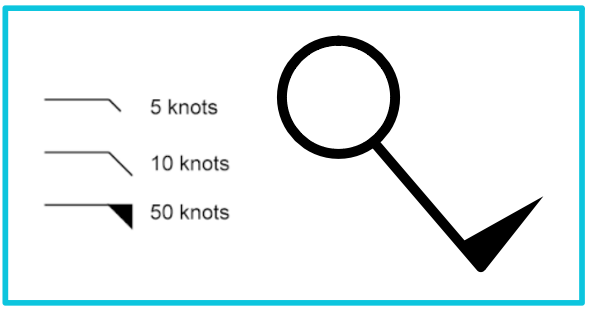
What speed is represented by a triangle?
5 knots
10 knots
50 knots
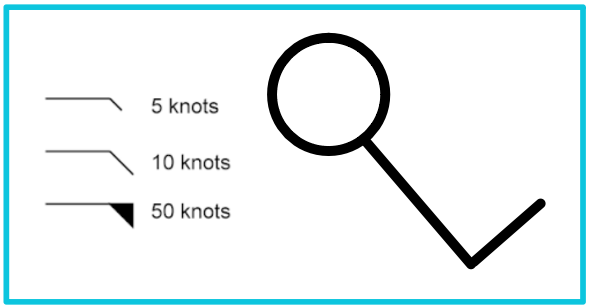
What speed is represented by a longer line?
5 knots
10 knots
50 knots

What speed is represented by a shorter line?
5 knots
10 knots
50 knots

What speed is represented by 1 shorter line and 1 longer line?
5 knots
15 knots
50 knots
55 knots
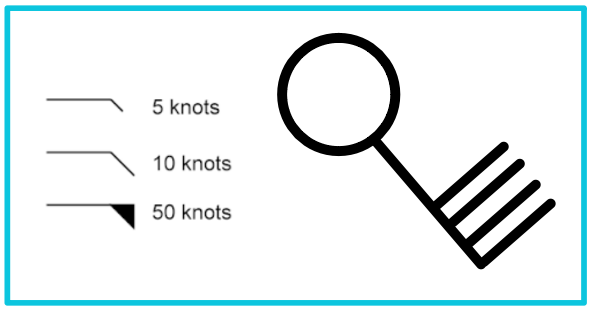
What speed is shown in this symbol?
4 knots
20 knots
10 knots
40 knots

What speed is shown when no "flags" come off the line?
0 knots
1-2 knots

What speed is shown in this symbol?
0 knots
100 knots
there is no speed information shown

What percent cloud cover is shown here?
0.1 = 10% (or less)
0.2-0.3 or 20-30%
0.6 = 60%
0.7-0.8 or 70-80%

What percent cloud cover is shown here?
0.1 = 10% (or less)
0.2-0.3 or 20-30%
0.6 = 60%
0.7-0.8 or 70-80%

What percent cloud cover is shown here?
0.1 = 10% (or less)
0.2-0.3 or 20-30%
0.6 = 60%
0.7-0.8 or 70-80%

What percent cloud cover is shown here?
0.1 = 10% (or less)
0.2-0.3 or 20-30%
0.6 = 60%
0.7-0.8 or 70-80%

What does this part of the station symbol indicate?
present weather
air pressure
temperature
wind speed

What does this part of the station symbol indicate?
air pressure right now
precipitation
air pressure TREND (over last 3 hours)
wind speed

What is the air pressure TREND over the last 3 hours?
falling by 23 nb
rising by 23 nb

What is the air pressure TREND over the last 3 hours?
falling by 19 nb
rising by 19 nb

What does this part of the station symbol indicate?
present weather
air pressure
temperature
wind speed

What type of precipitation is shown here?
hail
snow
fog
smog

What type of precipitation is shown here?
sleet
freezing rain
drizzle
hail

What type of precipitation is shown here?
smog
rain showers
snow showers
thunderstorms

What wind speed and direction is shown here?
10 knots from the West
10 knots from the East
20 knots from the West
20 knots from the East

What wind speed and direction is shown here?
5 knots from the NorthEast
5 knots from the NorthWest
10 knots from the NorthEast
10 knots from the NorthEast

What wind speed and direction is shown here?
0 knots from the SouthEast
0 knots from the SouthWest
1-2 knots from the SouthEast
1-2 knots from the SouthWest
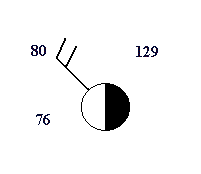
What is the temperature for the following station model?
4 ºF
76 ºF
80 ºF
129 ºF
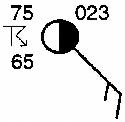
What is the dewpoint for the following station model?
10 ºF
23 ºF
65 ºF
75 ºF
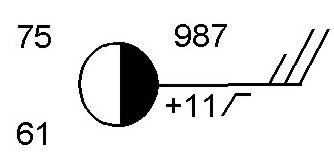
What is the barometric pressure for the following station model?
87 mb
998.7 mb
1098.7 mb
1098 mb
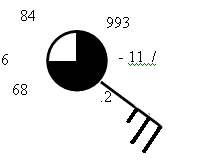
What is the amount of cloud cover for the following station model?
25%
50%
75%
100%

What is the wind direction
Northeast
Northwest
Southeast
Southwest
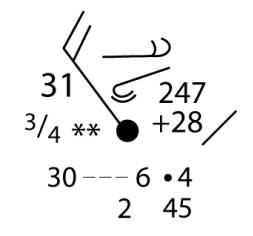


What is the cloud cover?
clear skies
partly cloudy
mostly cloudy
stormy

Choose the best forecast for this model.
It is an overcast day with little wind and temperature of 37
It is a slightly cloudy day, with rain falling and wind coming from the southwest.
It is a blizzard outside, heavy winds, low temperatures, and lots of snow.
The sun is shining and there are no clouds in the sky.

Choose the correct forecast based on this model.
It is an overcast day, with a 61 degree temperature, and no wind
It is a party cloudy day, with a 75 degree temperature and 25 knots of wind.
It's a stormy day with a temperature of 987.
It's a Wednesday and the temperature is positive 11
Choose the best forecast for this station model
It's an overcast day with wind coming from the northwest at 20 knots, and snow is falling.
Its a warm day, with little wind, and no precipitation.
A heavy wind is blowing from the southeast and thunderstorms are expected.
It's an overcast day, with high temperatures and low air pressure.

What is the temperature in degree Fahrenheit?
(a)

What is the dewpoint in degrees Fahrenheit?
(a)

What is the visibility in miles?
(a)

What is the present weather?
(a)

What is the cloud cover %?
- The answer should be a number
(a)

What is the wind direction?
(a)

What is the wind speed?
(a)

What is the barometric pressure?
(a)

How much precipitation has fallen in the last 6 hours?
(a)
On which station model would the present weather symbol * most likely be found?


Which station model shows the correct form for indicating a northwest wind at 25 knots and an air pressure of 1023.7 mb?


What is the present weather?
(a)

What is the cloud cover %?
(a)