
 Worksheets
PERFORMANCE MEASUREMENT
Total questions: 74
Worksheet time: 6hrs 10mins
Which of the following are elements of a mission statement?
(i) Purpose
(ii) Strategy
(iii) Values
(iv) Culture
All of them
(i) and (iii) only
(iii) only
(ii) and (iv) only
An organisation is divided into a number of divisions, each of which operates as a profit centre.
Which TWO of the following would be useful measuresto monitor divisional performance?
Contribution
Controllable profit
Return on investment
Residual income
When measuring performance which of the following could impact the overall results for the business? (i) A new competitor
(ii) A change in local government
(iii) An increase in interest rates
(iv) A change in national government
(i) and (iv) only
None of the above
(ii) and (iv) only
All of the above
Which of the following performance measurements could be a result of government legislation?
Carbon footprint
Retention of customers
Return on capital employed
Capacity ratio
Which of the following statements relating to sustainability is true?
(i) Sustainability involves taking a long‐term view and allowing the needs of present generations to be met without compromising the ability of future generations to meet their own needs.
(ii) Sustainability involves considering the needs of the organisation’s shareholders only.
(iii) Accountants have a public interest duty to protect society as a whole and the organisation’s sustainability
(i) only
(ii) only
(ii) and (iii) only
(i) and (iii) only
Which aspect of an organisation’s performance with respect to sustainability are measured using ‘triple bottom line’ measures?
Economy, effectiveness, efficiency
Economic, social, environmental
Profitability, liquidity, investment
Productivity, activity, profitability
In the last year a division’s controllable return on investment was 25% and its controllable profit was $80,000.
The cost of finance appropriate to the division was 18% per annum. What was the division’s controllable residual income in the last year?
$5,600
$22,400
$74,400
$76,400
A government body uses measures based upon the ‘three Es’ to the measure value for money generated by a publicly funded hospital. It considers the most important performance measure to be ‘cost per successfully treated patient’.
Which of the three E’s best describes the above measure?
Economy
Effectiveness
Efficiency
Externality
A government is looking at assessing hospitals by reference to a range of both financial and non‐financial factors, one of which is survival rates for heart by‐pass operation.
Which of the three E’s best describes the above measure?
Economy
Effectiveness
Efficiency
Externality
Which of the following measures would not be appropriate for a cost centre?
Cost per unit
Contribution per unit
Comparison of actual labour cost to budget labour cost
Under or over absorption of overheads
A government is looking at assessing state schools by reference to a range of both financial and non‐financial factors, one of which is average class sizes.
Which of the three E’s best describes the above measure?
Economy
Effectiveness
Efficiency
Externality
For operational purposes, for a company operating a fleet of delivery vehicles, which of the following would be most useful?
Cost per mile run
Cost per driver hour
Cost per tonne mile
Cost per kg carried
A division has a residual income of $240,000 and a net profit before imputed interest of $640,000. If it uses a rate of 10% for computing imputed interest on its invested capital, what is its return on investment (ROI) to the nearest whole number?
4%
10%
16%
27%
JKL Inc budgeted to make 1,000 unitsin May using 2,000 hours of direct labour. Actual output was 1,100 units which took 2,300 hours.
What is the production/volume ratio?
91%
105%
110%
115%
RL Inc budgeted to make 200 unitsin June with a standard labour usage of 0.6 hours per unit. Actual output was 180 units which took 126 hours.
What is the efficiency ratio?
86%
90%
105%
116%
CAP Inc budgeted to make 50 units in July with a standard labour usage of 1.2 hours per unit. Actual output was 49 units which took 61 hours.
What is the capacity ratio?
96%
98%
100%
102%
HH plc monitors the % of total sales that derives from products developed in the last year.
Which part of the balanced scorecard is this measure classified under?
Financial perspective
Customer perspective
Internal business process perspective
Innovation and learning perspective
Which of the following KPIs would be used to assess the liquidity of a company?
(i) Return on capital employed
(ii) Gross profit percentage
(iii) Acid test ratio
(iv) Gearing ratio
(i) and (ii) only
(iii) only
(iv) only
(iii) and (iv) only
K Class has calculated the following indictors
(i) Return on capital employed
(ii) Training costs as a percentage of total costs
Which of the balanced scorecard perspectives would these measures relate to?
Financial
Financial
Financial
Internal business process
Internal
Innovation and learning
Financial
Innovation and learning
Area 27 are a pizza delivery company and have asked you to suggest some performance indicators that could be used to measure the customer perspective and the internal business process perspective of the balanced scorecard.
Which of the following would be appropriate?
Number of customer complaints
Time taken from order to delivery pizza
Cost per pizza
Cost of time spent on training
Number of late deliveries
Profit per pizza
Cost of delivery vehicles
Gross profit percentage

What is the company’s current ratio (to the nearest two decimal places)?
1.48
1.41
1.96
1.02

What is the company’s quick ratio (to the nearest two decimal places)?
1.41
1.02
1.48
1.30
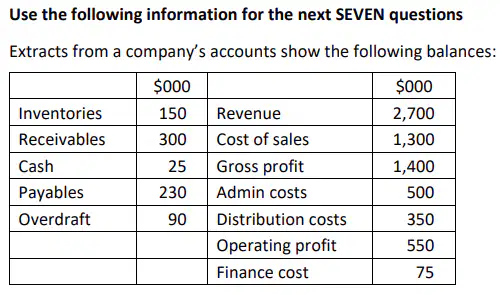
What is the receivables’ collection period in days (to the nearest day)?
41 days
84 days
78 days
45 days
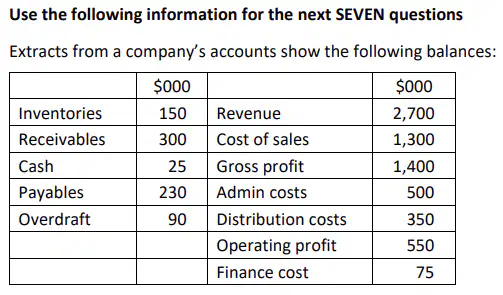
What is the payables’ payment period in days (to the nearest day)?
31 days
65 days
60 days
35 days
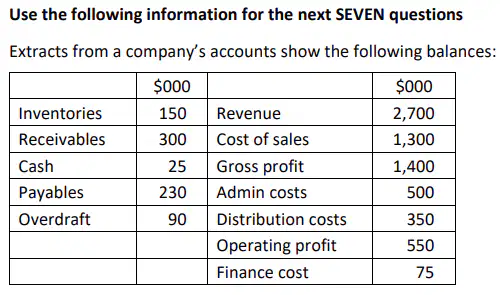
What is the inventory holding period (to the nearest day)?
4 days
10 days
24 days
42 days
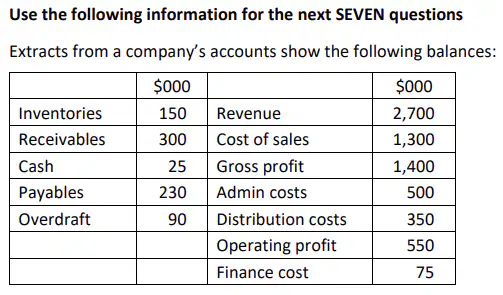
What is the return on sales for the company?
52%
39%
20%
25%
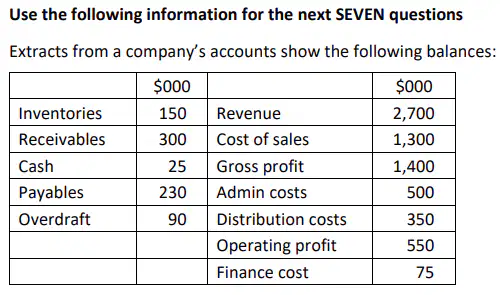
What is the interest cover of the company?
4.67 times
5.67 times
7.33 times
6.50 times
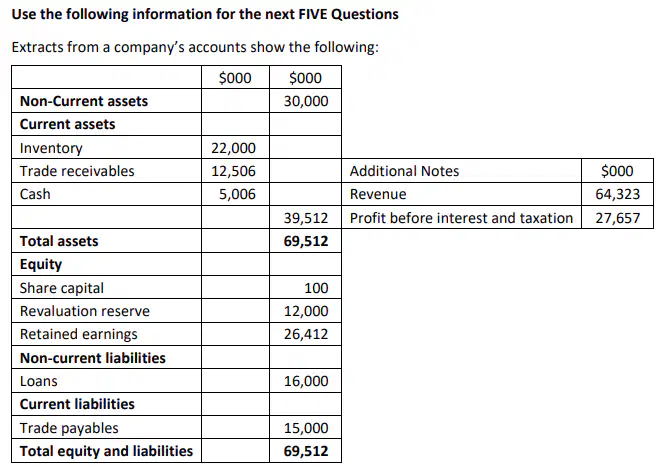
What is the gearing ratio (total debt/equity) of the company?
44.3%
41.5%
60.6%
57.1%
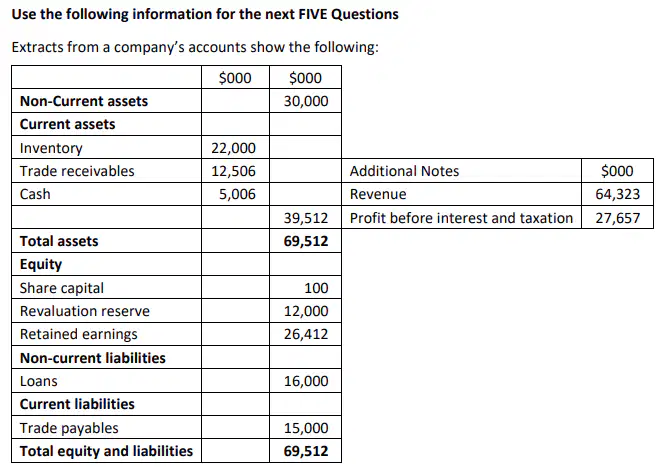
What is the company’s current ratio (to the nearest two decimal places)?
2.63
1.27
1.61
1.17
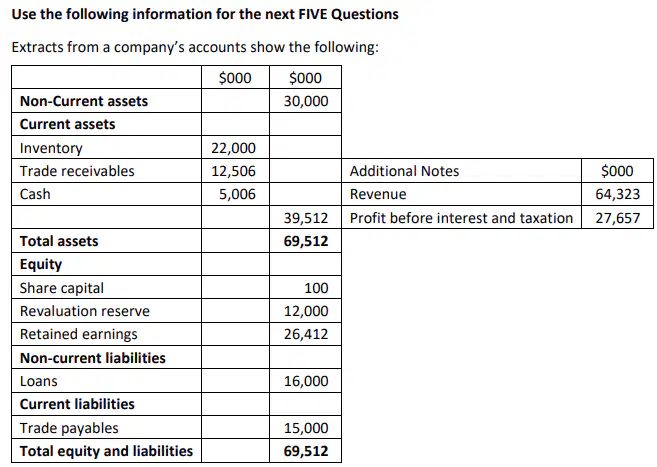
What is the company’s quick ratio (to the nearest two decimal places)?
0.83
1.27
1.17
2.57

What is the ROCE of the company (return on capital employed)?
72%
92%
47%
51%
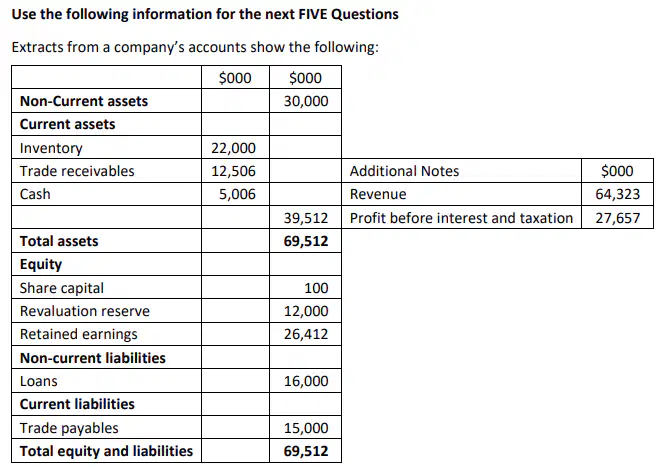
What are the receivables collection period of the company (to the nearest whole day)?
14 days
18 days
71 days
90 days
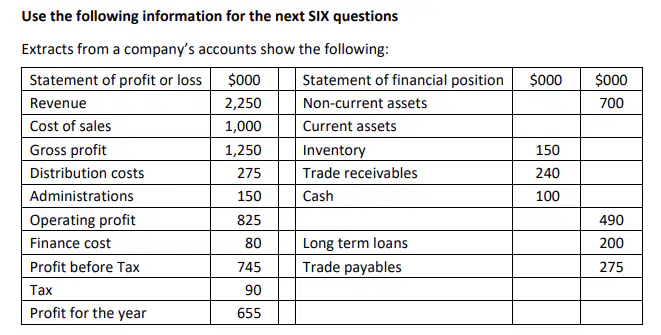
What is the gross profit margin?
55.6%
36.7%
33.1%
29.1%
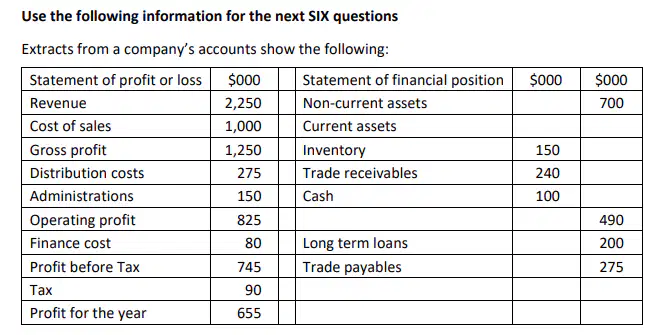
What is the return on sales?
55.6%
36.7%
33.1%
29.1%
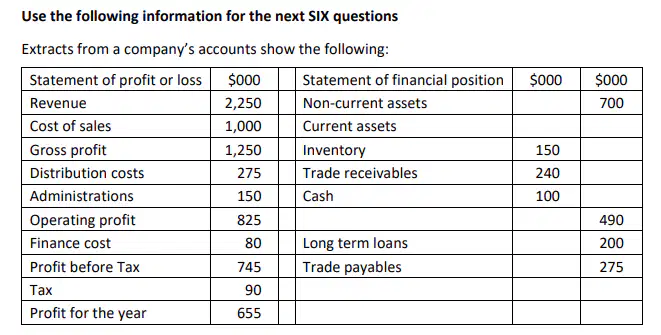
What is the current ratio?
1.2
0.9
1.4
1.8
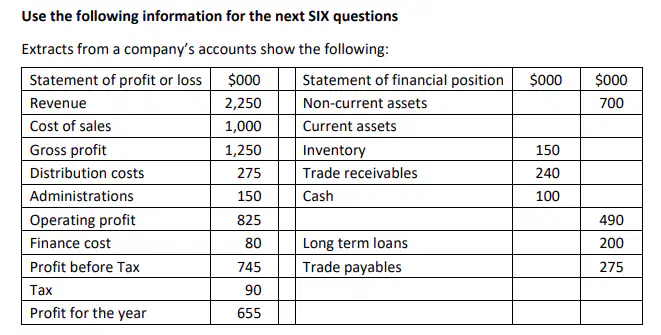
What are the receivables collection period in days?
88 days
80 days
70 days
39 days
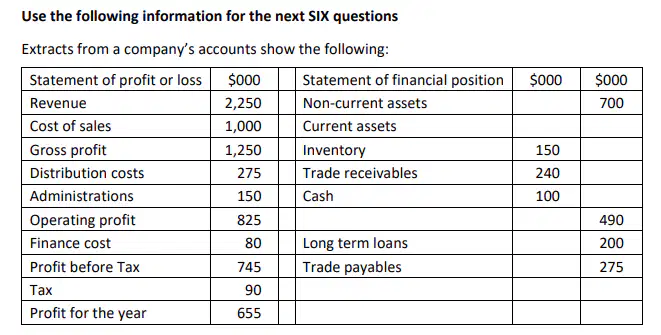
What are the payable payment period in days?
100 days
80 days
143 days
45 days
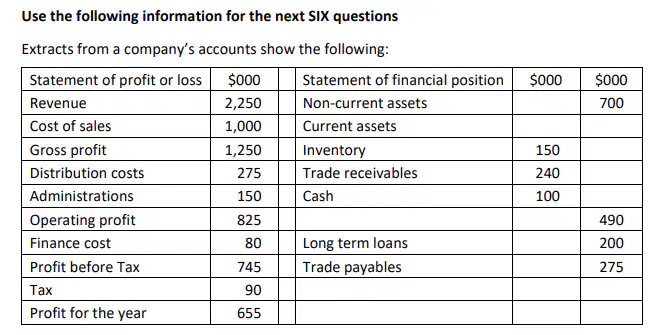
What is the inventory holding period in days?
24 days
55 days
44 days
66 days
A division has a residual income of $50,000 and a net profit before imputed interest of $80,000.
If it uses a rate of 10% for computing imputed interest on its invested capital, what is its return on investment (ROI) to the nearest whole number?
4%
10%
16%
27%
A division of a company has capital employed of $2m and its return on capital is 12%. It is considering a new project requiring capital of $500,000 and is expected to yield profits of $90,000 per annum. The company’s interest rate is 10%.
If the new project is accepted, what will the residual income of the division be?
$40,000
$80,000
$30,000
$330,000
The following information relates to a small production unit during a period:
Budgeted hours 9,500 hours
Actual hours worked 9,200 hours
Standard hours of work produced 9,300 hours
What is the efficiency ratio for the period?
97%
98%
99%
101%
A company makes a product for which the standard labour time is 2 hours per unit. The budgeted production hours for a given week were 820. During the week the production staff were able to produce 380 units of product. Staff worked and were paid for 800 hours. During the week 20 production hours were lost due to a shortage of material.
What is the efficiency ratio?
95.00%
95.12%
97.44%
97.50%
A company has calculated that its activity ratio is 103.5% and that its efficiency ratio is 90%. What is the capacity ratio?
86.96%
93.15%
115.00%
193.50%
How is the activity (production volume) ratio calculated?
Actual hours ÷ Budgeted hours
Budgeted hours ÷ Actual hours
Standard hours for actual output ÷ Actual hours
Standard hours for actual output ÷ Budgeted hours
The direct labour capacity ratio for a period was 104%.
What could have caused this?
Actual hours worked being greater than budgeted hours
Actual hours worked being less than budgeted hours
Standard time for actual output being greater than budgeted hours
Standard time for actual output being less than budgeted hours
Green division is one of many divisions in the Colour group. At its year‐end, the non‐current assets invested in Green were $30 million, and the net current assets were $5 million. Included in this total was a new item of plant that was delivered three days before the year end. This item cost $4 million and had been paid for by Colour, which had increased the amount of long‐term debt owed by Green by this amount. The profit earned in the year by Green was $6 million before the deduction of $1.4 million of interest payable to Colour.
What is the most appropriate measure of ROI for the Green division?
13.1%
14.8%
17.1%
19.4%
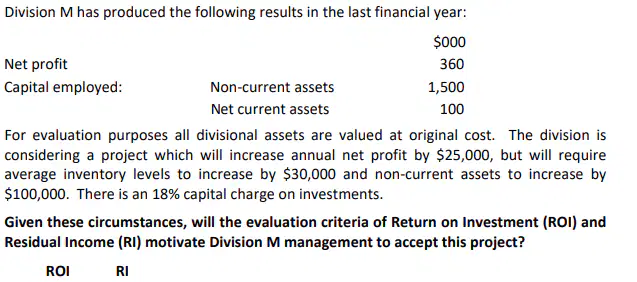
Yes Yes
Yes No
No Yes
No No
Which TWO of the following performance indicators could be used to measure the quality of a service?
Number of customer complaints
Customer retention
Overtime worked
Number of sick days
Which balanced scorecard perspective would the performance indicator ‘Training costs as a % of total costs’ come under?
Financial
Customer
Innovation and learning
Internal business process
A company wants to measure performance under the ‘Internal business process’ perspective of the balanced scorecard. Which of the following would be an appropriate measure?
ROI
Warranty claims
New products developedNew products developed
Labour capacity ratio

(a)
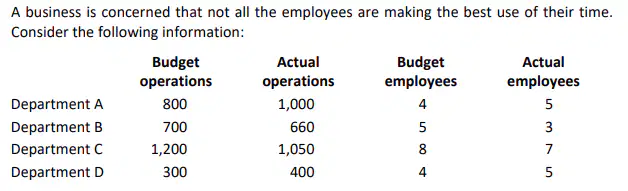
Which department is making the best use of the employees’ time when compared to budget?
A
B
C
D
Quality control costs can be categorised into internal and external failure costs, inspection costs and prevention costs. In which of these four classifications would the following costs be included?
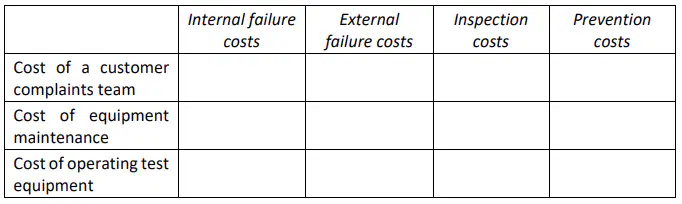
In the context of quality costs, what would customer compensation costs and test equipment running costs be classified as?
Internal failure costs Prevention costs
Internal failure costs Appraisal costs
External failure costs Appraisal costs
External failure costs Prevention costs
A customer returns a faulty product to a firm for repair under a warranty scheme. The firm operates a total quality management system.
Which of the following best describes the cost of the repair?
An internal failure cost
An external failure cost
An appraisal cost
A prevention cost
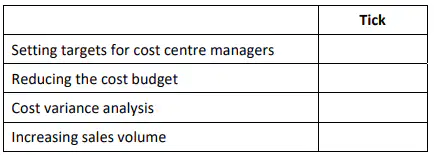
Which two of the following could be used to control costs?

Value analysis looks to do which of the following?
Which of the following is defined as ‘the body of knowledge concerned with the analysis of the work methods and the equipment used in performing a job, the design of an optimum work method and the standardisation of proposed work methods’?
Work study
Work measurement
Job study
Method measurement

Which of the following relates to Value analysis and which to value engineering?
Which of the following techniques would be useful for controlling costs?
(i) Actual versus flexed budget
(ii) Variance analysis
(iii) Trend of costs analysis
(i) and (ii) only
(i) and (iii) only
(ii) and (iii) only
(i), (ii) and (iii)
Copenhagen is an insurance company. Recently there has been concern that too many quotations have been sent to clients either late or containing errors. The department concerned has responded that it is understaffed, and a high proportion of current staff has recently joined the firm. The performance of this department is to be carefully monitored.
Which of the following non‐financial performance indicators would NOT be an appropriate measure to monitor and improve the department’s performance?
Percentage of quotations found to contain errors when checked
Percentage of quotations not issued within company policy of three working days
Percentage of department’s quota of staff actually employed
Percentage of budgeted number of quotations actually issued
A company wants to encourage an investment centre to make new investments. Performance measurement using which of the following KPIs would achieve this?
ROI
ROCE
RI
IRR
Why would a company want to encourage the use of non‐financial performance indicators?
To encourage short termism
To look at the fuller picture of the business
To enable results to be easily manipulated to the benefit of the manager
To prevent goal congruence
Which of the following is not a type of benchmarking?
Internal
Strategic
International
Functional
In a responsibility accounting system which of the following costs is LEAST likely to appear on the performance report for the manager of a production department?
Cost of direct labour
Rent of machinery
Repairs to machinery
Cost of materials used
In a responsibility accounting system for which of the following should the purchasing manager be held responsible?
Raw material prices
Raw material usage
Labour hours worked
Labour wage rates
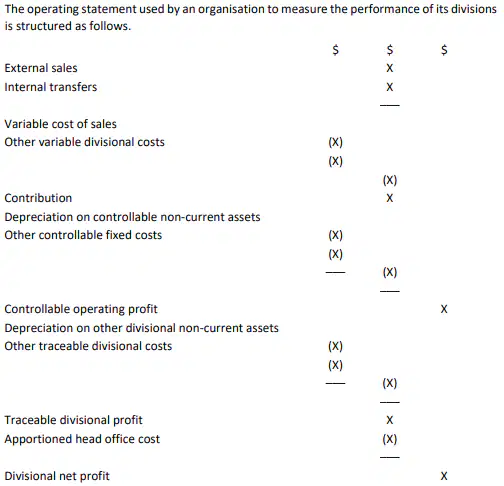
Which of the following would provide the best basis for measuring the performance of a manager of an investment centre?
Contribution
Controllable operating profit
Traceable divisional profit
Divisional net profit
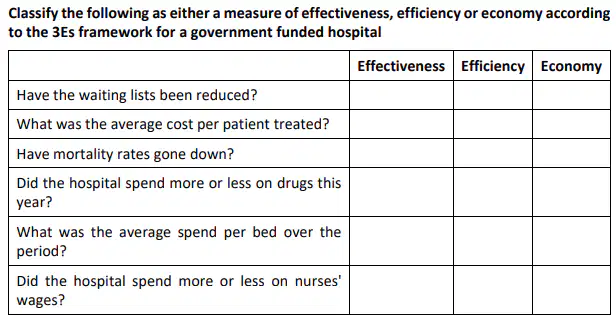

Effectiveness
Economy
Ethics
Efficiency
Which of the following statements are correct?
Non‐financial performance indicators can be used easily to compare one organisation to another
Financial performance indicators encourage a long‐term view of performance
Financial performance indicators provide all the analysis of progress needed
Non‐financial performance indicators are difficult to determine
How can short‐termism be prevented?
Focus performance measurement on financial performance only
Focus performance measurement on non‐financial performance only
Focus performance measurement on both financial and non‐financial performance
Create budgets for more than one year at a time
The management process which involves comparison of competences with best practice within and outside the organisation is known as?
Balanced scorecard
Benchmarking
Productivity
Resource analysis
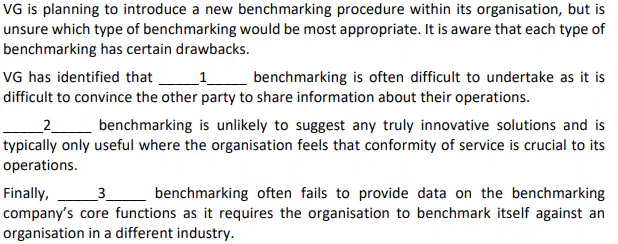
Which of the options below can be used to fill in the missing words in gaps 1, 2 and 3?
A Functional
B Internal
C Competitive
(a)
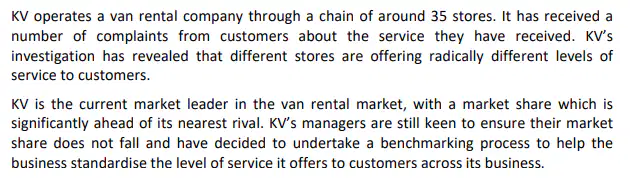
Which type of benchmarking would be most appropriate for KV to adopt?
Functional
Strategic
Competitive
Internal

