
 Worksheets
NOCTI: Electrical Construction #3
Total questions: 96
Worksheet time: 58mins
What is the primary reason for locking out and tagging out circuits before working on them?
To prevent accidental machine operation
To improve the efficiency of the work
To check the functionality of the circuit
To increase the voltage in the circuit
Which of the following is NOT a recommended safety practice when working with electrical installations?
Using insulated tools
Wearing rubber gloves and boots
Working on live circuits
Keeping the work area dry
What is the purpose of using a conduit in electrical wiring?
To enhance the aesthetic appearance of the installation
To protect wires from mechanical damage
To increase the current carrying capacity of the wire
To reduce the cost of wiring
When installing a new electrical outlet, what is the first step?
Connect the wires to the outlet
Turn off the power to the circuit
Cut the wires to the appropriate length
Test the outlet with a voltage tester
Which tool is essential for troubleshooting a circuit that repeatedly blows fuses?
Hammer
Multimeter
Screwdriver
Pliers
What does it mean if a circuit breaker keeps tripping?
The circuit is perfectly fine
There is likely an overload in the circuit
The circuit breaker is of high quality
The electrical panel is outdated
According to the National Electrical Code (NEC), what is the minimum allowable wire size for most household circuits?
18-gauge
14-gauge
12-gauge
16-gauge
What must be done when a wiring installation does not comply with local electrical codes?
It must be left as is
It must be reported to the authorities
It must be corrected to meet the standards
It must be inspected more frequently
Why is it important to ensure all connections are tight during an installation?
To prevent energy efficiency
To reduce the risk of fire
To increase the resistance in the circuit
To make the installation look neat
What is the best practice for ensuring that an electrical panel is safe to work on?
Check that all breakers are in the "on" position
Ensure the panel is free of dust and debris
Verify that the main breaker is turned off
Label all circuits accurately
In a parallel circuit, if one bulb burns out, what happens to the other bulbs?
All other bulbs will also burn out.
All other bulbs will become brighter.
All other bulbs will stay lit at the same brightness.
All other bulbs will turn off but not burn out.

What is the unit of voltage?
volts
watts
amps
ohms
What is the unit of resistance?
ampere
watt
ohm
volt
What voltage is necessary to produce a current of 200 amperes through a resistance of 100 Ω?
What resistance would produce a current of 120 amps from a 6-V battery?
What tool is used to strip insulation from electrical wires?
Hammer
Pliers
Screwdriver
Wire strippers
What is the purpose of leaving a service loop of extra wire at outlet or switch boxes?
To connect additional devices
To allow for future adjustments or repairs
To reduce the amount of wire needed
To make the wiring look neater
Required by code in potentially wet locations. (stops the current) when short circuit occurs.
Three way switch
Double pole switch
GFCI
Single pole switch

Match the following

motor

transformer

junction box

ground connection

lighting panel

What electrical symbol is this?
smoke detector
storm drain
phone jack
dishwasher

What electrical symbol is this?
smoke detector
220V outlet
110V outlet
light switch

What electrical symbol is this?
phone
fan
light
smoke detector

Where would you need this type of outlet?
laundry
bathroom
garage & outside
all of the above

This is a GFI Outlet:
true
false
Match the following

Controls 1 path

Controls 2 paths, one at a time

Controls 2 paths at same time

Controls 4 paths, 2 at a time

Controls multiple paths, 1 at a time.
Label the symbols
Ground
Switch
Battery
Fuse
Relay
Motor

Identify the picture.
Junction Box
Weatherproof duplex receptacle outlet
Ceiling Fixture
Single Receptacle outlet

Identify the picture.
Drop cord Fixture
Ceiling Fixture
Single-pole switch
Junction Box

Identify the picture.
Three-way switch
Single-pole switch
Double-pole switch
Four-way switch

Identify the picture.
Triplex receptacle outlet
Single receptacle outlet
Ceiling fixture
Duplex receptacle outlet

Identify the picture.
Three-way switch
Double-pole switch
Weatherproof switch
Low-voltage switch

Identify the picture.
Junction box
Fluorescent fixture
Telephone
240-volt receptacle outlet

Identify the picture.
GFCI receptacle outlet
Weatherproof duplex receptacle outlet
Triplex receptacle outlet
Single receptacle outlet

What is the name of this component?
fuse
cell
wire
bell

What is the name of this component?
fuse
cell
motor
lamp
The government organization whose purpose is to set and enforce worksite safety and health standards is:
OSHA (Occupational Safety Health Administration)
EEOC (Equal Employment Opportunity Commission)
NLRB (National Labor Relations Board)
OPM (Office of Personnel Management)
In residential structures, GFCI is required in
living rooms
bedrooms
dining rooms
kitchens
What article in the National Electrical Code covers motors, motor branch-circuit and feeder conductors and their protection?
Article 430
Article 440
Article 450
Article 500
The transformer winding to which the line is connected is called the ________ winding.
primary
field
voltage
current
The winding ratio of a ________ transformer has a rating of 3:1 winding ratio.
neutral
step-down
step-up
control
What is the resistance total for a 560 ohm, 1 k ohm, and a 3.3 k ohm resistor in series?
323.76 ohms
1,327 ohms
4,860 ohms
13,860
A _______ fire extinguisher should be used on an electrical fire.
Class A
Class B
Class C
Class D
What safety practice is used to prevent equipment from being energized?
pump
lockout/tagout
remove fuse
off switch
An ohmmeter is used to measure
current
voltage
resistance
power
Which of the following is used to measure a current?
ohmmeter
ammeter
wattmeter
voltmeter
In an AC circuit, if resistance remains the same and voltage is doubled, then current
reduces by half
remains the same
is doubled
increases fourfold
If the voltage source supplies 260 volts and the resistance measures 5 ohms, the current is
28 amps
36 amps
48 amps
52 amps

In the DC circuit below, if R5 burns open, the total current
increases
decreases
remains the same
goes to zero
Every digital multimeter can measure three basic things - current, voltage, and
capacitance
sinusoidal
resistance
pulse

Where is the resistor located on this diagram?
A
C
D
B
The proper angle for setting up a ldder is to place the basea/an ____ of the working length of the ladder from the wall or other vertical surface.
sixteenth
eighth
quarter
third
The MINIMUM amount of free wire that must be left in a workbox is
2 inches
4 inches
6 inches
8 inches
Non-metallic sheathed cable must be supported ____ from every outlet or junction box.
4 inches
8 inches
12 inches
16 inches

Pliers
wire strippers
side cutters
wire tester
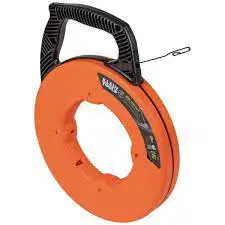
Filing pole
Wire puller
Fish tape
Wire Holder
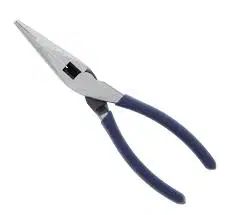
Long pliers
Needle nose
Pliers
Vise grib

Side cutters
Angle cutters
pliers
Lineman pliers

Lineman pliers
pliers
needle nose pliers
side cutters

screwdriver
Philips screwdriver
Allen wrench
Flat head
What is the primary advantage of using LED lighting over incandescent bulbs?
LEDs have a shorter lifespan.
LEDs generate more heat.
LEDs are less energy-efficient.
LEDs have a longer lifespan and are more energy-efficient.
What is the function of a circuit breaker in an electrical system?
To convert AC to DC.
To decrease the resistance in the circuit.
To interrupt the circuit in case of excessive current, preventing damage.
To increase the voltage supply to the circuit.
How does a diode function in an electrical circuit?
By allowing current to flow in both directions equally
By converting electrical energy into light
By storing electrical energy for later use
By allowing current to flow in only one direction
What is the primary function of a fuse in an electrical circuit?
To increase the current flow
To decrease the resistance
To interrupt the circuit in case of excessive current
To convert AC to DC
What safety precautions should be followed when working with electricity?
Wearing sunglasses
Swimming while working with electricity
Using wet hands
Follow safety precautions such as wearing PPE, grounding equipment, avoiding water, using insulated tools, and turning off power.
Explain the concept of electrical power and how it is calculated.
Electrical power is not related to voltage or current.
Electrical power is measured in volts.
Electrical power is calculated by multiplying the voltage (V) across the circuit by the current (I) flowing through it using the formula P = V * I.
Electrical power is calculated by dividing the voltage by the current.
What is the role of a transformer in electrical circuits?
To convert electrical energy into heat
To transfer electrical energy between circuits through electromagnetic induction and adjust voltage levels.
To store electrical energy in batteries
To generate electricity from mechanical energy
What is the purpose of a ground wire in an electrical system?
To prevent electrical current from flowing through the system
To regulate the voltage in the system
To increase the resistance in the circuit
To provide a path for excess electrical current to flow into the ground
What does AC stand for in electrical terms?
Amplified Current
Alternating Current
Analog Converter
Advanced Circuit
In general, a beginning tradesperson with little or no experience in the field
A class 5 technician
An apprentice
A laborer
A journeyperson
The NEC requires two grounding electrode rods to be placed in the ground a minimum of ____ apart
2 feet
3 feet
4 feet
6 feet
What is the minimum distance between straps on service entrance conductors?
12 inches
30 inches
4 1/2 feet
6 feet
What is the MINIMUM working space width required at the service panel?
16 inches
24 inches
30 inches
36 inches
Service conductors should have a clearance of not less than ___ from doors and windows designed to open
12 inches
16 inches
24 inches
36 inches
According the the NEC, a continuous load is one where the maximum current is expected to continue for ___ or more hours
3 hours
4 hours
6 hours
8 hours
The MINIMUM clearance of ___ must be maintained between overhead service conductors and residential driveways
10 feet
12 feet
14 feet
16 feet
The safety feature that completes an electric current and carries the current safely away
direct current
circuit breaker
grounding
alternating current

Which choice best identifies the hazard?
The cabinet is colored light blue.
Nothing. It looks good to me.
Unattended fire extinguisher
Locked cabinet door
When the insulation on an extension cord is damaged, you should:
Use duct tape to repair it
Do nothing
Remove it from service immediately
Touch the conductors to see it they are energized
A “Lock-out/Tag-out” system is used to:
Keep people from stealing your tools
Prevent accidental contact with electric current
Keep you from completing the work
Another step to your work

Define direct current (dc).
Current that reverses direction periodically
Current that flows in one direction only
Current that varies in magnitude
Current that flows in multiple directions

What is the term used to describe the number of cycles per second in an alternating current?
Amplitude
Frequency
Wavelength
Velocity
Who publishes the NEC?
How many chapters in the NEC?
9
Match the Chapter/Article to in topic
NEC Article 100
Common definitions
Chapter 2
Wiring & Protection
NEC Article 200
Use & ID of grounded conductors
Chapter 3
Wiring Methods & Materials
NEC Article 300
General requirements wiring methods
What article in the National Electrical Code covers motors, motor branch-circuit, and feeder conductors and their protection?
Article 421
Article 930
Article 430
Article 429
What article in the National Electrical Code covers Wiring and Protection?
Chapter 2
Chapter 3
Chapter 4
Chapter 5
What article in the National Electrical Code covers Wiring Methods and Materials?
Chapter 2
Chapter 3
Chapter 4
Chapter 5
How often is the NEC updated?
Every year
Every two years
Every three years
Every five years
Mandatory and permissive rules are defined in
NEC article 90
NEC article 100
NEC article 110
NEC article 200
How far should outlet receptacles be from a hot tub or spa?
Less than 3 feet
Between 3 and 6 feet
Between 6 and 9 feet
More than 9 feet
Is underground wiring allowed under a pool or spa?
Yes
No
The term approved means to be
a. listed by a Nationally Recognized Testing Laboratory (NRTL)
b. acceptable to the National Electrical Code
c. acceptable to the architect or engineer designing the job
d. acceptable to the authority having jurisdiction
The black-colored common terminal on a three-way switch should always have a __________ insulated wire connected to it.
white
black
red
any colored insulated wire is permitted
Which type of outlet is required by code for kitchen countertops?
Standard outlet
GFCI outlet
AFCI outlet
USB outlet