
 Worksheets
Physics Final S2
Total questions: 62
Worksheet time: 13hrs 43mins

The diagram below represents a transverse wave passing through a medium from left to right. Which of the following diagrams best represents the direction of vibration of the particles of the medium?


Waves X and Y are moving through identical materials. When wave X moves through the material, the particles in the material move up and down. When wave Y moves through the material, the particles in the material move from side to side. What can be determined about the waves?
Wave X is a longitudinal wave and wave Y is a longitudinal wave.
Wave X is a transverse wave and wave Y is a longitudinal wave.
Wave X is a longitudinal wave and wave Y is a transverse wave.
Wave X is a transverse wave and wave Y is a transverse wave.
Which of the following are examples of longitudinal waves? Select all that apply
A speaker playing music
A compression moving through a spring
Light rays travelling from the Sun to the Earth
An X ray providing an image of a broken bone
A source of waves and an observer are both initially stationary. The observer will detect a steadily increasing frequency if which of the following occurs?
He accelerates toward the source.
He moves toward the source at a constant speed.
The source accelerates away from him.
The source moves away from him at a constant speed.

The diagram below represents the letter P in front of a plane mirror. Which of the following diagrams best represents the image of P produced by the plane mirror?


A ray of light strikes a mirror at an angle of incidence of 60°. What is the angle of reflection?
0°
30°
60°
90°

The diagram below represents a light ray in air incident on a crown glass block. What will happen to the light ray when it enters the crown glass block?
It will slow down and bend toward the normal.
It will speed up and bend toward the normal.
It will slow down and bend away from the normal.
It will speed up and bend away from the normal.
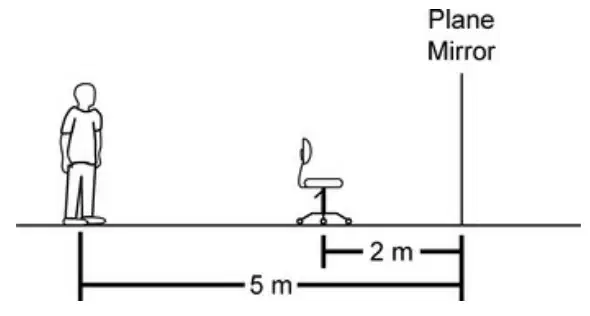
The diagram below represents a person standing 5 meters from a plane mirror and a chair located 2 meters from the mirror. What is the distance between the person and the image of the chair he observes through the mirror?
2 m
3 m
7 m
10 m
An object 0.2 meter tall is located 0.5 meter from a converging lens with a focal length of 1.0 meter. How far from the lens is the image?
A. 0.01 m
B. 0.2 m
C. 0.5 m
D. 1.0 m
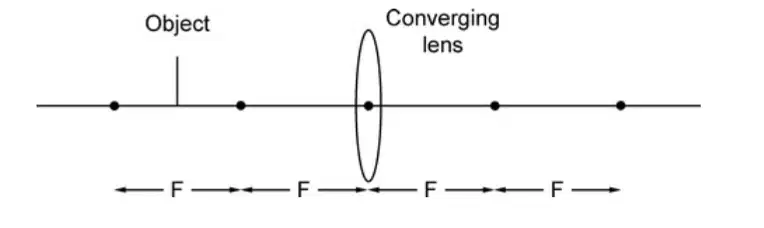
The diagram below depicts a converging lens of focal length F and an object placed between 1 and 2 focal lengths from the lens. Which of the following best describes the image of the object produced by the lens?
A. Virtual and erect
B. Real and inverted
C. Real and erect
D. Virtual and inverted
An object is located 0.12 meter to the left of a converging lens of focal length 0.080 meter. Where is the image located?
A. 0.12 m to the right of the lens
B. 0.20 m to the left of the lens
C. 0.24 m to the left of the lens
D. 0.24 m to the right of the lens

Read the passage and use the diagram which represents an object placed at point O, located 1.0 meter from a convex lens of focal length F = 0.50 meter, to answer the question: What is the distance between the lens and the image?
0.25 m
0.50 m
1.0 m
1.5 m
A converging lens is used to produce an image of an object. The distance from the object to the lens is twice the distance from the image to the lens. If the object is 0.050 meter tall, what is the size of the image?
0.010 m
0.020 m
0.025 m
0.050 m

Based on the diagram provided, which represents an object 0.20 meter from a converging lens with a focal length of 0.15 meter, this lens is a (a) lens, also known as a (b) lens.

What is the distance of the image (di) from the lens? Round to one decimal place.
0.6 m
1.2 m
0.2 m
0.1 m

What is the magnification of the image?
-3
6
-0.5
1
Which of the following are conductors?
Gold
Copper
Glass
Rubber
Wood
What is Ohm's Law?
(a) = (b) x Resistance
Mass
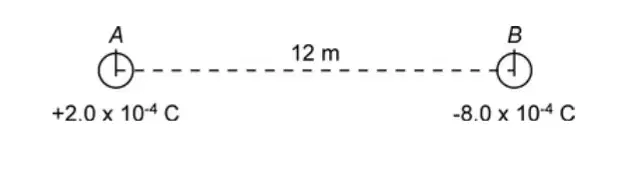
Use the diagram depicting two charged metal spheres with equal radii to answer the following question: What is the magnitude of the electrostatic force exerted on sphere A?
1.1 x 10^-9 N
1.3 x 10^-8 N
10. N
120 N

This is a ______ circuit.
Series
Parallel
Complex

The total resistance of this circuit is ______ Ohms.
3
4
0.33
0.25

What is the potential difference across R2?
A. 2.5 V
B. 5.0 V
C. 7.5 V
D. 10 V
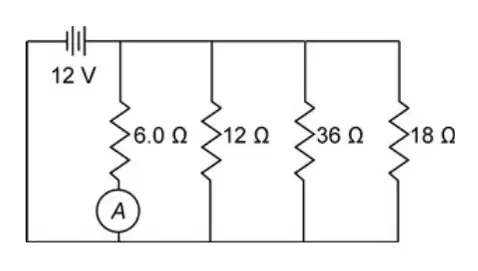
Use the diagram of an electric circuit consisting of four resistors and a 12-volt battery to answer the question: What is the equivalent resistance of this circuit?
A. 0.33 ohm
B. 3.0 ohms
C. 18 ohms
D. 72 ohms

Use the diagram of an electrical circuit consisting of an ammeter A, 12-ohm resistors R1 and R2, and a 24-volt power source to answer the question: What is the combined resistance of resistors R1 and R2?
A. 2.0 ohms
B. 6.0 ohms
C. 8.0 ohms
D. 16 ohms
Which of the following types of radioactive decay result in a different element? Select all that apply
Alpha Decay
Beta Minus Decay
Beta Plus Decay
Gamma Decay
Oxygen-15 is an isotope of oxygen that is used in the medical procedure called a PET scan. The half-life of oxygen-15 is roughly two minutes. If a hospital needs one gram of oxygen-15, and the drive from the medical supply company to the hospital is 16 minutes, how many grams of oxygen-15 should be shipped to the hospital?
64
128
256
512
How old is a sample of wood that has 12.5% of its original carbon remaining? Carbon-14 has a half-life of 5,730 years.
17190 years
16000 years
20000 years
21800 years
The equation E = mc2 relates to which of the following principles?
Mass always travels at the speed of light in a vacuum.
The energy of a photon is proportional to its frequency.
Energy is emitted or absorbed in discrete packets called photons.
The fundamental source of all energy is the conversion of mass into energy.
What is the energy equivalent of an object with a mass of 23 g?
6.9 x 10⁷J
2.1 x 10¹⁵J
6.9 x 10⁷MeV
2.1 x 10¹⁵ MeV
What is one benefit to using fission reactions instead of fusion reactions?
Fission reactions do not produce dangerous transuranium nuclides.
Fission reactions do not require extremely high temperatures.
Fission reactions utilize fuel that is more readily available.
Fission reactions generate more power per unit fuel.
What is the mass of an object with an energy equivalent of 8.19x10⁻¹⁴ joules (J)?
2.7x10⁻²²kg
9.1x10⁻³¹kg
2.2x10⁻³⁵kg
7.5x10−44kg
Which occurs as a result of a fusion reaction?
Mass and energy are destroyed
Mass and energy are created
Energy is converted into matter
Matter is converted into energy
If the image is located 10 cm away from the lens and the object is placed 15 cm away, what is the focal length?
-5
6
150
30
________________that has occurred in certain isotopes of elements in rocks allow the scientist to determine their age
asteroids
rock record
radioactive decay
erosion
plate tectonics
what is used to determine the absolute ages of rocks and other minerals
radiometric dating
the order of layers of rocky mountains
fossils
the color and texture of the rocks

(type in the letter) nuclear fission
(a)
(type in the letter) alpha particle
(a)
Gamma rays are
are very high energy, very short wavelength electromagnetic radiation
are very low energy, very long wavelength electromagnetic radiation
are very high energy, very long wavelength electromagnetic radiation
very heavy
a wave in which the motion of the medium is perpendicular to the direction of the wave.
transverse wave
longitudinal wave
sound wave
a wave in which the motion of the medium is in the same direction as the wave
ocean wave
transverse wave
longitudinal wave
radiation
Elements heavier than hydrogen and helium are formed through the process of nucleosynthesis which takes place
when a larger star becomes a white dwarf.
around the edges of a black hole.
every time a new star forms.
during a supernova explosion.
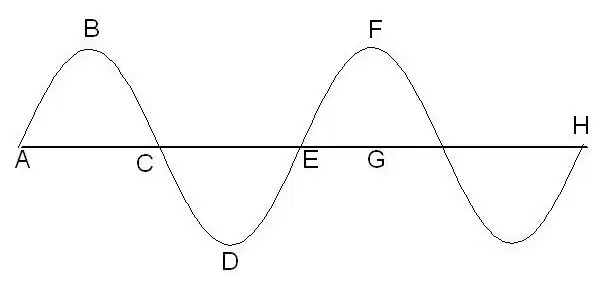
a)Between which letters is a wavelength?
b)Between which letters is the amplitude?
a) B and F
b)F and G
a)C and D
b)A and B
a)B and F
b)C and D
a)A and E
b)F and G

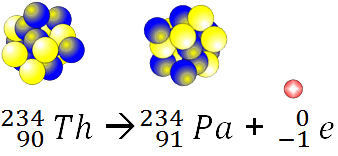
Which type of nuclear decay is being shown here?
beta minus
Beta plus

If we start off with element 24X50 after an beta minus decay we get another element Y that looks like
85209At = ___ + 24He
146C --> 0-1e + ________
How many grams are left after 1 half life?
How long will it take for a 28-gram sample of radon-222 to decay to 3.5 grams? the half-life of radon-222 of 3.82 days
15.28 days
11.46 days
3 days
4 days
24094Pu —› ____ + 42He
23692U
24796Cm
24493Np
24295Am
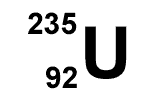

α particle
neutron
proton
electron
γ ray

What is the equivalent or total resistance (Re) across this circuit?
3 kΩ
10 kΩ
13 kΩ
18 kΩ
The relationship between voltage, current, and resistance is described by....
Bohr's Law
Ohm's Law
Kirkchoff's Law
Lorentz' Law


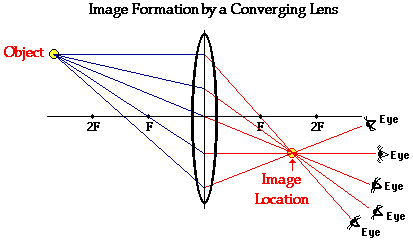
This image is.....
inverted and smaller
inverted and larger
not inverted and smaller
not inverted and larger

